

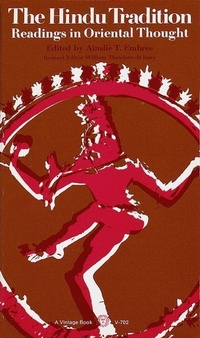
The Hindu Tradition
Readings in Oriental Thought
Published on 9. March 2011
384 pages
978-0-307-77909-0 (ISBN)
Description

This book, compiled from basic Hindu writings, is an exploration of the essential meaning of the Hindu tradition, the way of thinking and acting that has dominated life in India for the last three thousand years. Selections from religious, literary and philosophic works are preceded by introductory material that summarizes historical developments and cultural movements. While much attention is given to religion, many selections deal with social life, political relationships, and the Indian attitude to human love and passion. The arrangement of the material suggests the growth and development of Indian life through the centuries, and makes clear that Indian culture has never been static, but rather has been characterized at all times by a remarkable vitality and creativity.
The selections range in time from the Rig Veda, composed around 1000 B.C., to the writings of Radhakrishnan, formerly the President of India. They illustrate both the continuity of the Hindu tradition and its vitality, for Hinduism is probably more vibrant and alive at the present time than it has been for many centuries. The ideals and values, the unquestioned assumptions and the persistent doubts that are presented here from the literature of the past are the fundamental ingredients of the life of modern India.
The selections range in time from the Rig Veda, composed around 1000 B.C., to the writings of Radhakrishnan, formerly the President of India. They illustrate both the continuity of the Hindu tradition and its vitality, for Hinduism is probably more vibrant and alive at the present time than it has been for many centuries. The ideals and values, the unquestioned assumptions and the persistent doubts that are presented here from the literature of the past are the fundamental ingredients of the life of modern India.
More details
Other editions
Additional editions
Book
01/1972
Random House USA Inc
€31.13
Article exhausted; check different version
Persons
Ainslie Thomas Embree was born in Nova Scotia and educated at Dalhousie University in Halifax and Columbia University. He taught Indian history at Columbia University from 1958 to 1969, and was also professor of history at Duke University. He was the President of the American Institute of Indian Studies. Embree retired in 1991. Mr. Embree is the author of Charles Grant and British Rule in India and India's Search for National Identity. He has been coeditor of several books, including Approaches to Asian Civilizations, Guide to Oriental Classics, and The Development of Civilization. With S. M. Ikram, Mr. Embree has written Muslim Civilization in India.
WM. Theodore de Bary, Carpentier Professor of Oriental Studies at Columbia University, is Provost Emeritus of that university. From 1969-70 he was president of the Association for Asian Studies. He is editor and coauthor of the three-volume Sources of Indian, Chinese and Japanese Tradition; Approaches to Asian Civilization; A Guide to Oriental Classics; and Self and Society in Ming Thought.
WM. Theodore de Bary, Carpentier Professor of Oriental Studies at Columbia University, is Provost Emeritus of that university. From 1969-70 he was president of the Association for Asian Studies. He is editor and coauthor of the three-volume Sources of Indian, Chinese and Japanese Tradition; Approaches to Asian Civilization; A Guide to Oriental Classics; and Self and Society in Ming Thought.
Content
- Intro
- Title Page
- Copyright
- Acknowledgments
- Preface
- Explanatory Note
- Contents
- Part One - The Roots Of The Tradition: (The Age of the Vedas and the Upanishads, c. 1500-550 B.C.)
- Introduction
- Chapter I - The Ordering of the Universe
- The Ancient Gods
- Varuna
- Usha, the Dawn
- Indra
- Agni
- Soma
- The Origin of the Universe
- Time as Creator
- Sacrifice as Creator
- The One as Creator
- The Meaning of Sacrifice. Death
- Chapter II - The Social Order
- The Duty of Charity
- War
- Charms and Spells for a Good Life
- Against Jaundice
- Against Serpents
- To Compel a Woman's Love
- For Success in Trading
- In Praise of the Cow
- The Place of the Brahman
- The Crowning of a King
- King of Kings
- The Chosen One
- The Enduring Ruler
- Earth as Motherland
- Chapter III - The Crown of the Vedic Age: the Upanishads
- The New Meaning of Sacrifice
- Brahman: The Search for the Ground of the Universe
- Atman: The Real Self
- The Identity of Brahman and Atman
- Karma and Transmigration
- Emancipation from Karma
- Part Two - The Growth of the Tradition: (550 B.C.-300 A.D.)
- Introduction
- Chapter IV - The Exposition of Life's Duties
- The Class Structure
- The Statement of the Ideal
- Mutual Dependence of the Classes
- The Four Stages of Life
- The Student
- The Householder and Family Life
- The Hermit
- The Homeless Wanderer
- The Recognition of Life's Limitations
- The Possibility of Growth and Change
- Life as Sacrament
- A Widow's Act of Devotion
- Chapter V - The Maintenance of the Social Fabric
- Kingship as a Remedy for an Evil Society
- The Danger of Anarchy
- War and Peace
- Ashoka's Vision of True Conquest
- Chapter VI - The Search for Salvation
- Man's True Nature
- The Way of Salvation: Duty
- The Way of Salvation: Knowledge
- The Way of Salvation: Devotion
- Incarnation: The Response to Human Need
- Adoration of Shiva
- The Great Heresies of the Tradition
- Buddha's First Sermon
- The Jain Vision of Life
- Chapter VII - The Universe of the Great Epics
- The Mahabharata: The Founding of the Royal Line
- The Ramayana: The Defence of Dharma
- Part Three - The Flowering of the Tradition: (300-1200 A.D.)
- Introduction
- Chapter VIII - The Literary Reflection
- The Pleasure of Love
- The Pain of Love
- The Perils of Love
- A Wife's Devotion
- Divine and Human Love
- The Celebration of a Prince's Birth
- The Science of Pleasure
- Caution and Commonsense
- Chapter IX - The Philosophic Statement of the Tradition
- The Basis of Logical Thinking: Nyaya
- The Atomic Nature of Reality: Vaisheshika
- Proof of the Sacred Texts: Mimamsa
- The Dualism of Matter and Spirit: Sankhya
- The Way of Discipline: Yoga
- Non-Dualism: The Vedanta of Shankara
- Qualified Non-Dualism: The Vedanta of Ramanuja
- Chapter X - Sacred History
- A Story of Origins: The Churning of the Ocean
- The Price of Devotion: The Triumph of Prahlada
- The Lineage of Kings
- Sacred Geography
- The Nature of History
- Part Four - The Tradition and the People's Faith
- Introduction
- Chapter XI - In Praise of Shiva
- A Description of Shiva
- Appar
- Consecration to Shiva
- Triumph Through Shiva
- Sambandar
- Shiva's Glory
- The Lord is Everything
- Manikkaavachakar
- A Song to Awaken Shiva
- Sundaramurthi
- Shiva's Dwelling Places
- Ramaprasad
- Shiva's Consort, Kali
- Lalla
- The Indwelling Lord
- Chapter XII - In Praise of Vishnu as Krishna and Rama
- Purandaradasa
- Stomach Austerity
- Jnanadeva
- A Prayer for Grace
- Tukaram
- The Burden of the Past
- Mirabai
- Krishna's Bride
- Surdas
- Chaitanya
- Tulasidas
- Chapter XIII - The Meeting of Hindu and Muslim Devotion
- Kabir
- Nanak
- Morning Prayer
- Dadu
- Part Five - The Tradition and the Modern World
- Introduction
- Chapter XIV - Acceptance and Reform
- Rammohan Roy: Rationalist Prophet
- Original Hinduism
- A Defence of Hinduism
- Debendranath Tagore: Mysticism and Reform
- Keshub Chunder Sen: Christ and India
- M. G. Ranade: The Need for Social Reform
- Chapter XV - Rejection and Revival
- Dayananda Saraswati: Aggressive Reformer
- God and the Veda
- Against Christianity
- Against Islam
- B. G. Tilak: The Call to Action
- Sri Ramakrishna: Sainthood and the Modern World
- Vivekinanda: Hindu Prophet to the Western World
- Mrs. Annie Besant: Theosophy's Interpretation of Hinduism
- Chapter XVI - Four Twentieth Century Statements
- Rabindranath Tagore: A Vision of India
- Nationalism
- Sri Aurobindo: A Vision of Spiritual Evolution
- Mahatma Gandhi: A Vision of the Good Life
- Sarvepalli Radhakrishnan: A Vision of Hinduism
- Sources of English Translations and Selections
- About the Author
