

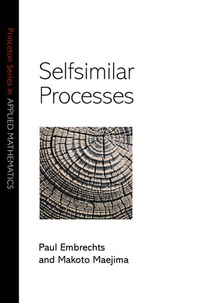
Selfsimilar Processes
1st Edition
Published on 10. January 2009
128 pages
978-1-4008-2510-3 (ISBN)
Description

The modeling of stochastic dependence is fundamental for understanding random systems evolving in time. When measured through linear correlation, many of these systems exhibit a slow correlation decay--a phenomenon often referred to as long-memory or long-range dependence. An example of this is the absolute returns of equity data in finance. Selfsimilar stochastic processes (particularly fractional Brownian motion) have long been postulated as a means to model this behavior, and the concept of selfsimilarity for a stochastic process is now proving to be extraordinarily useful. Selfsimilarity translates into the equality in distribution between the process under a linear time change and the same process properly scaled in space, a simple scaling property that yields a remarkably rich theory with far-flung applications.
After a short historical overview, this book describes the current state of knowledge about selfsimilar processes and their applications. Concepts, definitions and basic properties are emphasized, giving the reader a road map of the realm of selfsimilarity that allows for further exploration. Such topics as noncentral limit theory, long-range dependence, and operator selfsimilarity are covered alongside statistical estimation, simulation, sample path properties, and stochastic differential equations driven by selfsimilar processes. Numerous references point the reader to current applications.
Though the text uses the mathematical language of the theory of stochastic processes, researchers and end-users from such diverse fields as mathematics, physics, biology, telecommunications, finance, econometrics, and environmental science will find it an ideal entry point for studying the already extensive theory and applications of selfsimilarity.
After a short historical overview, this book describes the current state of knowledge about selfsimilar processes and their applications. Concepts, definitions and basic properties are emphasized, giving the reader a road map of the realm of selfsimilarity that allows for further exploration. Such topics as noncentral limit theory, long-range dependence, and operator selfsimilarity are covered alongside statistical estimation, simulation, sample path properties, and stochastic differential equations driven by selfsimilar processes. Numerous references point the reader to current applications.
Though the text uses the mathematical language of the theory of stochastic processes, researchers and end-users from such diverse fields as mathematics, physics, biology, telecommunications, finance, econometrics, and environmental science will find it an ideal entry point for studying the already extensive theory and applications of selfsimilarity.
All prices
More details
Other editions
Additional editions
Paul Embrechts
Selfsimilar Processes
Book
08/2002
Princeton University Press
€63.00
Article not available at the moment
Person
Paul Embrechts is Professor of Mathematics at the Swiss Federal Institute of Technology (ETHZ), Zürich, Switzerland. He is the author of numerous scientific papers on stochastic processes and their applications and the coauthor of the influential book on Modelling of Extremal Events for Insurance and Finance. Makoto Maejima is Professor of Mathematics at Keio University, Yokohama, Japan. He has published extensively on selfsimilarity and stable processes.
Content
Preface ix
Chapter 1. Introduction 1
1.1 Definition of Selfsimilarity 1
1.2 Brownian Motion 4
1.3 Fractional Brownian Motion 5
1.4 Stable Lévy Processes 9
1.5 Lamperti Transformation 11
Chapter 2. Some Historical Background 13
2.1 Fundamental Limit Theorem 13
2.2 Fixed Points of Renormalization Groups 15
2.3 Limit Theorems (I) 16
Chapter 3. Selfsimilar Processes with Stationary Increments 19
3.1 Simple Properties 19
3.2 Long-Range Dependence (I) 21
3.3 Selfsimilar Processes with Finite Variances 22
3.4 Limit Theorems (II) 24
3.5 Stable Processes 27
3.6 Selfsimilar Processes with Infinite Variance 29
3.7 Long-Range Dependence (II) 34
3.8 Limit Theorems (III) 37
Chapter 4. Fractional Brownian Motion 43
4.1 Sample Path Properties 43
4.2 Fractional Brownian Motion for H = 1/2 is not a Semimartingale 45
4.3 Stochastic Integrals with respect to Fractional Brownian Motion 47
4.4 Selected Topics on Fractional Brownian Motion 51
4.4.1 Distribution of the Maximum of Fractional Brownian Motion 51
4.4.2 Occupation Time of Fractional Brownian Motion 52
4.4.3 Multiple Points of Trajectories of Fractional Brownian Motion 53
4.4.4 Large Increments of Fractional Brownian Motion 54.Chapter 5. Selfsimilar Processes with Independent Increments 57
5.1 K. Sato's Theorem 57
5.2 Getoor's Example 60
5.3 Kawazu's Example 61
5.4 A Gaussian Selfsimilar Process with Independent Increments 62
Chapter 6. Sample Path Properties of Selfsimilar Stable Processes with Stationary Increments 63
6.1 Classification 63
6.2 Local Time and Nowhere Differentiability 64
Chapter 7. Simulation of Selfsimilar Processes 67
7.1 Some References 67
7.2 Simulation of Stochastic Processes 67
7.3 Simulating Lévy Jump Processes 69
7.4 Simulating Fractional Brownian Motion 71
7.5 Simulating General Selfsimilar Processes 77
Chapter 8. Statistical Estimation 81
8.1 Heuristic Approaches 81
8.1.1 The R/S-Statistic 82
8.1.2 The Correlogram 85
8.1.3 Least Squares Regression in the Spectral Domain 87
8.2 Maximum Likelihood Methods 87
8.3 Further Techniques 90
Chapter 9. Extensions 93
9.1 Operator Selfsimilar Processes 93
9.2 Semi-Selfsimilar Processes 95
References 101
Index 109
Chapter 1. Introduction 1
1.1 Definition of Selfsimilarity 1
1.2 Brownian Motion 4
1.3 Fractional Brownian Motion 5
1.4 Stable Lévy Processes 9
1.5 Lamperti Transformation 11
Chapter 2. Some Historical Background 13
2.1 Fundamental Limit Theorem 13
2.2 Fixed Points of Renormalization Groups 15
2.3 Limit Theorems (I) 16
Chapter 3. Selfsimilar Processes with Stationary Increments 19
3.1 Simple Properties 19
3.2 Long-Range Dependence (I) 21
3.3 Selfsimilar Processes with Finite Variances 22
3.4 Limit Theorems (II) 24
3.5 Stable Processes 27
3.6 Selfsimilar Processes with Infinite Variance 29
3.7 Long-Range Dependence (II) 34
3.8 Limit Theorems (III) 37
Chapter 4. Fractional Brownian Motion 43
4.1 Sample Path Properties 43
4.2 Fractional Brownian Motion for H = 1/2 is not a Semimartingale 45
4.3 Stochastic Integrals with respect to Fractional Brownian Motion 47
4.4 Selected Topics on Fractional Brownian Motion 51
4.4.1 Distribution of the Maximum of Fractional Brownian Motion 51
4.4.2 Occupation Time of Fractional Brownian Motion 52
4.4.3 Multiple Points of Trajectories of Fractional Brownian Motion 53
4.4.4 Large Increments of Fractional Brownian Motion 54.Chapter 5. Selfsimilar Processes with Independent Increments 57
5.1 K. Sato's Theorem 57
5.2 Getoor's Example 60
5.3 Kawazu's Example 61
5.4 A Gaussian Selfsimilar Process with Independent Increments 62
Chapter 6. Sample Path Properties of Selfsimilar Stable Processes with Stationary Increments 63
6.1 Classification 63
6.2 Local Time and Nowhere Differentiability 64
Chapter 7. Simulation of Selfsimilar Processes 67
7.1 Some References 67
7.2 Simulation of Stochastic Processes 67
7.3 Simulating Lévy Jump Processes 69
7.4 Simulating Fractional Brownian Motion 71
7.5 Simulating General Selfsimilar Processes 77
Chapter 8. Statistical Estimation 81
8.1 Heuristic Approaches 81
8.1.1 The R/S-Statistic 82
8.1.2 The Correlogram 85
8.1.3 Least Squares Regression in the Spectral Domain 87
8.2 Maximum Likelihood Methods 87
8.3 Further Techniques 90
Chapter 9. Extensions 93
9.1 Operator Selfsimilar Processes 93
9.2 Semi-Selfsimilar Processes 95
References 101
Index 109

