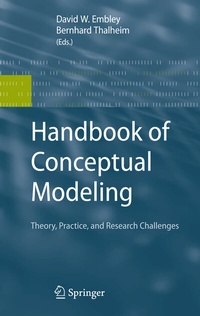
Handbook of Conceptual Modeling
Description

Conceptual modeling is about describing the semantics of software applications at a high level of abstraction in terms of structure, behavior, and user interaction.
Embley and Thalheim start with a manifesto stating that the dream of developing information systems strictly by conceptual modeling - as expressed in the phrase "the model is the code" - is becoming reality. The subsequent contributions written by leading researchers in the field support the manifesto's assertions, showing not only how to abstractly model complex information systems but also how to formalize abstract specifications in ways that let developers complete programming tasks within the conceptual model itself. They are grouped into sections on programming with conceptual models, structure modeling, process modeling, user interface modeling, and special challenge areas such as conceptual geometric modeling, information integration, and biological conceptual modeling.
The Handbook of Conceptual Modeling collects in a single volume many of the best conceptual-modeling ideas, techniques, and practices as well as the challenges that drive research in the field. Thus it is much more than a traditional handbook for advanced professionals, as it also provides both a firm foundation for the field of conceptual modeling, and points researchers and graduate students towards interesting challenges and paths for how to contribute to this fundamental field of computer science.
More details
Other editions
Additional editions