

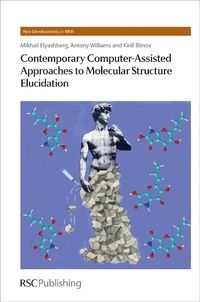
Contemporary Computer-Assisted Approaches to Molecular Structure Elucidation
1st Edition
Published on 9. November 2015
504 pages
978-1-78262-576-6 (ISBN)
Description

Computer-Assisted Structure Elucidation (CASE) systems are a combination of software algorithms and tools to support and enable chemists and spectroscopists engaged in the process of molecular structure elucidation via the analysis of spectroscopic data. These expert systems dramatically reduce the time associated with structure elucidation and improve the reliability of the results. Contemporary Computer-Assisted Approaches to Molecular Structure Elucidation describes the principles on which these expert systems for spectroscopic structure elucidation are based and concisely explains the algorithmic concepts behind the programs. The authors use their own personal experiences in the development of the Structure Elucidator (StrucEluc) CASE software system to discuss the present state-of-the-art in computer-assisted structure elucidation. Scientists that are presently using CASE systems will be interested in the algorithms and modern approaches and for organizations that are currently using the StrucEluc platform the book is designed to help researchers understand the strategies behind CASE as well as details regarding the StrucEluc platform. For scientists that have never used CASE systems they will now have access to all necessary information to understand CASE systems for mastering this new and very effective approach to structure elucidation. The authors overall goal is writing this book is to produce the 'must read' definitive text that will represent the results of decades of work to develop computer-assisted structure elucidation software systems. CASE systems are now powerful software tools commonly outperforming and correcting human interpretations of data. This book will also provide an historical perspective of the work of the founding fathers of the technique and identify the challenges that have been overcome to produce modern CASE systems.
Reviews / Votes
"Computer-assisted structure elucidation (CASE) aims to provide users in chemistry, molecular biology, or other areas dealing with structures of small molecules with suggestions on the structural identity of molecules based on spectroscopic, chromatographic and other boundary information. With "Contemporary computer-assisted approaches to molecular structure elucidation", Mikhail Elyashberg, Anthony Williams and Kirill Blinov, all world-renowned experts on the topic, have recently written a normative standard text-book on the topic. Published by RSC publishing in 2012 and on 481 pages, the book provides a comprehensive overview on computer-assisted structure elucidation.The book is divided into three parts (Basics of CASE, Overview of CASE systems, and a comprehensive discussion of their own system, Structure Elucidator) comprised of overall 14 chapters.
As the authors point out, the CASE process can be reduced to logically interfering `the most probable structural hypothesis from a set of statements reflecting the interrelation between a spectrum and structure'. Given that every human expert in structure elucidation will be biased by his or her own education, history of certain compound classes worked on, or types of spectroscopy used, CASE systems can be incredibly valuable by suggesting solutions to the structure elucidation problem outside of our range of experience.
The book delivers what the title promises. I have been working on CASE systems in the last 15 years and wrote a number of reviews on the topic. This is clearly the most comprehensive book on the topic on the market and generally a valuable resource for anyone working in the area of structure elucidation of small molecules." -- C. Steinbeck * Amazon review *
More details
Series
Language
English
Place of publication
Cambridge
United Kingdom
Target group
Professional and scholarly
Product notice
Reflowable
ISBN-13
978-1-78262-576-6 (9781782625766)
DOI
10.1039/9781849734578
Copyright in bibliographic data and cover images is held by Nielsen Book Services Limited or by the publishers or by their respective licensors: all rights reserved.
Schweitzer Classification
Other editions
Additional editions
Mikhail E. Elyashberg | Antony Williams | Kirill Blinov
Contemporary Computer-Assisted Approaches to Molecular Structure Elucidation
Book
11/2011
Royal Society of Chemistry
€189.50
Article not available at the moment
Mikhail E. Elyashberg | Antony Williams | Kirill Blinov
Contemporary Computer-Assisted Approaches to Molecular Structure Elucidation
E-Book
11/2011
1st Edition
Royal Society of Chemistry
€202.99
Available for download
Persons
Professor Mikhail E. Elyashberg graduated from the Faculty of Physics at the University of Tomsk, Russia. He obtained a PhD from the Moscow Pedagogical University and Dr. Chem. Sci from the Institute of Geochemistry and Analytical Chemistry at the Russian Academy of Sciences (GEOKHI RAS). He headed the Laboratory of Molecular Spectroscopy at the All-Russian Institute for Organic Synthesis in Moscow (1981-2001). Since 1995, has been the leading researcher at GEOKHI RAS and in 2001, he became Senior Scientist at Advanced Chemistry Development Ltd. (ACD) in Moscow. Professor Elyashberg is a Laureate of the State Prize of the Russian Federation, the highest scientific award in Russia. Antony J. Williams graduated with a BSc and PhD in chemistry from the University of Liverpool and University of London respectively. He subsequently became a Post-doctoral Fellow at the National Research Council in Ottawa and then an NMR Facility Director at the University of Ottawa. He has also worked as an NMR Technology Leader at Eastman-Kodak in Rochester and held a number of positions, including Chief Science Officer, at ACD/Labs. In 2007, he established ChemZoo, Inc and became host of ChemSpider, one of the primary internet portals for chemistry. ChemSpider was acquired by the Royal Society of Chemistry (RSC) in 2009 and Dr. Williams is currently Vice-President of Strategic Development at the RSC. Kirill A. Blinov received his MSc in Chemistry from Moscow State University. He started working on Computer-Assisted Structure Elucidation (CASE) systems in 1996 and is currently a senior scientist at Advanced Chemistry Development Inc. He is the primary architect of the ACD/Structure Elucidator software program and co-inventor of the indirect covariance processing algorithms used for the processing of 2D NMR spectroscopy data.
Content
Foreword;
Introduction;An Introduction to general CASE Principles;
Axiomatic Approaches to Structure Elucidation;
NMR Spectrum Prediction and Structure Confirmation;
Knowledge bases and their application to CASE;
Data processing, preparation and input;
Generating Molecular Connectivities from Spectral Data;
Approaches to Algorithmic Structure Generation;
The Challenges of Non-Standard Spectral Responses;
Algorithmic Determination of Relative Stereochemistry;
Applications of CASE to real world examples;
Applications of CASE systems to structure revision - algorithms and humans, the need for synergistic collaboration;
An Evaluation of the performance of modern CASE systems - Structure Elucidator;
Comparisons of Systematic CASE Systems Versus Traditional Approaches;
A Vision of the Future of CASE Systems;
Conclusions
Introduction;An Introduction to general CASE Principles;
Axiomatic Approaches to Structure Elucidation;
NMR Spectrum Prediction and Structure Confirmation;
Knowledge bases and their application to CASE;
Data processing, preparation and input;
Generating Molecular Connectivities from Spectral Data;
Approaches to Algorithmic Structure Generation;
The Challenges of Non-Standard Spectral Responses;
Algorithmic Determination of Relative Stereochemistry;
Applications of CASE to real world examples;
Applications of CASE systems to structure revision - algorithms and humans, the need for synergistic collaboration;
An Evaluation of the performance of modern CASE systems - Structure Elucidator;
Comparisons of Systematic CASE Systems Versus Traditional Approaches;
A Vision of the Future of CASE Systems;
Conclusions
