

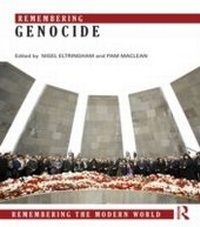
Remembering Genocide
1st Edition
Published on 27. June 2014
242 pages
978-1-317-75422-0 (ISBN)
Description

In Remembering Genocide an international group of scholars draw on current research from a range of disciplines to explore how communities throughout the world remember genocide. Whether coming to terms with atrocities committed in Namibia and Rwanda, Australia, Canada, the Punjab, Armenia, Cambodia and during the Holocaust, those seeking to remember genocide are confronted with numerous challenges. Survivors grapple with the possibility, or even the desirability, of recalling painful memories. Societies where genocide has been perpetrated find it difficult to engage with an uncomfortable historical legacy.
Still, to forget genocide, as this volume edited by Nigel Eltringham and Pam Maclean shows, is not an option. To do so reinforces the vulnerability of groups whose very existence remains in jeopardy and denies them the possibility of bringing perpetrators to justice. Contributors discuss how genocide is represented in media including literature, memorial books, film and audiovisual testimony. Debates surrounding the role museums and monuments play in constructing and transmitting memory are highlighted. Finally, authors engage with controversies arising from attempts to mobilise and manipulate memory in the service of reconciliation, compensation and transitional justice.
Still, to forget genocide, as this volume edited by Nigel Eltringham and Pam Maclean shows, is not an option. To do so reinforces the vulnerability of groups whose very existence remains in jeopardy and denies them the possibility of bringing perpetrators to justice. Contributors discuss how genocide is represented in media including literature, memorial books, film and audiovisual testimony. Debates surrounding the role museums and monuments play in constructing and transmitting memory are highlighted. Finally, authors engage with controversies arising from attempts to mobilise and manipulate memory in the service of reconciliation, compensation and transitional justice.
Reviews / Votes
'The long-awaited union of memory studies with empirical genocide research is consummated in this important volume. Combining empathy with clear-headed reconstructions of well- and lesser-known cases, Remembering Genocide communicates the universal significance of local knowledge about individual trauma, the construction of group catastrophe and its inter-generational transmission. Written with conceptual sophistication and narrative flair, these essays mark the birth of a genuinely global approach to the study of modernity's dark side.' - Dirk Moses, European University Institute, Italy'Maclean's and Eltringham's Remembering Genocide will be essential for students and scholars studying the aftermath of genocides.' - Alexander Korb, University of Leicester, UK
'Strong and well timed... making a significant contribution to a growing field of scholarship.' - Lynne Fallwell, Texas Tech University, USA
'These diverse essays provide multiple approaches to investigate the remembrance of genocide. The collection stands out for its global scope, with chapters on remembrance in North America, Europe, Africa, and Asia, as well as for its analysis of varied sites and media for remembrance, including museums and memorials, books, film and video, study tours, and political discourse. Summing up: Recommended' -B. Lieberman, Fitchburg State University, USA in CHOICE 'The long-awaited union of memory studies with empirical genocide research is consummated in this important volume. Combining empathy with clear-headed reconstructions of well- and lesser-known cases, Remembering Genocide communicates the universal significance of local knowledge about individual trauma, the construction of group catastrophe and its inter-generational transmission. Written with conceptual sophistication and narrative flair, these essays mark the birth of a genuinely global approach to the study of modernity's dark side.' - Dirk Moses, European University Institute, Italy
'Maclean's and Eltringham's Remembering Genocide will be essential for students and scholars studying the aftermath of genocides.' - Alexander Korb, University of Leicester, UK
'Strong and well timed... making a significant contribution to a growing field of scholarship.' - Lynne Fallwell, Texas Tech University, USA
More details
Series
Language
English
Place of publication
London
United Kingdom
Publishing group
Taylor & Francis Ltd
Target group
College/higher education
Illustrations
2 s/w Abbildungen, 24 s/w Photographien bzw. Rasterbilder
24 Halftones, black and white; 2 Illustrations, black and white
File size
5,64 MB
ISBN-13
978-1-317-75422-0 (9781317754220)
Copyright in bibliographic data and cover images is held by Nielsen Book Services Limited or by the publishers or by their respective licensors: all rights reserved.
Schweitzer Classification
Other editions
Additional editions
Nigel Eltringham | Pam Maclean
Remembering Genocide
Book
07/2014
1st Edition
Routledge
€214.50
Shipment within 15-20 days
Nigel Eltringham | Pam Maclean
Remembering Genocide
Book
06/2014
1st Edition
Routledge
€65.00
Shipment within 15-20 days
Persons
Nigel Eltringham is Senior Lecturer in Social Anthropology at the University of Sussex. He is the author of Accounting for Horror: Post-Genocide Debates in Rwanda (2004) and editor of Framing Africa: Portrayals of a Continent in Contemporary Mainstream Cinema (2013). He is currently working on a monograph on the International Criminal Tribunal for Rwanda.
Pam Maclean is an Honorary Fellow, Faculty of Arts and Education at Deakin University. She has published widely on Holocaust memory, particularly in relation to Holocaust videotestimony and her publications include Testifying to the Holocaust (2008), co-edited with Michele Langfield and Dvir Abramovich.
Pam Maclean is an Honorary Fellow, Faculty of Arts and Education at Deakin University. She has published widely on Holocaust memory, particularly in relation to Holocaust videotestimony and her publications include Testifying to the Holocaust (2008), co-edited with Michele Langfield and Dvir Abramovich.
Content
Remembering Genocide - Nigel Eltringham and Pam Maclean . 1. 'No-mans Land' and the Creation of Partitioned Histories in India/Pakistan - Pippa Virdee. 2. Three Films, One Genocide: Remembering the Armenian Genocide through Ravished Armenia(s) - Donna-Lee Frieze. 3. Memorial Stories: Commemorating the Rwanda Genocide through Fiction - Nicki Hitchcott. 4. To be Hunted like Animals: Samuel and Joseph Chanesman Remember their Survival in the Polish Countryside during the Holocaust - Pam Maclean. 5. Set in Stone? The Intergenerational and Institutional Transmission of Holocaust Memory - Avril Alba. 6. National Memory and Museums: Remembering Settler Colonial Genocide of Indigenous Peoples in Canada - Tricia Logan. 7. Memory at the Site: Witnessing, Education and the Repurposing of Tuol Sleng and Cheoung Ek in Cambodia - Elena Lesley. 8. Contested Notions of Genocide and Commemoration: The Case of the Herero in Namibia - Henning Melber. 9. Burying Genocide: Official Remembrance and Reconciliation in Australia - Damien Short. 10. Bodies of Evidence: Remembering the Rwandan Genocide at Murambi - Nigel Eltringham.
