

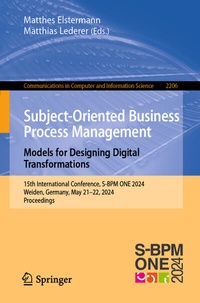
Subject-Oriented Business Process Management. Models for Designing Digital Transformations
Description

This book constitutes the refereed post proceedings of the 15th International Conference on Subject-Oriented Business Process Management, S-BPM ONE 2024, held in Weiden, Germany, during May 21-22, 2024.
The 14 full papers and 8 short papers included in this book were carefully reviewed and selected from 30 submissions. These papers have been organized in the following topical sections: Processes And Data; Subject-Oriented Modeling, Philosophy, and Technology; Processes and Sustainability; Good Process Practices.
More details
Other editions
Additional editions
Content
.-
Processes And Data
.
.- Digital Twin Data Provision within Engineering: An AAS PLM Implementation En-suring Interoperability.
.- Data Catalogs in an industrial SME context - A systematic literature review.
.- Data Mesh: How to Implement the Paradigm Shift.
.- Improving Agile Maturity in Data Teams: A Framework for Enhanced Business Pro-cess Agility.
.- Synergizing Data Contracts and BPM to improve Process Interoperability: An Analy-sis of Gaps and Opportunities of Data Exchange Agreements in BPM Models.
.-
Subject-Oriented Modeling, Philosophy, and Technology
.
.- An Aspect-Oriented Extension of the Parallel Activity Specification Schema: A First Draft.
.- How Business Process Modeling Can Benefit from Rhetorical Structure Theory.
.- Modeling the Behavior of IoT Systems: A Subject-Oriented Reference Model.
.- Subject-Oriented Modeling Workflow Control Patterns with PASS.
.- Subject- and Process-oriented Comparison of Multi-Factor Authentication Methods.
.- S-BPM as an Alternative to BPMN in the Context of Low-Code: Applicability, User Experience and Transformation from S-BPM to BPMN.
.-
Processes and Sustainability
.
.- Faciliating the preparation of Life Cycle Assessment through Subject-Oriented Pro-cess Modeling: A methodological framework.
.- A Framework for Sustainable Web Design in the Era of Digital Transformation.
.- Green thoughts & creative spaces: An experimental study on influence of innovation labs on productivity and sustainability of process.
.- Towards Resilient Digital Supply Chains.
.-
Good Process Practices
.
.- Walking Away from Omelas: Towards a Comprehensive Model for Successful Adop-tion of Industry 4.0 Technologies in SMEs.
.- Interoperable Product Change Management within Engineering: A Digital Twin Ap-proach.
.- Next-Generation Business Process Management (BPM): A Systematic Literature Review of Cognitive Computing and Improvements in BPM.
.- Three Stances in Enterprise System Design.
.- Process Orientation in Authorities: Opportunities, Challenges and Best Practices.
.- Which good practices minimize procedural problems in IT workflows between au-thorities.
.- Meta-Prompt Engineering in ChatGPT-4 for AI-Generated BPM Reference Models.
