

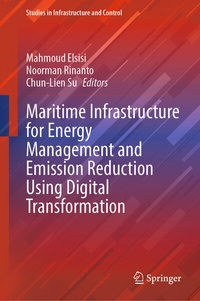
Maritime Infrastructure for Energy Management and Emission Reduction Using Digital Transformation
Description

This book offers a comprehensive exploration of how digital transformation can revolutionize maritime infrastructure for enhanced energy management and emission reduction. As global industries strive to meet stringent environmental regulations and sustainability goals, the maritime sector faces significant challenges in reducing its carbon footprint and optimizing energy consumption. Through a systematic analysis of digital technologies such as IoT, artificial intelligence, and digital twins, this book delves into practical applications that enable real-time monitoring, predictive maintenance, and efficient energy use across maritime operations. Key topics include the integration of renewable energy sources, cybersecurity considerations in digital maritime systems, and case studies highlighting successful implementations of digital strategies. The regulatory framework governing emissions and energy management in maritime operations is also addressed, alongside future trends and innovations shaping the industry's sustainable evolution. This book is essential reading for maritime professionals, researchers, policymakers, and academics seeking to understand the transformative potential of digital technologies in addressing environmental challenges and driving operational efficiency within maritime infrastructure.
More details
Other editions
Additional editions
Persons
Mahmoud Elsisi received the B.Sc., M.Sc., and Ph.D. degrees from the Electrical Engineering Department, Faculty of Engineering at Shoubra, Benha University, Cairo, Egypt, in 2011, 2014, and 2017, respectively. He worked as Assistant Professor at the Electrical Engineering Department, Faculty of Engineering at Shoubra, Benha University. From August 2019 to July 2022, he worked as Assistant Professor with the Industry 4.0 Implementation Center, Center for Cyber-Physical System Innovation, National Taiwan University of Science and Technology, Taipei, Taiwan. He is currently Associate Professor with the Electrical Engineering Department, National Kaohsiung University of Science and Technology, Kaohsiung, Taiwan. His research interests include studying the machine learning, deep learning, the Internet of Things (IoT), cybersecurity, model predictive control, neural networks, fuzzy logic, Kalman filter, observers, decentralized control of large-scale systems, robotic control, autonomous vehicle control, renewable energy, power system dynamics.
Noorman Rinanto received the B.Eng. and M.Eng. in electrical engineering from Sepuluh Nopember Institute of Surabaya (ITS), Surabaya, Indonesia, in 2006 and 2012, respectively. He completed the Ph.D. degree at the Department of Electrical Engineering, National Taiwan University of Science and Technology (NTUST), Taipei, Taiwan, in 2023. He is currently Assistant Professor with the Marine Electrical Engineering Department, Shipbuilding Institute of Polytechnic Surabaya, Surabaya, Indonesia. His research interests include sensor fusion, machine learning, artificial intelligence, intelligent robot and automation system, battery management system, smart control system, Industrial Internet of Things (IIoT), signal and image processing.
Chun-Lien Su received the diploma degree in electrical engineering from National Kaohsiung Institute of Technology, Taiwan, and the M.S. and Ph.D. degrees in electrical engineering from the National Sun Yat-Sen University, Taiwan, in 1992, 1997, and 2001, respectively. In 2002 and 2006, he was Assistant Professor and Associate Professor at the Department of Marine Engineering, National Kaohsiung Marine University, Taiwan, respectively. From 2012 to 2017, he was as Full Professor where he was Director at the Energy and Control Research Center. From August 2017 to January 2018, he was Visiting Professor at the Department of Energy Technology, Aalborg University, Denmark. He was Director at the Maritime Training Center, National Kaohsiung University of Science and Technology (NKUST) from February 2018 to July 2020. Since August 2020, he has been at the Department of Electrical Engineering in NKUST and Director at Center for Electrical Power and Energy, where he is now Distinguished Professor.
Content
Introduction to Maritime Infrastructure and Digital Transformation.- Challenges in Energy Management and Emission Reduction.- Digital Technologies for Energy Monitoring and Optimization.- Advanced-Data Analytics for Maritime Energy Efficiency.- Digital Twin Applications in Maritime Systems.- Cybersecurity in Digital Maritime Infrastructure.- Integration of Renewable Energy Sources in Maritime Operations.- Case Studies of Successful Energy Management Initiatives.- Regulatory Framework and Policy Implications.- Future Trends and Innovations in Maritime Energy Management.
