

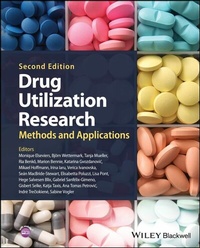
Drug Utilization Research
Description

Towards a better understanding of how medicines are used in society
Drug Utilization Research (DUR) is a discipline which combines aspects of pharmacotherapy, epidemiology, and health services research into an interdisciplinary set of methods for analyzing and assessing the prescribing, dispensing and consumption of medicines. It combines both qualitative and quantitative approaches to facilitate the safe and effective use of pharmaceuticals. Drug Utilization Research: Methods and Applications provides a comprehensive introduction to this discipline, prepared by an international team of authors with broad experience in numerous fields. Now reorganized and updated to reflect the latest research and global challenges, it is an indispensable resource for understanding the use of pharmaceuticals.
Readers of the second edition of Drug Utilization Research will find:
- New chapters on methods, including more hands-on guidance on how to plan and conduct different types of drug utilization
- A section on specific applications in areas such as psychotropics, opioids, cancer drugs, antibacterials, and cardiovascular drugs
- A new section with case studies illustrating applications of DUR in different continents
- Detailed treatment of subjects including DUR and health policy, DUR in specific populations, and many more
Drug Utilization Research is ideal for epidemiologists, pharmacists, physicians, nurses and others interested in drug use and its outcomes.
More details
Other editions
Additional editions
Persons
Editors
Monique Elseviers, Björn Wettermark, Tanja Mueller, Ria Benko, Marion Bennie, Katarina Gvozdanovic, Mikael Hoffmann, Irina Iaru, Verica Ivanovska, Seán MacBride-Stewart, Elisabetta Poluzzi, Lisa Pont, Hege Salvesen Blix, Gabriel Sanfélix-Gimeno, Gisbert Selke, Katja Taxis, Ana Tomas Petrovic, Indre Treciokiene, Sabine Vogler
Content
List of contributors ix
Preface to the second edition xvii
Acknowledgements xix
About the companion website xxiii
Part 1 Introduction to drug utilization research 1
1 Introduction to drug utilization research 3
Björn Wettermark, Monique Elseviers, Tanja Mueller, Anna Birna Almarsdottir, Ria Benkö, Marion Bennie, Irina Iaru, Katarina Gvozdanovic, Mikael Hoffmann, Verica Ivanovska, Seán MacBride-Stewart, Elisabetta Poluzzi, Lisa G. Pont, Hege Salvesen Blix, Gabriel Sanfelix-Gimeno, Gisbert W. Selke, Katja Taxis, Ana Tomas Petrovic, Indre Treciokiene, and Sabine Vogler
Part 2 Methodology of drug utilization research 15
2.1 Research methods in drug utilization research 17
Björn Wettermark, Indre Treciokiene, Sofia Kälvemark Sporrong, and Louise C. Druedahl
2.2 Qualitative methods in drug utilization research 25
Louise C. Druedahl and Sofia Kälvemark Sporrong
2.3 Quantitative studies in drug utilization research 41
Björn Wettermark, Monique Elseviers, and Cristina Mihaela Ghiucic
2.4 Descriptive studies in drug utilization research 51
Cristina Mihaela Ghiciuc, Indre Treciokiene, Björn Wettermark, and Monique Elseviers
2.5 Analytical studies in drug utilization research 63
Per-Jostein Samuelsen, Björn Wettermark, and Monique Elseviers
2.6 Intervention studies in drug utilisation research 73
Tanja Mueller, Giampiero Mazzaglia, and Carlos E. Durán
2.7 Statistics in drug utilization research 82
Monique Elseviers
2.8 Primary drug utilization data 95
Tatiana Chama Borges Luz and Evalill Nilsson
2.9 Secondary drug utilization data 104
Mohammadhossein Hajiebrahimi, Lisa G. Pont, and Kristina Garuoliene
2.10 Classification systems in drug utilization 115
Hege Salvesen Blix, Stuart McTaggart, and Robert Vander Stichele
2.11 Measuring volumes in drug utilization 126
Hege Salvesen Blix and Mikael Hoffmann
2.12 Measuring price and expenditure in drug utilization 137
Sabine Vogler
2.13 Aggregate-level drug utilization analyses 148
Indre Treciokiene and Claudia Garcia Serpa Osorio-de-Castro
2.14 Individual-level drug utilization analyses 158
Lotte Rasmussen, Björn Wettermark, Mikael Hoffmann, and Douglas Steinke
2.15 Multilevel analyses in drug utilization research 169
Juan Merlo and George Leckie
2.16 Visualization of drug utilization data 188
Maria Matuz, Ria Benko, and Mikael Hoffmann
2.17 Artificial intelligence and machine learning in drug utilization research 205
Maurizio Sessa, Saeed Shakibfar, Morten Andersen, and Jing Zhao
2.18 Ethics in drug utilization research 215
Indre Treciokiene, Sofia Kälvemark Sporrong, Björn Wettermark, and Louise C. Druedahl
Part 3 Applied drug utilization research 223
Section 3.1 Drug utilization research and health policy 225
3.1.1 Pharmaceutical policy and drug utilization: Definitions, concepts, and taxonomies 225
Sabine Vogler and Anna Birna Almarsdóttir
3.1.2 Managed introduction of new medicines in healthcare systems 233
Irina Iaru and Sabine Vogler
3.1.3 Promoting appropriate use of medicines in a healthcare system 248
Marion Bennie, Amanj Kurdi, and Yared Santa-Ana-Téllez
Section 3.2 Comparative drug utilization research 258
3.2.1 Introduction to comparative drug utilization research 258
Seán MacBride-Stewart and Ana Tomas Petrovic
3.2.2 Comparison of drug utilization across countries 260
Yared Santa-Ana Tellez and Monique Elseviers
3.2.3 Comparative drug utilization research comparing regions within countries 271
Seán MacBride-Stewart
3.2.4 Comparison of drug utilization across different prescribers and different health care settings 280
Seán MacBride-Stewart, Ksenia Zagorodnikova, and Irene Langner
3.2.5 Comparative drug utilization research comparing different patients 292
Ana Tomas Petrovic and Mia von Euler
Section 3.3 Drug utilization research in specific populations 303
3.3.1 Drug utilization in pregnant women 303
Hedvig Nordeng and Marleen van Gelder
3.3.2 Drug utilization in the paediatric population 314
Antonio Clavenna and Ingvild Odsbu
3.3.3 Drug utilization in older people 321
Petra Denig and Katharina Schmidt-Mende
Section 3.4 Drug utilization research in specific therapeutic areas 331
3.4.1 Introduction to methodological issues in specific therapeutic areas 331
3.4.2 Drug utilization research on cardiovascular medicines 332
Elisabetta Poluzzi, Ana Tomas Petrovic, and Björn Wettermark
3.4.3 Drug utilization research on antibacterials 342
Ria Benko and Samuel Coenen
3.4.4 Drugs utilization research in specific therapeutic areas - opioids 352
Aleksi Hamina, Svetlana Skurtveit, and Mikael Hoffmann
3.4.5 Drug utilization research on selected psychotropics 363
Jonathan Brett and Helga Zoega
3.4.6 Drug utilization research in the area of cancer drugs 373
Tanja Mueller and Mikael Hoffmann
Section 3.5 Adherence and drug utilization research 381
3.5.1 Introduction to medication adherence research 381
Bernard Vrijens
3.5.2 Assessment of medication adherence in field research 387
Monique Elseviers and Bernard Vrijens
3.5.3 Assessment of medication adherence in databases 397
Gabriel Sanfélix Gimeno and Tanja Mueller
3.5.4 Interventions to improve medication adherence 406
Catherine Goetzinger and Marie P. Schneider
3.5.5 Digital tools and medication adherence 419
Alexandra L. Dima, Urska Nabergoj-Makovec, and Job F.M. van Boven
Section 3.6 The role of drug utilization in the broader field of health research 428
3.6.1 Risk management and drug utilization research 428
Giampiero Mazzaglia, Ippazio Cosimo Antonazzo, and Peter Mol
3.6.2 Pharmacovigilance and drug utilization research 437
Katarina Gvozdanovic, Bernard Begauld, and Emanuel Raschi
3.6.3 The role of drug utilization in outcomes research 445
Henrik Toft Sørensen, Gianluca Trifirò, and Evalill Nilsson
3.6.4 Pharmacoeconomics and drug utilization research 456
Cara Usher, Kathleen Bennett, Lorenzo G. Mantovani, and Dyfrig Hughes
3.6.5 The environment and drug utilisation research 464
Marmar Nekoro, Johanna Villén, and Ana Tomas Petrovic
Section 3.7 Assessment and improvement of the quality of medicine use 482
3.7.1 Defining the quality of medicines use 482
Seán MacBride-Stewart
3.7.2 Assessing the quality of medication use 488
Petra Denig, Björn Wettermark, and Wade Thompson
3.7.3 Challenges in the quality of medicine use 498
Katja Taxis and Carl Llor
3.7.4 Development and evaluation of interventions to improve the quality of medicine use 505
Seán MacBride-Stewart and Katja Taxis
3.7.5 Implementation of interventions to enhance quality use of medicines 517
Liset van Dijk and Marcia Vervloet
3.7.6 Patient perspectives 525
Janine Traulsen and Janet Krska
Part 4 Drug utilization research around the world 535
4.1 Introduction to drug utilization research around the world 537
Monique Elseviers
4.2 Drug utilization research in Africa 541
Ilse Truter, Johanita Burger, and Joseph Fadare
4.3 Drug utilization research in the Eastern Mediterranean region 546
Mamoon A. Aldeyab, Zainab Said Al-Hashimy, and Maha Talaat
4.4 Drug utilization research in South-East Asia 551
Anita Kotwani, Nithima Sumpradit, and Aminath Moomina
4.5 Drug utilization research in the Western Pacific Region 557
Lisa G. Pont, Tuan Anh Nguyen, and Elizabeth Roughead
4.6 Drug utilization research in North America 563
Juan M. Hincapie-Castillo, Shawn Bugden, and Ingrid Sketris
4.7 Drug utilization research in South and Central America 569
Claudia Garcia Serpa Osorio-de-Castro, Luciane Cruz Lopes, and Carlos E. Durán
4.8 Drug utilization research in Europe 574
Marion Bennie, Lotte Rasmussen, and Janne Sepp
4.9 The Glasgow Declaration 580
Monique Elseviers, Björn Wettermark, Tanja Mueller, Anna Birna Almarsdottir, Ria Benkö, Marion Bennie, Irina Iaru, Katarina Gvozdanovic, Mikael Hoffmann, Verica Ivanovska, Seán MacBride-Stewart, Elisabetta Poluzzi, Lisa G. Pont, Hege Salvesen Blix, Gabriel Sanfelix-Gimeno, Gisbert W. Selke, Katja Taxis, Ana Tomas Petrovic, Indre Treciokiene, and Sabine Vogler
Index 583
List of contributors
Mamoon A. Aldeyab
Department of Pharmacy
School of Applied Sciences
University of Huddersfield
Huddersfield
United Kingdom
Anna Birna Almarsdottir
WHO Collaborating Centre for Research and Training in the Patient Perspective on Medicines Use
Department of Pharmacy
Faculty of Health and Medical Sciences University of Copenhagen
Denmark
Morten Andersen
Department of Drug Design and Pharmacology
University of Copenhagen
Copenhagen
Denmark
Tuan Anh Nguyen
National Ageing Research Institute
Swinburne University
Melbourne
Australia
Ippazio Cosimo Antonazzo
Centre for Public Health Research (CESP)
University of Milan - Bicocca
Milan
Italy
Bernard Begauld
Faculty of Medicine
University of Bordeaux
France
Ria Benko
Institute of Clinical Pharmacy
Faculty of Pharmacy
University of Szeged
Hungary
and
Emergency Department
Albert-Szent Györgyi Medical Centre
Central Pharmacy
University of Szeged
Hungary
Kathleen Bennett
Data Science Centre
School of Population Health
RCSI University of Medicine and Health Sciences
Dublin
Ireland
Marion Bennie
Strathclyde Institute of Pharmacy and Biomedical Sciences
University of Strathclyde
Glasgow
Scotland, UK
Hege Salvesen Blix
Antibiotic Resistance and Infection Prevention
Norwegian Institute of Public Health
OsloNorway
and
WHO Collaborating Centre for Drug Statistics Methodology
Norwegian Institute of Public Health
Oslo
Norway
Jonathan Brett
St Vincent's Clinical School
UNSW Medicine
UNSW Sydney
Australia
and
School of Population Health
Faculty of Medicine and Health
University of New South Wales
Sydney
Australia
Shawn Bugden
School of Pharmacy
Memorial University
Newfoundland
Canada
Johanita Burger
Medicine Usage in South Africa (MUSA)
North-West University
South Africa
Tatiana Chama Borges Luz
Rene Rachou Research Center
Oswaldo Cruz Foundation
Brazil
and
eHealth Institute
Department of Medicine and Optometry
Linnaeus University
Sweden
and
Department of Learning, Informatics, Management and Ethics (LIME)
Karolinska Institutet
Stockholm
Sweden
Antonio Clavenna
Laboratory of Child Health and Development Epidemiology
Istituto di Ricerche Farmacologiche Mario Negri IRCCS
Milan
Italy
Samuel Coenen
Centre for General Practice
Department of Family Medicine and Population Health (FAMPOP) and Laboratory of Medical Microbiology
Vaccine and Infectious Disease Institute (VAXINFECTIO)
University of Antwerp - Campus Drie Eiken
Antwerp
Belgium
Luciane Cruz Lopes
University of Sorocaba
Sao Paulo
Brazil
Petra Denig
Department of Clinical Pharmacy and Pharmacology
University Medical Center Groningen
University of Groningen
Groningen
The Netherlands
Alexandra L. Dima
Health Technology Assessment in Primary Care and Mental Health (PRISMA)
Institut de Recerca Sant Joan de Deu
Barcelona
Spain
Louise C. Druedahl
Centre for Advanced Studies in Biomedical Innovation Law (CeBIL)
Faculty of Law
University of Copenhagen
Denmark
Carlos E. Durán
Department of Data Science and Biostatistics
University Medical Center
Utrecht
The Netherlands
Monique Elseviers
Department of Clinical Pharmacology
University of Ghent
Ghent
Belgium
and
Centre for Research and Innovation in Care (CRIC)
University of Antwerp
Antwerp
Belgium
Joseph Fadare
Department of Pharmacology and Therapeutics
Ekiti State University College of Medicine
Ado-Ekiti
Nigeria
Claudia Garcia Serpa Osorio-de-Castro
Department of Medicines Policies and Pharmaceutical Services
Sergio Arouca National School of Public Health
Oswaldo Cruz Foundation
Rio de Janeiro
Brazil
Kristina Garuoliene
Pharmacy and Pharmacology Center
Faculty of Medicine
Vilnius University
Lithuania
Cristina Mihaela Ghiciuc
Department of Pharmacology, Clinical Pharmacology and Algesiology
Faculty of Medicine
Grigore T. Popa University of Medicine and Pharmacy of Iasi
Romania
Catherine Goetzinger
National Health Observatory Luxembourg and Deep Digital Phenotyping Research Unit
Department of Precision Health
Luxembourg Institute of Health
Strassen
Luxembourg
and
Faculty of Science, Technology and Medicine
University of Luxembourg
Luxembourg
Katarina Gvozdanovic
Pharmacoepidemiology Department
Andrija Stampar Teaching Institute of Public Health
ZagrebCroatia
Mohammadhossein Hajiebrahimi
Department of Pharmacy
Faculty of Pharmacy
Uppsala University
Sweden
Aleksi Hamina
Niuvanniemi Hospital
Kuopio
Finland
and
Norwegian Centre for Addiction Research (SERAF)
Institute of Clinical Medicine
University of Oslo
Oslo
Norway
Juan M. Hincapie-Castillo
Gillings School of Global Public Health
University of North Carolina
Chapel Hill, NC
USA
Mikael Hoffmann
The NEPI Foundation
Stockholm
Linköping
Sweden
and
Unit of Health Care Analysis
Department of Health, Medicine and Caring Sciences (HMV)
Linköping University
Linköping
Sweden
and
Department of Pharmacy
Faculty of Pharmacy
Uppsala University
Sweden
Dyfrig Hughes
Centre for Health Economics & Medicines Evaluation
Bangor University
United Kingdom
Irina Iaru
Department of Pharmacology, Physiology and Pathophysiology
Faculty of Pharmacy
Iuliu Hatieganu University of Medicine and Pharmacy, Cluj-Napoca
Romania
Verica Ivanovska
World Health Organization
Geneva
Sofia Kälvemark Sporrong
Department of Pharmacy
Faculty of Pharmacy
Uppsala University
Sweden
and
Department of Pharmacy
Faculty of Health and Medical Sciences
University of Copenhagen
Copenhagen
Denmark
Anita Kotwani
Department of Pharmacology
Vallabhbhai Patel Chest Institute
University of Delhi
Delhi
India
Janet Krska
Clinical and Professional Pharmacy
Medway School of Pharmacy
United Kingdom
Amanj Kurdi
Strathclyde Institute of Pharmacy and Biomedical Sciences
University of Strathclyde
Glasgow
Scotland, UK
and
Department of Pharmacology and Toxicology
College of Pharmacy
Hawler Medical University
Erbil
Kurdistan Region Government
Iraq
and
Department of Clinical Pharmacy
College of Pharmacy
Al-Kitab University
Kirkuk
Iraq
and
School of Pharmacy
Sefako Makgatho Health Sciences University
Pretoria
South Africa
Irene Langner
AOK Research Institute (WIdO)
Berlin
Germany
George Leckie
Centre for Multilevel Modelling (CMM)
School of Education
University of Bristol
United Kingdom
Carl Llor
The Foundation University Institute for Primary Health Care
Research Jordi Gol i Gurina (IDIAPJGol), Via Roma Health Centre
Barcelona
Spain
Seán MacBride-Stewart
Pharmacy Services
NHS Greater Glasgow and Clyde
Glasgow
Scotland
Lorenzo G. Mantovani
Department of Statistics
School of Medicine
University of Milan
Italy
Maria Matuz
Institute of Clinical Pharmacy
Faculty of Pharmacy
University of Szeged
Hungary
Giampiero Mazzaglia
Centre for Public Health Research (CESP)
School of Medicine and Surgery
University of Milan - Bicocca
Milan
Italy
Stuart McTaggart
Public Health Scotland
Edinburgh
United Kingdom
Juan Merlo
Unit for Social Epidemiology
Department of Clinical Sciences
Centre for Primary Health Care Research
Faculty of Medicine
Lund University
Malmo
Sweden
Peter Mol
Medicines Evaluation Board
Utrecth
The Netherlands
and
Department of Clinical Pharmacy and Pharmacology
University Medical Centre Groningen
University of Groningen
The Netherlands
Aminath Moomina
Medicines and Goods Therapeutic Division
Food and Drug Authority
Republic of Maldives
Tanja Mueller
Strathclyde Institute of Pharmacy and Biomedical Sciences
University of Strathclyde
Glasgow
Scotland
Urska Nabergoj-Makovec
Department of Social Pharmacy
Faculty of Pharmacy
University of Ljubljana
Ljubljana
Slovenia
Marmar Nekoro
Swedish Knowledge Centre on Pharmaceuticals in the Environment
Swedish Medical Products Agency
P.O Box 26,...
