

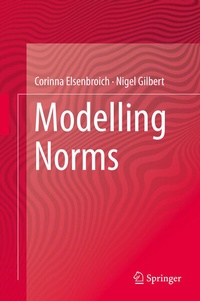
Modelling Norms
Description

The book focusses on questions of individual and collective action, the emergence and dynamics of social norms and the feedback between individual behaviour and social phenomena. It discusses traditional modelling approaches to social norms and shows the usefulness of agent-based modelling for the study of these micro-macro interactions. Existing agent-based models of social norms are discussed and it is shown that so far too much priority has been given to parsimonious models and questions of the emergence of norms, with many aspects of social norms, such as norm-change, not being modelled. Juvenile delinquency, group radicalisation and moral decision making are used as case studies for agent-based models of collective action extending existing models by providing an embedding into social networks, social influence via argumentation and a causal action theory of moral decision making. The major contribution of the book is to highlight the multifaceted nature of the dynamics of social norms, consisting not only of emergence, and the importance of embedding of agent-based models into existing theory.
Reviews / Votes
From the reviews:
"It serves as a very nice introduction to the literature on modeling social norms . . The book . does a nice job balancing between discussing the theory of norms and the particular challenges brought on by modeling social phenomena. . the book is both a pleasant read and a very nice introduction to the literature." (Ryan Muldoon, Journal of Artificial Societies and Social Simulation, Vol. 17 (1), 2014)More details
Other editions
Additional editions
Persons
Content
Introduction.- Theorising Norms.- Theorising Crime.- Agent-based Modelling.- The Environment and Social Norms.- Punishment and Social Norms.- Imitation and Social Norms.- Socially Situated Social Norms.- Internalisation and Social Norms.- Modelling Norms.- Delinquent Networks.- Social Construction of Knowledge.- Morality.- We-Intentionality.- Conclusion.- Index.
