

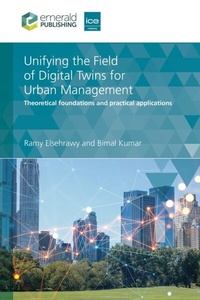
Unifying the Field of Digital Twins for Urban Management
Theoretical Foundations and Practical Applications
1st Edition
Published on 19. May 2025
264 pages
978-1-83662-236-9 (ISBN)
Description

Unifying the Field of Digital Twins for Urban Management presents a holistic and integrated approach to the rapidly evolving field of digital twins for urban management. The framework offers a structured approach that encompasses both theoretical underpinnings and practical applications. It aims to provide a foundation to support enhanced decision-making, optimised resource utilisation, and improved urban resilience and sustainability.
The book aims to address a lack of consistency, coherence and uniformity within current approaches, and offers a unified framework to facilitate collaboration and knowledge exchange across diverse areas, such as urban management, systems thinking, data science and social science.
Key features include
a systematic framework (DATUM) to unify the field of digital twins for urban management
coverage of theoretical foundations and a step-by-step methodology to guide digital twin-based interventions
a standardised language to facilitate classification, documentation and communication of digital twin use cases
validation of the DATUM framework through a combination of focus group research, case studies and action research, ensuring applicability and effectiveness.
Unifying the Field of Digital Twins for Urban Management is designed for a wide audience, including digital twin practitioners, researchers, urban managers and policy makers interested in harnessing the potential of digital twins to improve urban environments.
The book aims to address a lack of consistency, coherence and uniformity within current approaches, and offers a unified framework to facilitate collaboration and knowledge exchange across diverse areas, such as urban management, systems thinking, data science and social science.
Key features include
a systematic framework (DATUM) to unify the field of digital twins for urban management
coverage of theoretical foundations and a step-by-step methodology to guide digital twin-based interventions
a standardised language to facilitate classification, documentation and communication of digital twin use cases
validation of the DATUM framework through a combination of focus group research, case studies and action research, ensuring applicability and effectiveness.
Unifying the Field of Digital Twins for Urban Management is designed for a wide audience, including digital twin practitioners, researchers, urban managers and policy makers interested in harnessing the potential of digital twins to improve urban environments.
More details
Language
English
Place of publication
Leeds
United Kingdom
Publishing group
Emerald Publishing Limited
Target group
Professional and scholarly
ISBN-13
978-1-83662-236-9 (9781836622369)
Copyright in bibliographic data and cover images is held by Nielsen Book Services Limited or by the publishers or by their respective licensors: all rights reserved.
Schweitzer Classification
Other editions
Additional editions

Ramy Elsehrawy | Bimal Kumar
Unifying the Field of Digital Twins for Urban Management
Theoretical Foundations and Practical Applications
Book
05/2025
ICE Publishing
€97.50
Shipment within 3-4 weeks
Persons
Dr Ramy Elsehrawy is Senior Information Management Consultant at Mott MacDonald, Newcastle Upon Tyne, UK.
Professor Bimal Kumar is Professor of Innovative Digital Construction Technologies at the University of Strathclyde, UK.
Professor Bimal Kumar is Professor of Innovative Digital Construction Technologies at the University of Strathclyde, UK.
Content
Introduction 1
1.1. Background, rationale and motivations
1.2. Core challenge
1.3. The motivation behind this book
1.4. The scope of this book
1.5. Book structure
2 Our lens and approach
2.1. Introduction
2.2. Our philosophy - critical realism
2.3. Research methodology
2.4. DSR [1]: Awareness of problem
2.5. DSR [2]: Suggestion
2.6. DSR [3]: Development
2.7. DSR [4]: Evaluation
2.8. DSR [5]: Conclusion
3 Navigating the landscape
3.1. Introduction
3.2. Systems thinking
3.3. Urban management
3.4. Digital twin
3.5. Systematic literature review
3.6. Q1 - Synthesis of results
3.7. Q2 - Synthesis of results
3.8. Q3 and Q4 - Synthesis of results
3.9. Summary
4 Designed amalgam of twinning for urban
management (DATUM): the way forward
4.1. Introduction
4.2. Three-layered perspective
4.3. Layer 2: The morphogenetic/morphostatic framework
4.4. Layer 3: The structure of scientific revolution
4.5. The evolution of urban management
4.6. Designed amalgam of twinning for urban
management [DATUM]
4.7. Summary
5 Methods: digital twin uses classification
system (DTUCS)
5.1. Introduction
5.2. Digital twin uses classification system
5.3. The gemini framework: reference architecture
6 Philosophical foundations: critical realism
6.1. Introduction
6.2. Way forward - three theoretical propositions
7 Methodology: Data-driven multimethod
methodology [DM2]
7.1. Introduction
7.2. Existing CR-informed methodologies
7.3. Data-driven multi-method methodology [DM2]
7.4. Summary
8 Putting DATUM to the test
8.1. Introduction
8.2. Evaluation of philosophical element
8.3. Evaluation of methodical element
8.4. Evaluation of DATUM
8.5 Summary
9 Reflections and future prospects
9.1. Introduction
9.2. Contributions of this book
9.3. Recommendations
9.4. Future work
Index
1.1. Background, rationale and motivations
1.2. Core challenge
1.3. The motivation behind this book
1.4. The scope of this book
1.5. Book structure
2 Our lens and approach
2.1. Introduction
2.2. Our philosophy - critical realism
2.3. Research methodology
2.4. DSR [1]: Awareness of problem
2.5. DSR [2]: Suggestion
2.6. DSR [3]: Development
2.7. DSR [4]: Evaluation
2.8. DSR [5]: Conclusion
3 Navigating the landscape
3.1. Introduction
3.2. Systems thinking
3.3. Urban management
3.4. Digital twin
3.5. Systematic literature review
3.6. Q1 - Synthesis of results
3.7. Q2 - Synthesis of results
3.8. Q3 and Q4 - Synthesis of results
3.9. Summary
4 Designed amalgam of twinning for urban
management (DATUM): the way forward
4.1. Introduction
4.2. Three-layered perspective
4.3. Layer 2: The morphogenetic/morphostatic framework
4.4. Layer 3: The structure of scientific revolution
4.5. The evolution of urban management
4.6. Designed amalgam of twinning for urban
management [DATUM]
4.7. Summary
5 Methods: digital twin uses classification
system (DTUCS)
5.1. Introduction
5.2. Digital twin uses classification system
5.3. The gemini framework: reference architecture
6 Philosophical foundations: critical realism
6.1. Introduction
6.2. Way forward - three theoretical propositions
7 Methodology: Data-driven multimethod
methodology [DM2]
7.1. Introduction
7.2. Existing CR-informed methodologies
7.3. Data-driven multi-method methodology [DM2]
7.4. Summary
8 Putting DATUM to the test
8.1. Introduction
8.2. Evaluation of philosophical element
8.3. Evaluation of methodical element
8.4. Evaluation of DATUM
8.5 Summary
9 Reflections and future prospects
9.1. Introduction
9.2. Contributions of this book
9.3. Recommendations
9.4. Future work
Index
