


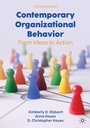
Contemporary Organizational Behavior
Description

This textbook equips students with the latest research on analyzing and improving individual and organizational performance. Each chapter starts with key terms, then contains a short, engaging summary of the central concepts, a spotlight on research to encourage practical application of academic research, one authoritative reading from topic experts, a real-world case study from a contemporary organization, and experiential exercises that bring topic concepts to life. Each section contains an extended case study that integrates concepts across multiple chapters.
This new edition offers an updated format and integrates the foundations of organizational behavior, as well as the latest thinking on topics set in a contemporary context, such as virtual work and working in the gig economy. Throughout the book, the authors address how AI is reshaping workplace dynamics.
Whether undergraduates or graduate students, this text helps learners experience life in contemporary organizations. It is designed with learning in mind, as each chapter engages the learning cycle: experiencing through exercises, reflecting on personal experience, drawing on theory, and applying through case studies.
More details
Other editions
Additional editions
Persons
Kimberly D. Elsbach is a Professor Emerita of Management and previously held the Stephen G. Newberry Chair in Leadership at the Graduate School of Management, University of California, Davis, USA.
Anna Kayes is a Professor of Management at the Howard Brown School of Business and Leadership at Stevenson University, USA.
D. Christopher Kayes is Professor of Management at The George Washington University School of Business and a Senior Fellow at the Center for Excellence in Public Leadership at The George Washington University, USA.
Content
Chapter 1: Introduction to Contemporary Organizational Behavior .- Chapter 2: Individual Characteristics .- Chapter 3: Learning in the Workplace .- Chapter 4: Perception .- Chapter 5: Leadership .- Chapter 6: Motivation .- Chapter 7 .- Chapter 8: Decision Making .- Chapter 9: Groups and Teams .- Chapter 11: Diversity and Communication .- Chapter 12: Culture .- Chapter 13: Change, Innovation, Stress .- Chapter 14: Corporate Social Responsibility, Ethics, and Sustainability .
