

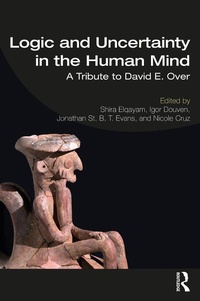
Logic and Uncertainty in the Human Mind
A Tribute to David E. Over
1st Edition
Published on 10. June 2020
286 pages
978-1-351-62041-3 (ISBN)
Description

David E. Over is a leading cognitive scientist and, with his firm grounding in philosophical logic, he also exerts a powerful influence on the psychology of reasoning. He is responsible for not only a large body of empirical work and accompanying theory, but for advancing a major shift in thinking about reasoning, commonly known as the 'new paradigm' in the psychology of human reasoning.
Over's signature mix of philosophical logic and experimental psychology has inspired generations of researchers, psychologists, and philosophers alike over more than a quarter of a century. The chapters in this volume, written by a leading group of contributors including a number who helped shape the psychology of reasoning as we know it today, each take their starting point from the key themes of Over's ground-breaking work. The essays in this collection explore a wide range of central topics-such as rationality, bias, dual processes, and dual systems-as well as contemporary psychological and philosophical theories of conditionals. It concludes with an engaging new chapter, authored by David E. Over himself, which details and analyses the new paradigm psychology of reasoning.
This book is therefore important reading for scholars, researchers, and advanced students in psychology, philosophy, and the cognitive sciences, including those who are not familiar with Over's thought already.
Over's signature mix of philosophical logic and experimental psychology has inspired generations of researchers, psychologists, and philosophers alike over more than a quarter of a century. The chapters in this volume, written by a leading group of contributors including a number who helped shape the psychology of reasoning as we know it today, each take their starting point from the key themes of Over's ground-breaking work. The essays in this collection explore a wide range of central topics-such as rationality, bias, dual processes, and dual systems-as well as contemporary psychological and philosophical theories of conditionals. It concludes with an engaging new chapter, authored by David E. Over himself, which details and analyses the new paradigm psychology of reasoning.
This book is therefore important reading for scholars, researchers, and advanced students in psychology, philosophy, and the cognitive sciences, including those who are not familiar with Over's thought already.
Reviews / Votes
David Over is renowned for his fruitful application of his skills in logic to questions about the psychology of reasoning and the meaning of conditionals. This book gives well-deserved recognition to his achievements.Timothy Williamson, University of Oxford, UK
You hold in your hands a book to honour Professor David Over. His extraordinary career - from philosopher to cognitive psychologist - reflects his passion to understand how humans reason. As its varied and striking contents make clear, the honour is more than merited.
P.N. Johnson-Laird, Princeton University, USA
This is an erudite volume in honour of an erudite and generous scholar. Philosophically informed psychology was pioneered by David Over, and the contributors collected here provide a fitting tribute by extending his legacy in the multiple problem areas where he made major contributions.
Keith E. Stanovich, University of Toronto, Canada David Over is renowned for his fruitful application of his skills in logic to questions about the psychology of reasoning and the meaning of conditionals. This book gives well-deserved recognition to his achievements.
Timothy Williamson, University of Oxford, UK
You hold in your hands a book to honour Professor David Over. His extraordinary career - from philosopher to cognitive psychologist - reflects his passion to understand how humans reason. As its varied and striking contents make clear, the honour is more than merited.
P.N. Johnson-Laird, Princeton University, USA
This is an erudite volume in honour of an erudite and generous scholar. Philosophically informed psychology was pioneered by David Over, and the contributors collected here provide a fitting tribute by extending his legacy in the multiple problem areas where he made major contributions.
Keith E. Stanovich, University of Toronto, Canada
More details
Edition
1. Auflage
Language
English
Place of publication
London
United Kingdom
Publishing group
Taylor & Francis Ltd
Target group
College/higher education
Product notice
Reflowable
Illustrations
17 Tables, black and white; 2 Line drawings, black and white
ISBN-13
978-1-351-62041-3 (9781351620413)
Copyright in bibliographic data and cover images is held by Nielsen Book Services Limited or by the publishers or by their respective licensors: all rights reserved.
Schweitzer Classification
Other editions
Additional editions
Shira Elqayam | Igor Douven | Jonathan St B. T. Evans
Logic and Uncertainty in the Human Mind
A Tribute to David E. Over
Book
06/2020
1st Edition
Routledge
€73.10
Shipment within 10-20 days
Shira Elqayam | Igor Douven | Jonathan St B. T. Evans
Logic and Uncertainty in the Human Mind
A Tribute to David E. Over
Book
06/2020
1st Edition
Routledge
€208.00
Shipment within 10-20 days
Persons
Shira Elqayam is Professor of Cognitive Psychology and Cognitive Science at De Montfort University. Her research interests are in reasoning and rationality, with emphasis on normative thinking and rationality in context. Her work is interdisciplinary with many insights inspired by language and philosophy.
Igor Douven is a philosopher and cognitive scientist. He is currently Research Director at the French National Centre for Scientific Research (INSHS). His main research interests are in concepts, conditionals, and rationality.
Jonathan St. B. T. Evans is Emeritus Professor of Psychology at the University of Plymouth. He is best known for his work on conditionals and dual process theories of reasoning. He has conducted many studies of thinking, reasoning, and decision making since the 1970s, publishing numerous journal articles and several books on these topics.
Nicole Cruz is a cognitive scientist at the University of New South Wales. In 2018, she received her PhD in Psychology at Birkbeck, University of London in conjunction with the School for Advanced Studies in the Social Sciences (EPHE) in Paris. Her main areas of research are reasoning and decision making under uncertainty, using tools from philosophical logic, experimental psychology, and computational modelling.
Igor Douven is a philosopher and cognitive scientist. He is currently Research Director at the French National Centre for Scientific Research (INSHS). His main research interests are in concepts, conditionals, and rationality.
Jonathan St. B. T. Evans is Emeritus Professor of Psychology at the University of Plymouth. He is best known for his work on conditionals and dual process theories of reasoning. He has conducted many studies of thinking, reasoning, and decision making since the 1970s, publishing numerous journal articles and several books on these topics.
Nicole Cruz is a cognitive scientist at the University of New South Wales. In 2018, she received her PhD in Psychology at Birkbeck, University of London in conjunction with the School for Advanced Studies in the Social Sciences (EPHE) in Paris. Her main areas of research are reasoning and decision making under uncertainty, using tools from philosophical logic, experimental psychology, and computational modelling.
Content
Chapter 1: The contribution of David Over: An intellectual biography by Ken Manktelow & Jonathan Evans
Chapter 2: Satisficing, meta-reasoning, and the rationality of further deliberation by Rakefet Ackerman, Igor Douven, Shira Elqayam, & Kinneret Teodorescu
Chapter 3: Deduction from uncertain premises? by Nicole Cruz
Chapter 4: Conditionals, truth conditions and indeterminacy by Dorothy Edgington
Chapter 5: The suppositional conditional is not (just) the probability conditional by Jonathan Evans
Chapter 6: Probabilistic entailment and iterated conditionals by Angelo Gilio, Niki Pfeifer & Giuseppe Sanfilippo
Chapter 7: Two Systems for Thinking with a Community: Outsourcing versus Collaboration by Babak Hemmatian & Steven Sloman
Chapter 8: Integrating causal Bayes nets and inferentialism in conditional inference by Mike Oaksford & Nick Chater
Chapter 9: Objecting to uncertain conditional sentences: A cross-linguistic study by Guy Politzer, Jean Baratgin, Ikuko Hattori, & Masasi Hattori
Chapter 10: Children's comprehension of conditional requests by Guy Politzer, Frank Jamet, & Jean Baratgin
Chapter 11: Delusional rationality by Stephanie Rhodes, Niall Galbraith, & Ken Manktelow
Chapter 12: Relevance and conditionals: A synopsis of open pragmatic and semantic issues by Niels Skovgaard Olsen
Chapter 13: Correlation detection with and without the theory of conditionals: A model update of Hattori & Oaksford (2007) by Tatsuji Takahashi
Chapter 14: Working memory, autonomy, and dual process theories: A roadmap by Valerie Thompson & Ian Newman
Chapter 15: The development of the new paradigm in the psychology of reasoning by David Over
Chapter 2: Satisficing, meta-reasoning, and the rationality of further deliberation by Rakefet Ackerman, Igor Douven, Shira Elqayam, & Kinneret Teodorescu
Chapter 3: Deduction from uncertain premises? by Nicole Cruz
Chapter 4: Conditionals, truth conditions and indeterminacy by Dorothy Edgington
Chapter 5: The suppositional conditional is not (just) the probability conditional by Jonathan Evans
Chapter 6: Probabilistic entailment and iterated conditionals by Angelo Gilio, Niki Pfeifer & Giuseppe Sanfilippo
Chapter 7: Two Systems for Thinking with a Community: Outsourcing versus Collaboration by Babak Hemmatian & Steven Sloman
Chapter 8: Integrating causal Bayes nets and inferentialism in conditional inference by Mike Oaksford & Nick Chater
Chapter 9: Objecting to uncertain conditional sentences: A cross-linguistic study by Guy Politzer, Jean Baratgin, Ikuko Hattori, & Masasi Hattori
Chapter 10: Children's comprehension of conditional requests by Guy Politzer, Frank Jamet, & Jean Baratgin
Chapter 11: Delusional rationality by Stephanie Rhodes, Niall Galbraith, & Ken Manktelow
Chapter 12: Relevance and conditionals: A synopsis of open pragmatic and semantic issues by Niels Skovgaard Olsen
Chapter 13: Correlation detection with and without the theory of conditionals: A model update of Hattori & Oaksford (2007) by Tatsuji Takahashi
Chapter 14: Working memory, autonomy, and dual process theories: A roadmap by Valerie Thompson & Ian Newman
Chapter 15: The development of the new paradigm in the psychology of reasoning by David Over
