

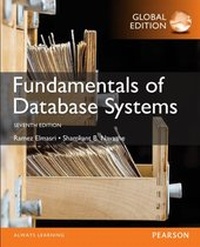
Fundamentals of Database Systems, Global Edition
Description

The full text downloaded to your computer
With eBooks you can:
- search for key concepts, words and phrases
- make highlights and notes as you study
- share your notes with friends
eBooks are downloaded to your computer and accessible either offline through the Bookshelf (available as a free download), available online and also via the iPad and Android apps.
Upon purchase, you'll gain instant access to this eBook.
Time limit
The eBooks products do not have an expiry date. You will continue to access your digital ebook products whilst you have your Bookshelf installed.
For database systems courses in Computer Science This book introduces the fundamental concepts necessary for designing, using, and implementing database systems and database applications. Our presentation stresses the fundamentals of database modeling and design, the languages and models provided by the database management systems, and database system implementation techniques. The book is meant to be used as a textbook for a one- or two-semester course in database systems at the junior, senior, or graduate level, and as a reference book. The goal is to provide an in-depth and up-to-date presentation of the most important aspects of database systems and applications, and related technologies. It is assumed that readers are familiar with elementary programming and data-structuring concepts and that they have had some exposure to the basics of computer organisation.
All prices
More details
Other editions
Additional editions
Persons
For database systems courses in Computer Science
This book introduces the fundamental concepts necessary for designing, using, and implementing database systems and database applications. Our presentation stresses the fundamentals of database modeling and design, the languages and models provided by the database management systems, and database system implementation techniques.
The book is meant to be used as a textbook for a one- or two-semester course in database systems at the junior, senior, or graduate level, and as a reference book. The goal is to provide an in-depth and up-to-date presentation of the most important aspects of database systems and applications, and related technologies. It is assumed that readers are familiar with elementary programming and data-structuring concepts and that they have had some exposure to the basics of computer organization.
Content
- Part 1: Introduction to Databases
- Chapter 1: Databases and Database Users
- Chapter 2: Database Systems Concepts and Architecture
- Part 2: Conceptual Data Modeling and Database Design
- Chapter 3: Data Modeling Using the Entity Relationship (ER) Model
- Chapter 4: The Enhanced Entity Relationship (EER) Model
- Part 3: The Relational Data Model and SQL
- Chapter 5: The Relational Data Model and Relational Database Constraints
- Chapter 6: Basic SQL
- Chapter 7: More SQL: Complex Queries, Triggers, Views, and Schema Modification
- Chapter 8: The Relational Algebra and Relational Calculus
- Chapter 9: Relational Database Design by ER- and EER-to-Relational Mapping
- Part 4: Database Programming Techniques
- Chapter 10: Introduction to SQL Programming Techniques
- Chapter 11: Web Database Programming Using PHP
- Part 5: Object, Object-Relational, and XML: Concepts, Models, Languages, and Standards
- Chapter 12: Object and Object-Relational Databases
- Chapter 13: XLM: Extensible Markup Language
- Part 6: Database Design Theory and Normalization
- Chapter 14: Basics of Functional Dependencies and Normalization for Relational Databases
- Chapter 15: Relational Database Design Algorithms and Further Dependencies
- Part 7: File Structures, Hashing, Indexing, and Physical Database Design
- Chapter 16: Disc Storage, Basic File Structures, Hashing, and Modern Storage Architectures
- Chapter 17: Indexing Structures for Files and Physical Database Design
- Part 8: Query Processing and Optimization
- Chapter 18: Strategies for Query Processing
- Chapter 19: Query Optimization
- Part 9: Transaction Processing, Concurrency Control, and Recovering
- Chapter 20: Introduction to Transaction Processing Concepts and Theory
- Chapter 21: Concurrency Control Techniques
- Chapter 22: Database Recovery Techniques
- Part 10: Distributed Databases, NOSQL Systems, Cloud Computing, and Big Data
- Chapter 23: Distributed Database Concepts
- Chapter 24: NOSQL Databases and Big Data Storage Systems
- Chapter 25: Big Data Technologies Based on MapReduce and Hadoop
- Part 11: Advanced Database Models, Systems, and Applications
- Chapter 26: Enhanced Data Models: Introduction to Active, Temporal, Spatial, Multimedia, and Deductive Databases
- Chapter 27: Introduction to Information Retrieval and Web Search
- Chapter 28: Data Mining Concepts
- Chapter 29: Overview of Data Warehousing and OLAP
- Part 12: Additional Database Topics: Security
- Chapter 30: Database Security
- Appendix A: Alternative Diagrammatic Notations for ER Models
- Appendix B: Parameters of Disks
- Appendix C: Overview of the QBE Language
- Appendix D: Overview of the Hierarchical Data Model
- Appendix E: Overview of the Network Data Model
