

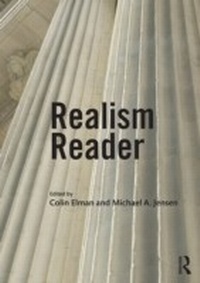
The Realism Reader
1st Edition
Published on 12. August 2014
550 pages
978-1-317-93713-5 (ISBN)
Description

The Realism Reader provides broad coverage of a centrally important tradition in the study of foreign policy and international politics. After some years in the doldrums, political realism is again in contention as a leading tradition in the international relations sub-field.
Divided into three main sections, the book covers seven different and distinctive approaches within the realist tradition: classical realism, balance of power theory, neorealism, defensive structural realism, offensive structural realism, rise and fall realism, and neoclassical realism. The middle section of the volume covers realism's engagement with critiques levelled by liberalism, institutionalism, and constructivism and the English School. The final section of the book provides materials on realism's engagement with some contemporary issues in international politics, with collections on United States (U.S.) hegemony, European cooperation, and whether future threats will arise from non-state actors or the rise of competing great powers.
The book offers a logically coherent and manageable framework for organizing the realist canon, and provides exemplary literature in each of the traditions and dialogues which are included in the volume. Offering substantial commentary and analysis and including enhanced pedagogy to facilitate student learning, The Realism Reader will provide a 'one-stop-shop' for undergraduates and masters students taking a course in contemporary international relations theory, with a particular focus on realism.
Divided into three main sections, the book covers seven different and distinctive approaches within the realist tradition: classical realism, balance of power theory, neorealism, defensive structural realism, offensive structural realism, rise and fall realism, and neoclassical realism. The middle section of the volume covers realism's engagement with critiques levelled by liberalism, institutionalism, and constructivism and the English School. The final section of the book provides materials on realism's engagement with some contemporary issues in international politics, with collections on United States (U.S.) hegemony, European cooperation, and whether future threats will arise from non-state actors or the rise of competing great powers.
The book offers a logically coherent and manageable framework for organizing the realist canon, and provides exemplary literature in each of the traditions and dialogues which are included in the volume. Offering substantial commentary and analysis and including enhanced pedagogy to facilitate student learning, The Realism Reader will provide a 'one-stop-shop' for undergraduates and masters students taking a course in contemporary international relations theory, with a particular focus on realism.
Reviews / Votes
"The Realism Reader is an absolutely superb collection of writings from the leading schools of modern realist thought and from their most prominent critics. It is perfect for the undergraduate and Masters-level classroom." Jack S. Levy, Board of Governors' Professor, Rutgers University, USA."Realism, as vital as ever, comes in more varieties than ever. In this single volume Elman and Jensen bring together the chief varieties of modern realism, clarify how they cohere and differ, and present some of the controversies that realists continue to provoke. The Realism Reader will be invaluable to students of international relations." John M. Owen IV, Taylor Professor of Politics, University of Virginia
More details
Language
English
Place of publication
London
United Kingdom
Publishing group
Taylor & Francis Ltd
Target group
College/higher education
Illustrations
1 s/w Abbildung, 1 s/w Zeichnung
1 Line drawings, black and white; 1 Illustrations, black and white
File size
3,49 MB
ISBN-13
978-1-317-93713-5 (9781317937135)
Copyright in bibliographic data and cover images is held by Nielsen Book Services Limited or by the publishers or by their respective licensors: all rights reserved.
Schweitzer Classification
Other editions
Additional editions
Colin Elman | Michael Jensen
The Realism Reader
Book
05/2014
1st Edition
Routledge
€97.80
Shipment within 15-20 days
Colin Elman | Michael Jensen
The Realism Reader
Book
04/2014
1st Edition
Routledge
€297.36
Shipment within 15-20 days
Persons
Colin Elman is Associate Professor of Political Science at Syracuse University. He has published articles in International Organization, International Studies Quarterly, the International History Review, the American Political Science Review, International Security, and Security Studies. He is co-founder and Secretary-Treasurer of both the International History and Politics, and Qualitative and Multi-Method Research organized sections of the American Political Science Association, and co-founder and Executive Director of the Consortium for Qualitative Research Methods.
Michael A. Jensen is a Faculty Research Associate at the National Consortium for the Study of Terrorism and Responses to Terrorism (START), University of Maryland, where he serves as the Data Collection Manager for the Global Terrorism Database. He also currently teaches courses on international security and terrorism for the Elliott School of International Affairs at George Washington University and the Department of Criminology and Criminal Justice at the University of Maryland. Prior to joining START, he was a post-doctoral fellow at the Moynihan Institute of Global Affairs, Syracuse University.
Michael A. Jensen is a Faculty Research Associate at the National Consortium for the Study of Terrorism and Responses to Terrorism (START), University of Maryland, where he serves as the Data Collection Manager for the Global Terrorism Database. He also currently teaches courses on international security and terrorism for the Elliott School of International Affairs at George Washington University and the Department of Criminology and Criminal Justice at the University of Maryland. Prior to joining START, he was a post-doctoral fellow at the Moynihan Institute of Global Affairs, Syracuse University.
Content
Chapter 1: Introduction SECTION ONE: REALIST RESEARCH PROGRAMS Chapter 2: Classical Realism: The twentieth century, Edward Hallett Carr, "The Beginnings of a Science" and "The Realist Critique" Hans J. Morgenthau, "The Moral Blindness of Scientific Man" Hans J. Morgenthau, "A Realist Theory of International Politics" John H. Herz, "Idealist Internationalism and the Security Dilemma," Arnold Wolfers, "The Pole of Power and the Pole of Indifference," Chapter 3: Balance of Power Theory Ernst B. Haas, "The Balance of Power: Prescription, Concept, or Propaganda," Edward Vose Gulick, "Aims" Robert Jervis, "Feedback" Jack S. Levy and William R. Thompson, "Balancing on Land and Sea: Do States Ally against the Leading Global Power?" Chapter 4: Neorealism, Kenneth Waltz, "Political Structures" and "Anarchic Orders and Balances of Power" Kenneth Waltz, "Realist Thought and Neorealist Theory," Kenneth Waltz, "The Origins of War in Neorealist Theory," Chapter 5: Defensive Structural Realism, Robert Jervis, "Cooperation Under the Security Dilemma," Stephen M. Walt, "Alliance Formation and the Balance of World Power," Charles L. Glaser, "Realists as Optimists: Cooperation as Self-Help." Stephen Van Evera, "Introduction" Evan Braden Montgomery, "Breaking Out of the Security Dilemma: Realism, Reassurance, and the Problem of Uncertainty," Chapter 6: Offensive Structural Realism, John J. Mearsheimer, "Anarchy and the Struggle for Power" Glenn H. Snyder, "Mearsheimer's World-Offensive Realism and the Struggle for Security," Christopher Layne, "The 'Poster Child for Offensive Realism:' America as Global Hegemon," Chapter 7: Rise and Fall Realism, Robert Gilpin, "The Nature of International Political Change" and "Hegemonic War and International Change" A.F.K. Organski, "Power Transition," Jack Levy, "Declining Power and the Preventive Motive for War," Dale Copeland, "Neorealism and the Myth of Bipolar Stability: Toward a New Dynamic Realist Theory of Major War," Chapter 8: Neoclassical Realism, Charles Glaser, "The Necessary and Natural Evolution of Structural Realism," Jeffrey W. Taliaferro , Steven E. Lobell, and Norrin M. Ripsman, "Introduction: Neoclassical Realism, The State, and Foreign Policy" Thomas J. Christensen and Jack Snyder, "Chain Gangs and Passed Bucks: Predicting Alliance Patterns in Multipolarity," Randall L. Schweller, "Unanswered Threats: A Neoclassical Realist Theory of Underbalancing," Colin Dueck, "Neoclassical Realism and the National Interest: Presidents, Domestic Politics, and Major Military Interventions," SECTION TWO: CRITIQUES AND RESPONSES, Chapter 9: The Liberal Critique, Andrew Moravcsik, "Taking Preferences Seriously: A Liberal Theory of International Politics," Brian C. Rathbun, "Is Anybody Not an (International Relations) Liberal?" John M. Owen, "How Liberalism Produces Democratic Peace," Christopher Layne, "Kant or Cant: the Myth of Democratic Peace," Chapter 10: The Institutionalist Critique, David A. Baldwin, "Neoliberalism, Neorealism, and World Politics," Robert O. Keohane and Lisa L. Martin, "Institutional Theory as a Research Program," Joseph M. Grieco, "Anarchy and the Limits of Cooperation: A Realist Critique of the Newest Liberal Institutionalism," John Mearsheimer, "The False Promise of International Institutions," Chapter 11: The Constructivist/English School Critique, Alexander Wendt, "Anarchy is What States Make of It: The Social Construction of Power Politics," Michael C. Desch, "Culture Clash: Assessing the Importance of Ideas in Security Studies," Richard Little, "The English School vs. American Realism: A Meeting of Minds or Divided by a Common Language?" Dale Copeland, "A Realist Critique of the English School," SECTION THREE: REALIST THEORIES AND CONTEMPORARY INTERNATIONAL POLITICS Chapter 12: Realism, American 'Hegemony' and 'Soft' Balancing William C. Wohlforth, "The Stability of a Unipolar World," Christopher Layne, "The Unipolar Illusion Revisited: The Coming End of the United State's Unipolar Moment," Robert A. Pape, "Soft Balancing against the United States," Keir A. Lieber, Gerard Alexander, "Waiting for Balancing: Why the World Is Not Pushing Back," Chapter 13: Realism and European Cooperation, John Mearsheimer, "The Future of the American Pacifier," Barry R. Posen, "European Union Security and Defense Policy: Response to Unipolarity?" Jolyon Howorth and Anand Menon, "Still Not Pushing Back: Why the European Union is Not Balancing the United States," Chapter 14: Realism, Nonstate Actors, and the Rise of China, Charles L. Glaser, "Structural Realism in a More Complex World," Barry R. Posen, "The Security Dilemma and Ethnic Conflict," John J. Mearsheimer, "China's Unpeaceful Rise," Jonathan Kirshner, "The Tragedy of Offensive Realism: Classical Realism and the Rise of China," Chapter 15: Is Realism Heading in the Right Direction? John A. Vasquez, "The Realist Paradigm and Degenerative versus Progressive Research Programs: An Appraisal of Neotraditional Research on Waltz's Balancing Proposition," Kenneth N. Waltz, "Evaluating Theories," Stephen M. Walt, "The Progressive Power of Realism," Jeffrey W. Legro and Andrew Moravcsik, "Is Anybody Still a Realist?" Peter D. Feaver, Gunther Hellman, Randall L. Schweller, Jeffrey W. Taliaferro, William C. Wohlforth, Jeffrey W. Legro, and Andrew Moravcsik, "Correspondence: Brother Can You Spare a Paradigm? (Or Was Anybody Ever a Realist),"
