

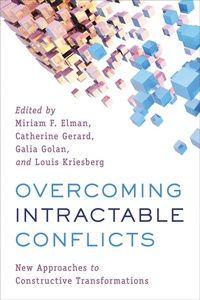
Overcoming Intractable Conflicts
New Approaches to Constructive Transformations
1st Edition
Published on 26. September 2019
424 pages
979-8-8818-5779-0 (ISBN)
Description

Despite considerable progress in research and practice in the constructive transformation of intractable conflicts beginning in the 1970s, many terribly destructive conflicts have recently erupted. New circumstances have emerged that have resulted in regressions.
The contributions in this book examine many of the new challenges and obstacles to the transformation of intractable conflicts. It also offers an array of new and promising opportunities for constructive transformations. The book brings together analyses of U.S.-based conflicts with those from many regions of the world. International, intra-state, and local conflicts are explored, along with those that have been violent and non-violent. The diversity in disciplines among the authors provides a wide range of theoretical approaches to explaining how a variety of intractable conflicts can be transformed.
Case studies of local, national, and transnational conflicts serve to illustrate this new landscape. These analyses are complemented by conceptual discussions relating to new conflict systems, actors, dynamics and strategies. Policy implications of findings are also presented.
The contributions in this book examine many of the new challenges and obstacles to the transformation of intractable conflicts. It also offers an array of new and promising opportunities for constructive transformations. The book brings together analyses of U.S.-based conflicts with those from many regions of the world. International, intra-state, and local conflicts are explored, along with those that have been violent and non-violent. The diversity in disciplines among the authors provides a wide range of theoretical approaches to explaining how a variety of intractable conflicts can be transformed.
Case studies of local, national, and transnational conflicts serve to illustrate this new landscape. These analyses are complemented by conceptual discussions relating to new conflict systems, actors, dynamics and strategies. Policy implications of findings are also presented.
More details
Edition
1. Auflage
Language
English
Place of publication
United States
Publishing group
Bloomsbury Publishing Plc
Illustrations
18 b/w illustrations;13 tables;
ISBN-13
979-8-8818-5779-0 (9798881857790)
Copyright in bibliographic data and cover images is held by Nielsen Book Services Limited or by the publishers or by their respective licensors: all rights reserved.
Schweitzer Classification
Other editions
Additional editions
Book
09/2019
Rowman & Littlefield International
€166.30
Shipment within 3-4 weeks
Persons
Miriam F. Elman is associate professor of political science and the Inaugural Robert D. McClure Professor of Teaching Excellence at the Maxwell School of Citizenship & Public Affairs, Syracuse University where she also serves as a research director at the Program for the Advancement of Research on Conflict and Collaboration (PARCC). Elman received her Ph.D. in political science from Columbia University and her B.A. in International Relations from the Hebrew University of Jerusalem. She is the editor and co-editor of five books, including most recently Democracy and Conflict Resolution: the Dilemmas of Israel's Peacemaking and Jerusalem: Conflict and Cooperation in a Contested City. In addition to her books, she is also the author and co-author of over 65 journal articles, book chapters and reports on topics related to international and national security, the nexus between religion, politics and conflict resolution, and the Israeli-Palestinian conflict. Elman's research has been supported by many government agencies and private foundations, including the US Department of Education, Arizona State University's Center for the Study of Religion and Conflict (CSRC), and Harvard University's Belfer Center for Science and International Affairs (BCSIA), where she was an International Security Fellow.
Catherine Gerard serves as Director of the Program for the Advancement of Research on Conflict and Collaboration (PARCC), Associate Director of Executive Education Programs, and Adjunct Professor of Public Administration at Syracuse University's Maxwell School of Citizenship and Public Affairs. In her role as Director of PARCC, she oversees an internationally known center for theory-building and practice in conflict analysis and resolution. Her focus is research, education, and practice of managers and students in the skills of collaborative leadership and change. She is co-editor of Pushing the Boundaries: New Frontiers in Conflict Resolution and Collaboration (2009) and co-author of "The Contribution of Leadership to the Movement from Violence to Incorporation" in the book, Conflict Transformation and Peacebuilding (2009). As Associate Director of Executive Education, she oversees the Executive degree programs and develops and instructs executive education programs for domestic and international customers.
Galia Golan is Darwin Professor Emerita of the Hebrew University of Jerusalem and former chair of the Political Science Department. She was also Chair, Program in Diplomacy and Conflict Studies, Interdisciplinary Center, Herzliya. She has published 10 books, most recently Israeli Peacemaking Since 1967: Factors for the Breakthroughs and Failures, (Routledge), now co-editing with Gilead Sher a volume Israeli Spoilers in Israeli-Arab Peacemaking. The recipient of the Israel Political Science Association 2007 Award for Lifetime Contribution, the International Studies Association Distinguished Scholar Award in Peace Studies 2016, and the 1995 New Israel Fund Women in Leadership Award, Dr. Golan was a leading scholar on Soviet foreign policy, authoring numerous books and articles on Soviet policy in the Middle East.
Louis Kriesberg is Professor Emeritus of Sociology, Maxwell Professor Emeritus of Social Conflict Studies, and founding director of the Program on the Analysis and Resolution of Conflicts (PARC), all at Syracuse University. His most recent books are: the 5th edition of Constructive Conflicts, co-authored with Bruce W. Dayton, published in 2017, Perspectives on Waging Conflicts Constructively: Concepts, Cases and Practice, Co-edited with Bruce Dayton. 2017;. Louis Kriesberg: Pioneer in Peace and Constructive Conflict Resolution Studies. Springer, 2016; Realizing Peace: A Constructive Conflict Approach, published by Oxford University Press, in 2015; and Conflict Transformation and Peacebuilding: Moving from Violence to Sustainable Peace (co-ed. with Bruce Dayton, 2009). Among earlier books are: International Conflict Resolution (1992), Timing the De-Escalation of International Conflicts (co-ed., 1991; and Intractable Conflicts and Their Transformation (co-ed., 1989).
Catherine Gerard serves as Director of the Program for the Advancement of Research on Conflict and Collaboration (PARCC), Associate Director of Executive Education Programs, and Adjunct Professor of Public Administration at Syracuse University's Maxwell School of Citizenship and Public Affairs. In her role as Director of PARCC, she oversees an internationally known center for theory-building and practice in conflict analysis and resolution. Her focus is research, education, and practice of managers and students in the skills of collaborative leadership and change. She is co-editor of Pushing the Boundaries: New Frontiers in Conflict Resolution and Collaboration (2009) and co-author of "The Contribution of Leadership to the Movement from Violence to Incorporation" in the book, Conflict Transformation and Peacebuilding (2009). As Associate Director of Executive Education, she oversees the Executive degree programs and develops and instructs executive education programs for domestic and international customers.
Galia Golan is Darwin Professor Emerita of the Hebrew University of Jerusalem and former chair of the Political Science Department. She was also Chair, Program in Diplomacy and Conflict Studies, Interdisciplinary Center, Herzliya. She has published 10 books, most recently Israeli Peacemaking Since 1967: Factors for the Breakthroughs and Failures, (Routledge), now co-editing with Gilead Sher a volume Israeli Spoilers in Israeli-Arab Peacemaking. The recipient of the Israel Political Science Association 2007 Award for Lifetime Contribution, the International Studies Association Distinguished Scholar Award in Peace Studies 2016, and the 1995 New Israel Fund Women in Leadership Award, Dr. Golan was a leading scholar on Soviet foreign policy, authoring numerous books and articles on Soviet policy in the Middle East.
Louis Kriesberg is Professor Emeritus of Sociology, Maxwell Professor Emeritus of Social Conflict Studies, and founding director of the Program on the Analysis and Resolution of Conflicts (PARC), all at Syracuse University. His most recent books are: the 5th edition of Constructive Conflicts, co-authored with Bruce W. Dayton, published in 2017, Perspectives on Waging Conflicts Constructively: Concepts, Cases and Practice, Co-edited with Bruce Dayton. 2017;. Louis Kriesberg: Pioneer in Peace and Constructive Conflict Resolution Studies. Springer, 2016; Realizing Peace: A Constructive Conflict Approach, published by Oxford University Press, in 2015; and Conflict Transformation and Peacebuilding: Moving from Violence to Sustainable Peace (co-ed. with Bruce Dayton, 2009). Among earlier books are: International Conflict Resolution (1992), Timing the De-Escalation of International Conflicts (co-ed., 1991; and Intractable Conflicts and Their Transformation (co-ed., 1989).
Content
1. Introduction, Galia Golan, Hebrew University of Jerusalem; Louis Kriesberg, Syracuse University
2.Gendered Perspective on Intractable Conflicts and Power Sharing, Ayelet Harel-Shalev, Ben-Gurion University of the Negev
3. Mapping and Monitoring Global Insecurity and the Global Illicit Economy: The Effects of Intractable Conflicts, Margaret Hermann, Syracuse University
4. Unrecognized States: Theory, Cases, and Policy Implications, Kristy Buzard, Syracuse University; Benjamin A.T. Graham, University of Southern California; Ben Horne
5. Transformation of Armed Conflict: Lessons from the Arab-Israeli Conflict , Galia Golan, Hebrew University of Jerusalem
6. Dynamics Contexts of Conflict: Complicated Actors and Settings in Northern Ireland , Ronit Berger, Interdisciplinary Center (IDC), Herzliya, Israel
7. Social Media Use and Fear Levels after the Paris 2015 Attacks: A Comparative Study, Bernard Enjolras, Institute for Social Research in Oslo, Norway; Shana Kushner Gadarian, Syracuse Uni
2.Gendered Perspective on Intractable Conflicts and Power Sharing, Ayelet Harel-Shalev, Ben-Gurion University of the Negev
3. Mapping and Monitoring Global Insecurity and the Global Illicit Economy: The Effects of Intractable Conflicts, Margaret Hermann, Syracuse University
4. Unrecognized States: Theory, Cases, and Policy Implications, Kristy Buzard, Syracuse University; Benjamin A.T. Graham, University of Southern California; Ben Horne
5. Transformation of Armed Conflict: Lessons from the Arab-Israeli Conflict , Galia Golan, Hebrew University of Jerusalem
6. Dynamics Contexts of Conflict: Complicated Actors and Settings in Northern Ireland , Ronit Berger, Interdisciplinary Center (IDC), Herzliya, Israel
7. Social Media Use and Fear Levels after the Paris 2015 Attacks: A Comparative Study, Bernard Enjolras, Institute for Social Research in Oslo, Norway; Shana Kushner Gadarian, Syracuse Uni
