

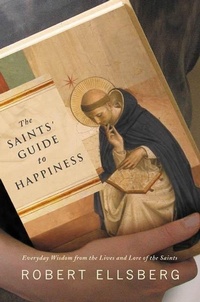
The Saints' Guide to Happiness
Description

"Eloquent . . . and delightfully readable . . . Catholic convert Ellsberg . . . makes the spiritual struggles . . . of sanctified men and women accessible and relevant." - Publishers Weekly
In All Saints-published in 1997 and already a classic of its kind-Robert Ellsberg told the stories of 365 holy people with great vividness and eloquence. In The Saints' Guide to Happiness, Ellsberg looks to the saints to answer the questions: What is happiness, and how might we find it?
Countless books answer these questions in terms of personal growth, career success, physical fitness, and the like. The Saints' Guide to Happiness proposes instead that happiness consists in a grasp of the deepest dimension of our humanity, which characterizes holy people past and present.
The book offers a series of "lessons" in the life of the spirit: the struggle to feel alive in a frenzied society; the search for meaningful work, real friendship, and enduring love; the encounter with suffering and death; and the yearning to grasp the ultimate significance of our lives. In these "lessons," our guides are the saints: historical figures like Augustine, Francis of Assisi, and Teresa of Avila, and moderns such as Dorothy Day, Flannery O'Connor, and Henri J. Nouwen. In the course of the book the figures familiar from stained-glass windows come to seem exemplars, not just of holy piety but of "life in abundance," the quality in which happiness and holiness converge.
"If you've been thirsting for a more authentic life, this is your book. . . . In these pages are living templates, which spark recognition." - Sister Helen Prejean, CSJ, author of Dead Man Walking
More details
Other editions
Additional editions

Person
Robert Ellsberg, a native of Los Angeles, became a Catholic in 1980 while a member of the Catholic Worker house in downtown Manhattan. He now serves as editor-in-chief of Orbis Books. Married with three children, he lives in Ossining, New York.
Content
Chapter 2: Learning to Let Go
Chapter 3 : Learning to Work
Chapter 4: Learning to Sit Still
Chapter 5: Learning to Love
Chapter 6: Learning to Suffer
Chapter 7: Learning to Die
Chapter 8: Learning to See
