

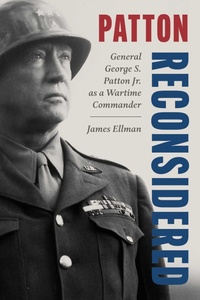
Patton Reconsidered
General George S. Patton Jr. as a Wartime Commander
Will be published approx. on 15. September 2026
308 pages
E-Book
978-0-8117-7809-1 (ISBN)
Description

This provocative reassessment challenges the myth of Patton and reveals the man?and general?behind the legend.
In MacArthur Reconsidered, which bestselling historian John C. McManus called ?a well-written, informed, lucidly argued critique,? James Ellman offered a challenging new look at General Douglas MacArthur. Now he turns his attention to another celebrated World War II commander, George S. Patton. Stripping away the polished helmet, ivory-handled pistols, and the practiced ?war face,? Ellman delivers a hard-hitting reappraisal of the controversial general's leadership and battlefield performance.
In keeping with his flair for the dramatic, Patton's successes in World War II tended toward the flashy. He took credit for turning around the American II Corps after the Battle of Kasserine Pass in North Africa, captured Palermo and won the race to Messina in Sicily, rushed across France after German lines ruptured during the Normandy campaign, relieved the 101st Airborne at Bastogne during the Battle of the Bulge, and led his beloved Third Army into Germany at war's end. Quite a record ? but how does it stand up?
According to Ellman, Patton was a one-dimensional tactician who was fortunate to often face a German Army largely in disarray. He was excellent on the offensive against an outnumbered, undersupplied foe but was average at best when confronting prepared, dug-in opposition. Other army commanders ? such as Courtney Hodges, William Simpson, and Alexander Patch ? achieved comparable results without Patton's personal and strategic shortcomings.
Patton was a flawed man on and off the battlefield, from repeatedly striking his own soldiers, to recurrent instances of insubordination, to delusions of reincarnation. His defects limited his range as a commander, caused significant friction in the Allied command structure and exposed serious limits in his judgement. His postwar political positions, including vehement anticommunism and a refusal to prosecute denazification in Germany, undermined United States policy, risked war with the Soviet Union, and made Patton a strategic liability. General Eisenhower ? who had tolerated Patton's missteps for so long and indeed valued his battlefield presence ? finally relieved Patton of high command.
Rigorously argued and sure to spark debate, Patton Reconsidered separates myth from reality and delivers a much-needed corrective to one of World War II's most enduring legends.
In MacArthur Reconsidered, which bestselling historian John C. McManus called ?a well-written, informed, lucidly argued critique,? James Ellman offered a challenging new look at General Douglas MacArthur. Now he turns his attention to another celebrated World War II commander, George S. Patton. Stripping away the polished helmet, ivory-handled pistols, and the practiced ?war face,? Ellman delivers a hard-hitting reappraisal of the controversial general's leadership and battlefield performance.
In keeping with his flair for the dramatic, Patton's successes in World War II tended toward the flashy. He took credit for turning around the American II Corps after the Battle of Kasserine Pass in North Africa, captured Palermo and won the race to Messina in Sicily, rushed across France after German lines ruptured during the Normandy campaign, relieved the 101st Airborne at Bastogne during the Battle of the Bulge, and led his beloved Third Army into Germany at war's end. Quite a record ? but how does it stand up?
According to Ellman, Patton was a one-dimensional tactician who was fortunate to often face a German Army largely in disarray. He was excellent on the offensive against an outnumbered, undersupplied foe but was average at best when confronting prepared, dug-in opposition. Other army commanders ? such as Courtney Hodges, William Simpson, and Alexander Patch ? achieved comparable results without Patton's personal and strategic shortcomings.
Patton was a flawed man on and off the battlefield, from repeatedly striking his own soldiers, to recurrent instances of insubordination, to delusions of reincarnation. His defects limited his range as a commander, caused significant friction in the Allied command structure and exposed serious limits in his judgement. His postwar political positions, including vehement anticommunism and a refusal to prosecute denazification in Germany, undermined United States policy, risked war with the Soviet Union, and made Patton a strategic liability. General Eisenhower ? who had tolerated Patton's missteps for so long and indeed valued his battlefield presence ? finally relieved Patton of high command.
Rigorously argued and sure to spark debate, Patton Reconsidered separates myth from reality and delivers a much-needed corrective to one of World War II's most enduring legends.
More details
Series
Language
English
Place of publication
PA
United States
File size
4,67 MB
ISBN-13
978-0-8117-7809-1 (9780811778091)
Copyright in bibliographic data and cover images is held by Nielsen Book Services Limited or by the publishers or by their respective licensors: all rights reserved.
Schweitzer Classification
Person
James Ellman holds degrees from Tufts and Harvard. He has also written Hitler's Great Gamble: A New Look at German Strategy, Operation Barbarossa, and the Axis Defeat in World War II (Stackpole, 2019), MacArthur Reconsidered: General Douglas MacArthur as a Wartime Commander (Stackpole, 2023), and Seeds of Victory: Defeat, Triumph, and the American Way of War (Stackpole, 2025). He lives in Hawaii.
Content
INTRODUCTION
United States
Chapter 1 ? BORN TO COMMAND
Africa
Chapter 2 ? TORCH
Chapter 3 ? TUNISIA
Sicily
Chapter 4 ? HUSKY
Chapter 5 ? THE RACE TO MESSINA
Western Europe
Chapter 6 ? QUICKSILVER
Chapter 7 ? BREAKOUT
Chapter 8 ? THE LORRAINE CAMPAIGN
Luxembourg
Chapter 9 THE BATTLE OF THE BULGE
Chapter 10 ? INTO GERMANY
Conclusion
United States
Chapter 1 ? BORN TO COMMAND
Africa
Chapter 2 ? TORCH
Chapter 3 ? TUNISIA
Sicily
Chapter 4 ? HUSKY
Chapter 5 ? THE RACE TO MESSINA
Western Europe
Chapter 6 ? QUICKSILVER
Chapter 7 ? BREAKOUT
Chapter 8 ? THE LORRAINE CAMPAIGN
Luxembourg
Chapter 9 THE BATTLE OF THE BULGE
Chapter 10 ? INTO GERMANY
Conclusion
