

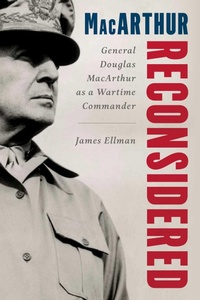
MacArthur Reconsidered
General Douglas MacArthur as a Wartime Commander
Published on 1. July 2023
288 pages
978-0-8117-7159-7 (ISBN)
Description

James Ellman digs deep, connects the dots, and concludes that General Douglas MacArthur was decidedly not a military genius.
One of America's most controversial generals, Douglas MacArthur's rise through the U.S. Army's ranks was meteoric. However, he did not lead large formations of men in combat until he assumed command of forces in the Philippines in 1941. When war commenced with the bombing of Pearl Harbor, MacArthur's performance on the battlefield was a failure: he underestimated the Japanese, and his poorly trained forces were outmaneuvered and outfought by a much smaller invading force. However, in what became a repeating hallmark of his career, he successfully portrayed his actions to much of the American people as brilliant and heroic regardless of victory or defeat. After fleeing to Australia, MacArthur famously announced, ?I will return,? and followed through on a quest to retake Manila regardless of its impact on Allied global strategy or its cost in American, Australian, and Filipino blood.
In his subsequent role as America's shogun in Tokyo, MacArthur was again surprised by an enemy he underestimated. The Korean War yielded his greatest victory, at Inchon, but also his greatest defeat, along the Yalu River. Unwilling to accept anything but complete victory, he openly defied President Truman: MacArthur fatally undermined chances for an early peace, planned to seed a great swath of enemy territory with radioactive cobalt, and attempted to widen a conflict which threatened to become a third world war. Raging against his subsequent firing, he only truly faded away after he was publicly criticized by a panoply of America's greatest WWII generals.
Today, MacArthur still polarizes. Many biographies agree he was a great and patriotic leader marred by a few failures. Ellman argues the opposite: MacArthur was a lackluster battlefield commander who suffered stunning defeats while undermining the command structure of our military.
One of America's most controversial generals, Douglas MacArthur's rise through the U.S. Army's ranks was meteoric. However, he did not lead large formations of men in combat until he assumed command of forces in the Philippines in 1941. When war commenced with the bombing of Pearl Harbor, MacArthur's performance on the battlefield was a failure: he underestimated the Japanese, and his poorly trained forces were outmaneuvered and outfought by a much smaller invading force. However, in what became a repeating hallmark of his career, he successfully portrayed his actions to much of the American people as brilliant and heroic regardless of victory or defeat. After fleeing to Australia, MacArthur famously announced, ?I will return,? and followed through on a quest to retake Manila regardless of its impact on Allied global strategy or its cost in American, Australian, and Filipino blood.
In his subsequent role as America's shogun in Tokyo, MacArthur was again surprised by an enemy he underestimated. The Korean War yielded his greatest victory, at Inchon, but also his greatest defeat, along the Yalu River. Unwilling to accept anything but complete victory, he openly defied President Truman: MacArthur fatally undermined chances for an early peace, planned to seed a great swath of enemy territory with radioactive cobalt, and attempted to widen a conflict which threatened to become a third world war. Raging against his subsequent firing, he only truly faded away after he was publicly criticized by a panoply of America's greatest WWII generals.
Today, MacArthur still polarizes. Many biographies agree he was a great and patriotic leader marred by a few failures. Ellman argues the opposite: MacArthur was a lackluster battlefield commander who suffered stunning defeats while undermining the command structure of our military.
More details
Series
Language
English
Place of publication
PA
United States
Illustrations
22 BW Photos, 15 Maps
File size
5,26 MB
ISBN-13
978-0-8117-7159-7 (9780811771597)
Copyright in bibliographic data and cover images is held by Nielsen Book Services Limited or by the publishers or by their respective licensors: all rights reserved.
Schweitzer Classification
Other editions
Additional editions
Book
07/2023
Stackpole Books
€28.50
Article not available at the moment
Person
James Ellman holds a bachelor's degree in history and economics from Tufts University and an MBA from Harvard. He has also written Hitler's Great Gamble: A New Look at German Strategy, Operation Barbarossa, and the Axis Defeat in World War II (Stackpole, 2019). He lives in Hawaii.
Content
- Intro
- Contents
- List of Abbreviations
- Introduction
- First Retreat The Fall of the Philippines
- Chapter 1 An Appointment with Destiny
- Chapter 2 The Southern Road to War
- Chapter 3 Air Raid on Pearl Harbor
- Chapter 4 Bataan
- First Advance The Hard Way Back
- Chapter 5 I Shall Return
- Chapter 6 The Offensive-Defensive
- Chapter 7 The Advance Accelerates
- Second Advance Honolulu to Tokyo
- Chapter 8 Leyte
- Chapter 9 Redemption and Destruction
- Second Retreat Seoul to the Naktong
- Chapter 10 A New War
- Last Advance Inchon to the Yalu
- Chapter 11 Inchon
- Chapter 12 To Destroy the Enemy
- Last Retreat From the Yalu to the Potomac
- Chapter 13 There Is No Substitute for Victory!
- Chapter 14 Stalemate
- Conclusion
- Notes
- Selected Bibliography
- index
- About the Author
