

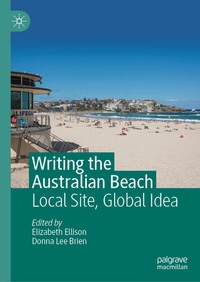
Writing the Australian Beach
Description

Writing the Australian Beach
is the first book in fifteen years to explore creative and cultural representations of this iconic landscape, and how writers and scholars have attempted to understand and depict it. Although the content chiefly focuses on Australia, the beach as both a location and idea resonates deeply with readers around the world. This edited collection includes three sections.
Forms of Beach Writing
examines the history of beach writing in Australia and in a number of forms: screenwriting, social media writing, and food writing. In turn,
Multiplicities of Australian Beach Writing
examines how forms of writing-poetry, travel writing, horror film, and memoir-engage with some specific beaches in Australia. And, finally,
Reading the Beach
as a Text considers how the beach itself functions in cultural narratives: how we walk the beach; the revealing story of beach soccer; and the design and use of ocean baths. Given its scope, the collection offers a unique resource for scholars of Australian culture and creative writing, and for all those interested in Australian beaches.
Reviews / Votes
"A fascinating and informative insight into the primacy of the beach in the modern Australian landscape" (Robert Drewe, Author of The Bodysurfers, The Bay of Contented Men, The Rip and The True Colour of the Sea, Australia)"A new volume on the beach and its unpredictability, on the multiplicity of its meanings, its uses, and its users, is timely . If the twentieth century stories about the Australian beach can be characterised by their hints of hedonism, exemplifications of community and family, and gestures toward natural and human threat, twenty-first century stories may afford something new: the opportunity to bring a fresh, and a more diverse, gaze onto the stories and myths of the beach." (Jen Webb, Distinguished Professor of Creative Practice, University of Canberra)
More details
Other editions
Additional editions
Persons
Donna Lee Brien is Professor of Creative Industries at Central Queensland University, Australia. With an internationally recognised research profile in non-fiction genres, including memoir and food writing, she has an extensive publishing history as both author and editor with leading publishers.
Content
Acknowledgements.- Preface.- Chapter 1 Writing the Australian beach: Texts, sites, events and people.- SECTION: Forms of beach writing.- Chapter 2 Surfers and lifeguards: A short history of beach writing in Australia.- Chapter 3 Screenwriting the beach: Conflict, catharsis and the character arc in Australian film.- Chapter 4 Instafamous: Social media influencers and Australian beaches.- Chapter 5 Food writing and the Australian beach: From leisure to labour.- SECTION: Multiplicities of Australian beach writing.- Chapter 6.- Exploring Australian coastal Gothic: Poetry and place.- Chapter 7 Writing Noosa's beach: Travellers' narratives and modernity.- Chapter 8 Beaches in Australian horror films: Sites of fear and retreat.- Chapter 9 Challenging conceptions of beach as paradise in fiction and memoir: The Gold Coast's bathing beauties.- SECTION: Reading the beach as text.- Chapter 10 Walking the Australian beach: Mapping footprints in the sand.- Chapter 11 Australian beach soccer: Tracing paradoxical narratives.- Chapter 12 Australia's ocean baths: Stories of design, aesthetics and swimming.- Chapter 13 Sculpture by the Sea: A visual essay.- Index.
