

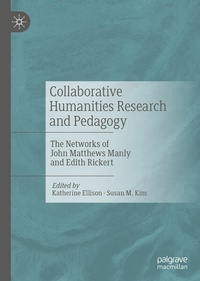
Collaborative Humanities Research and Pedagogy
Description

This edited collection of essays brings together scholars across disciplines who consider the collaborative work of John Matthews Manly and Edith Rickert, philologists, medievalists and early modernists, cryptologists, and education reformers. These pioneers crafted interdisciplinary partnerships as they modeled and advocated for cooperative alliances at every level of their work and in all their academic relationships. Their extensive network of intellectual partnerships made possible groundbreaking projects, from the eight-volume
Text of the Canterbury Tales
(1940) to the deciphering of the Waberski Cipher, yet, except for their Chaucer work, their many other accomplishments have received little attention.
Collaborative Humanities Research and Pedagogy
not only surveys the rich range of their work but also emphasizes the transformative intellectual and pedagogical benefits of collaboration.
Reviews / Votes
"It's not often that the tireless work of editors, archivists and educators is treated with the same scholarly level of appreciation typically allotted to writers and poets. In the case of Manly and Rickert such attention is richly deserved, and this collection, edited by Ellison and Kim, brings a range of perspectives to bear upon their storied careers, producing a range of valuable new insights. As an overview of Manly and Rickert's valuable contributions, this book recommends itself to any university with provision in early modern literary studies. For those working in the area, valuable and unexpected connections are made throughout that will re-enliven The Text of the Canterbury Tales , and the pair's other contributions, adding new levels of depth and appreciation to these important texts." (Dr Joseph Darlington, Futureworks Media School)More details
Other editions
Additional editions
Persons
Katherine Ellison is Professor of English at Illinois State University, USA. She is author of A Cultural History of Early Modern English Cryptography Manuals (2017) and Fatal News: Reading and Information Overload in Early Eighteenth-Century Literature (2014),and co-editor of A Material History of Medieval and Early Modern Ciphers (2020) and Topographies of the Imagination: New Approaches to Defoe (2017). Ellison has published widely on cryptology and its intersections with the humanities.
Susan M. Kim is Professor of English at Illinois State University, USA. She is co-editor of A Material History of Medieval and Early Modern Ciphers (2020) and co-author of This Language, A River: A History of English (2017) and Inconceivable Beasts: The Wonders of the East in the Beowulf Manuscript (2013), winner of the International Society of Anglo-Saxonists biennial Best Book award (2015). Kim has published widely on Old English literature and the history of English.
Content
