

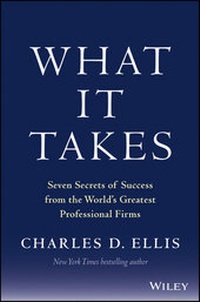
What It Takes
Description

Reviews / Votes
"This is the best book about corporate leadership thatI've ever read. Charley Ellis really knows what he's talkingabout."--John Whitehead, former Co-Chairman,Goldman Sachs & Co., former Deputy Secretary of State "Clear, crisp, and actionable insights on leadership,which can only come from a well experienced scholar andpractitioner like Charley Ellis in his usual wise simple andriveting story-telling style. And yes, simple doesn't meaneasy."--Abdullatif A. Al-Othman, Governor, SaudiArabia General Investment Authority "What It Takes is Ellis' finest work onorganizational excellence. He has distilled the essentialprinciples of organizational excellence, illustrating them withpotent examples and memorable anecdotes. His intimate knowledge ofthe organizations, deepened by 300 interviewers with insiders,imparts powerful insights and lessons for those aspiring to buildand sustain great and enduring organizations."--NgKok Song, Chief Investment Officer, Government of SingaporeInvestment Corporation "Charley Ellis has taken an incisive look under the hoodof some of the world's greatest professional organizations and hasput his perceptive finger on not only what has made them succeedbut has also led them to endure."--D. RonaldDaniel, former Managing Partner, McKinsey & Company "Once, again, Charley Ellis has delved into the mysteriesof leadership with clarity and insight."--JimRothenberg, Chairman, Capital Research and ManagementCompany "Charley Ellis looks hard at how great firmssucceed in fields as different as law, consulting and medicine . .. and finds what it takes that they have incommon."--Jeff Bewkes, CEO, Time Warner "Charley Ellis takes us through a series of master classeson corporate leadership. This is an outstanding contributionto help us understand that which divides winners fromlosers."--Lord Myners, former UK TreasuryMinister "A very interesting study of the similarities anddifferences in the leadership of five very different professionalfirms. Should be required reading for other firms in thoseprofessions."--Samuel C. Butler, former PresidingPartner, Cravath, Swaine & Moore "What It Takes is a clear-eyed view into thecomplexities of building and sustaining great organizations.Charley Ellis' artful storytelling imparts insights thatwould benefit anyone aspiring to thoughtful, effective leadershipthroughout markets and histories."--Lei Zhang,Founder and CEO, Hillhouse Capital Management Group "I cannot imagine anyone better qualified than Charley Ellisto analyze, identify and describe those characteristics whichseparate outstandingly successful professional firms from themerely very good ones. This fascinating book should berecommended reading for anyone wishing to become a leader in any ofthe professions described and indeed for anyone with an ambition tosucceed in business."--Peter Stormonth Darling,former Chairman, Mercury Asset Management "Of course everyone knows of the five great institutionswhich are the subject of Charley Ellis' latest book. But what is itthat made them outstanding? Charley in this searching andunsentimental if admiring analysis provides answers: A good ideatransformed into a novel business model, passion, commitment, goodjudgment particularly in the early years and great people. AnotherCharley Ellis book to treasure."--Sir WinfriedBischoff, Chairman, Lloyds Banking GroupMore details
Other editions
Additional editions
Person
Content
Chapter 2
Culture
How We Do Things around Here
All strong organizations, from global religions and major nations to street-corner gangs, develop norms of behavior, beliefs, and values that comprise their cultures. Culture translates mission into daily operating practice and bonds group members together. For an organization to rise to greatness, and particularly to sustain excellence, its internal culture must be complementary to its mission or purpose.
A vibrant culture is expressed in consistent standards of behavior and in decisions made every day by many different people in many different situations. Just as character eventually dominates physical strength in people, culture will eventually prevail in organizations. What appears soft in the short run is strong in the long run; what appears hard often proves brittle and transient. Group members reproduce their firm’s values and expected behavior almost instinctively, and teach others. New people, to be accepted, must demonstrate that they are committed to the values and the expected behavior. In time, as the firm’s cultural norms become part of them, they become recognized as “culture carriers.”
Sustained commitment to excellence—particularly in ethics—attracts, keeps, and motivates exceptionally talented people who care intensely about achieving professional excellence at a level other professionals admire. Robust ethics and consistent care for clients are central to the cultural values of every great professional firm. They express themselves in policies and practices, in language and symbols, and in commitments of individuals to each other. For those who belong in the leading firms, the conventional “sacrifices” of long, intense hours and limited recreation are not really sacrifices at all. The true sacrifice would be to spend their careers in a less-than-best firm. As Aristotle said, “We are what we repeatedly do. Excellence, then, is not an act, but a habit.”
The people at great firms work harder than their competitors—both longer, more demanding days and more days and nights each week. While producing more, they also insist on producing at the highest quality. They take pride and find great meaning in what they and their firm can achieve for clients. Leaders need to send consistent messages about what does or does not fit the cultural ideal. It takes time and memorable events to accumulate the experience through which individuals learn to understand, value, and eventually “own” an organization’s culture. Strong cultures are exceedingly difficult to replicate. They can only develop over time through robust leadership and repeated successes. That’s why if a superior professional firm begins to lose its competitive edge, some of the best prospective clients will go elsewhere, and then some of the most promising young professionals will, too. If such slippage is not promptly reversed, it will accelerate, as we will see it fatally did at Arthur Andersen & Co.
Each firm’s culture is sui generis, but all great firms are remarkably similar in their demanding core values: intensity of commitment, persistent drive for improvement, unusually high quality standards, personal modesty, devotion to teamwork, long-term focus on serving clients well, ruthless objectivity, absolute integrity, and an unrelenting determination to excel. Of course, all this is a lot to ask. That’s why only those who know that these daunting commitments are right for them can be sure that being part of a great firm is what they really want—and need.
Every exemplary firm’s culture has many sources, particularly various leaders’ initiatives, failures, and successes, and the competitive environment. The Mayo Clinic’s culture of professionalism, consensus, egalitarianism, and idealism is the confluence of the personal values of the doctors Mayo with the conservatism and traditional thoughtfulness toward others of Upper Midwest Lutheranism. Add to these “Minnesota nice”—the plain qualities of service, thrift, modesty, and respect for individuals characteristic of the region’s Scandinavian, Swiss, and German farmers. Blend in the confident devotion to service of the Sisters of St. Francis, who have been involved in the clinic’s main hospital since its founding. Combine all this with the values of medicine as a calling and you have the necessary ingredients of a great culture.
The doctors Mayo—father and two sons—were the leaders in developing the culture in the late nineteenth century. As Dr. Will Mayo explained,
Every man has some inspiration for good in his life. With my brother and me, it came from our father. He taught us that any man who has physical strength, intellectual capacity, or unusual opportunity holds such endowments in trust to do with them for others in proportion to his gifts. We want the money we receive to go back to the people from whom it came and we think we can best give it back to them through medical education.
At Mayo Clinic, the culture is so strong and so important to so many people at all levels that anyone joining must quickly learn to accept its dominance. As old hands will advise, “Mayo does not change for you.” Widely held pride in the institution is balanced by rigorous self-criticism. Mayo people are hard on themselves and always on guard for possible shortcomings. People who are not comfortable with the Mayo culture usually leave within a few years. Those who stay for five years usually stay for life.
The Mayo adventure began in 1845 when, with no farewells to family or friends, 26-year-old William Worrall Mayo decided to leave Manchester, England, and try America. He had studied Latin, Greek, and chemistry and got his first job in New York City as a chemist at Bellevue Hospital. After leaving Bellevue for one year of study at Indiana Medical College, Mayo got his degree and in 1854 went west to St. Paul, then a town of only 4,000 inhabitants where citizens still worried, with good reason, about attacks by Indians. Moving on to Rochester, Mayo, known as “the little doctor” because he was only five-foot-four, made a living by combining medicine, farming, and local political office, including several years as a state senator. Keen on becoming a surgeon, he went back to New York City for several months in 1869 to study surgery and gynecology.
Medicine was far from today’s sophistication. In those days, for good reason, most sick people went home; only poor people went to hospitals. The stethoscope was novel, and the clinical thermometer had not yet been invented. Microscopes were first used in 1870, and even 20 years later most physicians had never seen one. Few diseases could be specified. Causes were largely unknown. Surgery was for emergencies only. But medicine and surgery, in which the Mayos would specialize, were going through several simultaneous revolutions. Anesthesia was new, untried, and little used, but would later give surgeons enough time to complete the complex procedures that could save lives.
Returning to Rochester, Mayo built a sizable practice with his wife’s active help. As boys, both Will and Charlie worked as prescription clerks in the drugstore below the Little Doctor’s office. Later they went on rounds with their father, learned to use his microscope, and began learning a doctor’s basic skills. Still later, they advanced to preparing sutures for surgeries. The boys learned the principles and ethics of physicians: The life of a doctor must be one of service; he must respond to every call whether or not he would ever get paid.
On a hot August day in 1883, a powerful tornado destroyed much of Rochester, killed several people, and hurt dozens. When found in the rubble, the seriously wounded were taken to hotels and offices for emergency care. Forty were taken to the convent of the Sisters of St. Francis where the Mayos and other doctors worked through the night. When nursing was needed longer than the volunteers could continue working, the 24 Sisters of St. Francis took on that responsibility even though their calling was teaching, not nursing.
Based on this dramatic experience, Mother Alfred Moes had an idea: Build a hospital in Rochester. She went to Dr. Mayo, but he said, “No. Rochester is too small and a hospital would cost too much.”
“How much?” asked Mother Alfred.
“Forty thousand dollars!”
She quickly countered, “Just promise me to take charge of it and we will set the building before you at once”—even if his cost estimate of $40,000 was accurate.
Over five years of spartan living while giving sewing, knitting, and piano lessons, the sisters saved $25,000 and bought land for another $2,200. They presented the $25,000 to the Little Doctor, who said $25,000 would pay not only for a hospital but for “the best that money could buy,” and went East to study hospital design. Two years later, the first patients were admitted to the new 27-bed hospital. From its beginning, the hospital admitted both paying and charity patients of any race or creed. Those “everyman” values were not everyone’s: Religious prejudice against Catholics was surging in the upper Midwest, and many local doctors refused to use the sisters’ new hospital. Mortality rates at the hospital were rising—apparently because local doctors were sending only their riskiest patients to Saint Marys Hospital—so the sisters decided to require a Mayo examination before admission. About the same time, the Mayo brothers decided to use only Saint Marys and told their patients to pay the hospital first and...
