

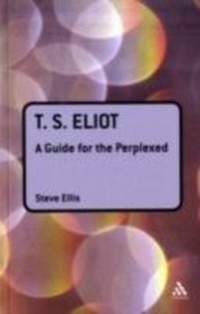
T. S. Eliot: A Guide for the Perplexed
A Guide for the Perplexed
1st Edition
Published on 25. June 2009
180 pages
978-1-4411-0849-4 (ISBN)
Description

T. S. Eliot is one of the most celebrated twentieth-century poets and one whose work is practically synonymous with perplexity. Eliot is perceived as extremely challenging due to the multi-lingual references and fragmentation we find in his poetry and his recurring literary allusions to writers including Dante, Shakespeare, Marvell, Baudelaire, and Conrad.
There is an additional difficulty for today's readers that Eliot probably didn't envisage: the widespread unfamiliarity with the Christianity that his work is steeped in. Steve Ellis introduces Eliot's work by using his extensive prose writings to illuminate the poetry. As a major critic, as well as poet, Eliot was highly conscious of the challenges his poetry set, of its relation to and difference from the work of previous poets, and of the ways in which the activity of reading was problematized by his work.
There is an additional difficulty for today's readers that Eliot probably didn't envisage: the widespread unfamiliarity with the Christianity that his work is steeped in. Steve Ellis introduces Eliot's work by using his extensive prose writings to illuminate the poetry. As a major critic, as well as poet, Eliot was highly conscious of the challenges his poetry set, of its relation to and difference from the work of previous poets, and of the ways in which the activity of reading was problematized by his work.
Reviews / Votes
"I can think of few critics better qualified than Steve Ellis to interpret T. S. Eliot to a new generation of readers. This incisive new account of all Eliot's major writings, in both verse and prose, not only provides a comprehensive survey of the best previous criticism; it also offers Ellis's own distinctive insights into Eliot's ouevre, drawing on an unrivalled acquaintance with Europe's literary and religious traditions to situate him within the contexts, of thought, values, ideas and form, which underpin and articulate the writings of this elusive, indispensable and endlessly rewarding poet." - Stan Smith, Research Professor in Literary Studies, Nottingham Trent University, UK "Among the innumerable Eliot guides on the market, this is the one to start with. Avoiding the all too common approaches to this notoriously perplexing poet - allusion hunting and step-by-step explication - Steve Ellis unlocks the poetry with Eliot's own extensive prose writings as his main key. The result is illuminating for beginner and Eliot aficionado alike. The binary opposites at the centre of Eliot's oeuvre, tradition versus innovation, conservative versus radical, 'ideal' versus actuality, belief versus scepticism, are addressed with freshness and clarity. Ellis traces both the continuities and contrasts running through Eliot's poetic development. He deals deftly with important influences, Laforgue, Baudelaire, Dante, in accounts of the poetry full of original insight and argument, while efficiently familiarising newcomers with critical cruxes and contentious issues (misogyny, anti-semitism). He has particularly perceptive things to say about the development of Eliot's poetic style, from the 'witty' to the deliberate, from the self-possessed to the ascetic. There are many other things to admire in this guide, but in particular all Eliot scholars will henceforth need to take account of Ellis's persuasive argument about the thorny issue of the relationship between The Waste Land and its 'Notes'." - Dr Gareth Reeves, Durham University, UK ... offers a fresh approach to writing an introductory guide. Instead of a sequential account of Eliot's life and work, [Ellis] reads the poetry through Eliot's prose.More details
Series
Edition
1. Auflage
Language
English
Place of publication
New York
United States
ISBN-13
978-1-4411-0849-4 (9781441108494)
Copyright in bibliographic data and cover images is held by Nielsen Book Services Limited or by the publishers or by their respective licensors: all rights reserved.
Schweitzer Classification
Other editions
Additional editions
Book
06/2009
Continuum International Publishing Group Ltd.
€137.50
Shipment within 3-4 weeks
Book
06/2009
Continuum International Publishing Group Ltd.
€29.00
Shipment within 3-4 weeks
Person
Steve Ellis is Professor of English at the University of Birmingham, UK and is also a poet and translator. His publications include The English Eliot (Routledge, 1991), Chaucer: An Oxford Guide (OUP, 2005) and Virginia Woolf and the Victorians (CUP 2007).
Content
Abbreviations and editions of Eliot's works used in the text
Introduction: Eliot's poetry and the use of Eliot's criticism
1. The early poetry and prose
2. From The Waste Land to 'The Hollow Men'
3. 'Ash-Wednesday' and the writing of the 1930s
4. Four Quartets
Conclusion: new Eliots for old?
Further Reading
Notes
Bibliography
Index
Introduction: Eliot's poetry and the use of Eliot's criticism
1. The early poetry and prose
2. From The Waste Land to 'The Hollow Men'
3. 'Ash-Wednesday' and the writing of the 1930s
4. Four Quartets
Conclusion: new Eliots for old?
Further Reading
Notes
Bibliography
Index
