

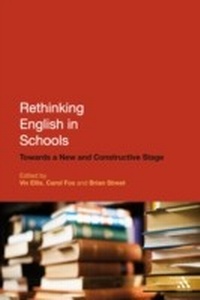
Rethinking English in Schools
Towards a New and Constructive Stage
1st Edition
Published on 20. November 2007
264 pages
978-1-4411-9987-4 (ISBN)
Description

Why should young people study a subject called English?
This question lies at the heart of this fascinating monograph, which brings together the diverse perspectives of many leading thinkers about English and literacy education.
This meticulously researched and well-written collection takes as its starting point the importance of the history of the subject in the formation of its constitution and its boundaries. First and foremost, it proposes that questions of aims and values have informed these choices. Equally, it suggests that returning to these educational questions helps us to understand curriculum and pedagogy in complex ways that a simple focus on content and methods neglects. Curriculum and pedagogy bring learners, teachers, institutions and the wider society into the debate.
This question lies at the heart of this fascinating monograph, which brings together the diverse perspectives of many leading thinkers about English and literacy education.
This meticulously researched and well-written collection takes as its starting point the importance of the history of the subject in the formation of its constitution and its boundaries. First and foremost, it proposes that questions of aims and values have informed these choices. Equally, it suggests that returning to these educational questions helps us to understand curriculum and pedagogy in complex ways that a simple focus on content and methods neglects. Curriculum and pedagogy bring learners, teachers, institutions and the wider society into the debate.
Reviews / Votes
A timely book about English and English teaching by writers whose professional interests keep them in touch with the English children learn to speak and the school English that comes to them as an educational package. Their central argument is that 'English in school - as an intellectual project - needs to be rethought and renewed in a 'constructive age of development' in the field of English studies, which includes contemporary awareness of the multimodality of language in the lives of children. The relevance of the matters discussed here extends to all who have comunication responsbilities with the young. 'Rethinking' will keep this book well to the fore. This book addresses the issues of why and how to study a subject called English. Although its assumed audience appears to be teachers of English in the UK for whom the National Curriculum is relevant, its thoughtful discussion addresses the concerns of teachers of English throughout the world. Of particular importance are the multiple perspectives it brings to the discussion. The teaching of English is shaped by history and politics. That is, the imperialist reality of multiple languages shapes the teaching of English. It is also shaped by teaching literatures. Ideally, teaching English reflects Vygotskyan theory, transactional theory, dialogic theory, and existentialism. Primarily, however, teaching English is a way of helping students make sense of their lives; therefore, in the modern classroom there is room for comics and graphics as well as traditional aesthetics. Of major importance is the inclusion of sociolinguistics in this discussion--the recognition that monolingualism in English is a not a universal, and that societal bilingualism and multilingualism are the reality for students in much of the world. This book is highly recommended for teachers in training, as well as experienced teachers. Summing Up: Highly recommended. All undergraduate and research collections. A timely and proactive reminder that critical analysis of English (and literacy) teaching, the "long tradition of socially critical work in English Education" referred by its publishers, has been patchy of late...the book is a challenge for us as an association to extend the writers' analyses here to a specific part of the 'field': primary literacy. With eloquence, intelligence and collective wisdom, this excellent collection of essays sets new directions and agendas for English Education.More details
Edition
1. Auflage
Language
English
Place of publication
New York
United States
ISBN-13
978-1-4411-9987-4 (9781441199874)
Copyright in bibliographic data and cover images is held by Nielsen Book Services Limited or by the publishers or by their respective licensors: all rights reserved.
Schweitzer Classification
Other editions
Additional editions
Viv Ellis | Carol Fox | Brian Street
Rethinking English in Schools
Towards a New and Constructive Stage
Book
12/2009
Continuum International Publishing Group Ltd.
€84.20
Shipment within 15-20 days
Persons
Brian Street is Professor of Language in Education at King's College, London, UK, and Visiting Professor of Education at the University of Pennsylvania, USA.
Carol Fox was formerly Reader in English Education at the University of Brighton, UK. Her research on young children's oral storytelling and the literature of war and peace in education has been widely influential.
Viv Ellis is Professor and Dean of the Faculty of Education at Monash University, Australia.
Carol Fox was formerly Reader in English Education at the University of Brighton, UK. Her research on young children's oral storytelling and the literature of war and peace in education has been widely influential.
Viv Ellis is Professor and Dean of the Faculty of Education at Monash University, Australia.
Content
Acknowledgements Chapter 1 Why English? Rethinking The School Subject (Viv Ellis, With Carol Fox And Brian Street) Section 1: How History And Politics Have Shaped English Teaching Chapter 2 The Picture Of Development In Vygotskyan Theory: Renewing The Intellectual Project Of English (Tony Burgess) Chapter 3 Deep Winters, Invincible Summers: Teaching English For Existential Purposes (Bob Fecho, With Kristi Amatucci; Sarah Skinner) Chapter 4 English In The History Of Imperialism: Teaching The Empire How To Read (Patrick Walsh) Chapter 5 - Individual, Community And Society: A Response To Section 1 (Janet Laugharne) Section 2: Culture As A Verb: Teaching Literatures Chapter 6 - How Critical Is The Aesthetic? The Role Of Literature In English (Ray Misson And Wendy Morgan) Chapter 7 - History, War And Politics: Taking 'Comix' Seriously (Carol Fox) Chapter 8 - 'The Uncreating Word': Some Ways Not To Teach English (Joy Alexander) Chapter 9 - Refreshing The Aesthetic: A Response To Section 2 (Sue Dymoke) Section 3: Language(S), Multiple Literacies And The Question Of English Chapter 10 The New Literacy Studies And Multimodality: Implications For The Subject And The Language 'English' (Brian Street) Chapter 11 Resisting Monolingualism In 'English': Reading And Writing The Politics Of Language (Bruce Horner And Min-Zhan Lu) Chapter 12 English As A Multilingual Subject: Theoretical And Research Perspectives (Janina Brutt-Griffler And James Collins) Chapter 13 The Multiple Languages And Literacies Of English: A Response To Section 3 (Suzanne M. Miller) Chapter 14 More Than 'Soldiering On? (Viv Ellis) Afterword by Shirley Brice Heath
