

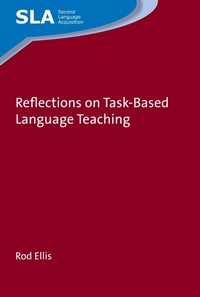
Reflections on Task-Based Language Teaching
Published on 18. June 2018
320 pages
978-1-78892-015-5 (ISBN)
Description

Task-based language teaching is now a well-established pedagogic approach but problematic issues remain, such as whether it is appropriate for all learners and in all instructional contexts. This book draws on the author's experience of working with teachers, together with his knowledge of relevant research and theory, to examine the key issues. It proposes flexible ways in which tasks can be designed and implemented in the language classroom to address the problems that teachers often face with task-based language teaching. It will appeal to researchers and teachers who are interested in task-based language teaching and the practical and theoretical issues involved. It will also be of interest to students and researchers working in the areas of applied linguistics, TESOL and second language acquisition.
Reviews / Votes
Rod Ellis has written (yet another) agenda-setting book, this time charting a journey through key issues in task-based language teaching. This is a must-read for researchers committed to the pedagogic relevance of their work, and for language educators in search of a deeper understanding of task-based research and pedagogy. * Jonathan Newton, Victoria University of Wellington, New Zealand * This comprehensive yet personal book will be invaluable reading for very diverse audiences. Synthesizing a lifetime of engagement with language education and tasks, Rod Ellis proposes an options-based approach that can be flexibly adapted across geographies and masterfully re-examines the quandaries cognitive and social researchers investigate through the questions teachers ask. * Lourdes Ortega, Georgetown University, USA * This review has recommended Reflections on Task-Based Language Teaching in particular to teacher educators and to researchers. However, classroom teachersat whatever stage of their career will find plenty to guide them in their teaching.
Chapter 5, titled "Preparing learners to perform tasks," is one good example. This is a book which should sell well and which will probably give fresh ideas to classroom teachers, whether or not they are also researchers. -- Marilyn Lewis, University of Auckland, New Zealand * TESOL Theory and Praxis, Volume 4 Issue 1 * [This book] is an honour to the work of one of the most esteemed scholars in TBLT. -- Melissa Baralt, Florida International University, USA * ELT Journal, Volume 73, Issue 2, April 2019 * [This book] comprehensively examines the theoretical and pedagogic aspects of task-based language teaching (TBLT), one of the long-standing topics in instructed SLA, and offers insights into TBLT as an approach to second language teaching. Ellis' (2003) previous book, Task-based Language Learning and Teaching, focuses on research and theories underlying TBLT. The current book complements his previous work by shedding more light on pedagogic issues related to TBLT. -- Taichi Yamashita and Long He, Iowa State University, USA * Applied Linguistics 2019: 1-5 *
More details
Series
Language
English
Place of publication
Bristol
United Kingdom
Target group
College/higher education
ISBN-13
978-1-78892-015-5 (9781788920155)
Copyright in bibliographic data and cover images is held by Nielsen Book Services Limited or by the publishers or by their respective licensors: all rights reserved.
Schweitzer Classification
Other editions
Additional editions
Book
06/2018
Multilingual Matters
€56.40
Shipment within 3-4 weeks
Person
Rod Ellis is Research Professor in the School of Education, Curtin University, Australia, Emeritus Distinguished Professor, University of Auckland, New Zealand and a Visiting Professor at Shanghai International Studies University. He is also an Appointed Fellow of the Royal Society of New Zealand. He has researched and published extensively in the fields of second language acquisition, language teaching and teacher education.
Content
Acknowledgements
Preface
Section 1: Introduction
Chapter 1: A Brief History of Task-based Language Teaching and Research
Chapter 2: Task-based Research and Language Pedagogy
Section 2: Researching Task-based Teaching
Chapter 3: Non-Reciprocal Tasks, Comprehension and Second Language Acquisition
Chapter 4: Focus on Form: A Critical Review
Chapter 5: Preparing Learners to Perform Tasks
Chapter 6: Is there a Role for Explicit Instruction in Task-based Language Teaching?
Chapter 7: Measuring Second Language Learners' Performance of Tasks
Section 3: Task-based Language Pedagogy
Chapter 8: Task-based Language Teaching: Sorting out the Misunderstandings
Chapter 9: Moving Task-based Language Teaching Forward
Chapter 10: Towards a Modular Curriculum
Chapter 11: An Options-based Approach to doing Task-based Language Teaching
Chapter 12: Teachers Evaluating Tasks
Section 4: Conclusion
Chapter 13: Key Issues in Task-based Research and Pedagogy
Preface
Section 1: Introduction
Chapter 1: A Brief History of Task-based Language Teaching and Research
Chapter 2: Task-based Research and Language Pedagogy
Section 2: Researching Task-based Teaching
Chapter 3: Non-Reciprocal Tasks, Comprehension and Second Language Acquisition
Chapter 4: Focus on Form: A Critical Review
Chapter 5: Preparing Learners to Perform Tasks
Chapter 6: Is there a Role for Explicit Instruction in Task-based Language Teaching?
Chapter 7: Measuring Second Language Learners' Performance of Tasks
Section 3: Task-based Language Pedagogy
Chapter 8: Task-based Language Teaching: Sorting out the Misunderstandings
Chapter 9: Moving Task-based Language Teaching Forward
Chapter 10: Towards a Modular Curriculum
Chapter 11: An Options-based Approach to doing Task-based Language Teaching
Chapter 12: Teachers Evaluating Tasks
Section 4: Conclusion
Chapter 13: Key Issues in Task-based Research and Pedagogy
