

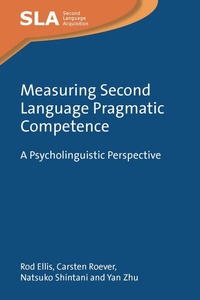
Measuring Second Language Pragmatic Competence
A Psycholinguistic Perspective
Published on 12. March 2024
336 pages
978-1-80041-775-5 (ISBN)
Description

Taking a psycholinguistic perspective, this book investigates how second language (L2) learners' pragmatic abilities in English can be measured. It complements and extends earlier work on the testing of implicit and explicit grammar. The authors present a set of tests they developed using both well-established methods of measuring pragmatic knowledge (e.g. a Metapragmatic Knowledge Test and role plays) and more original tests (e.g. an Irony Test and an Elicited Imitation Test). They explain the development of the tests and report the results of their work with native speakers of English and Chinese and Japanese L2 learners. A confirmatory factor analysis lends support to the theoretical basis of the tests. The authors also report studies that explored the use of the tests to investigate L2 linguistic proficiency, study abroad and formal instruction. In concluding, they consider the strengths and limitations of the tests and propose some directions for future research.
Reviews / Votes
Theoretically robust and eminently practical, this book describes the process of developing and validating an assessment battery covering three areas of pragmatics - speech acts, implicature and discourse. Adopting the theory of explicit and implicit knowledge, the book uniquely situates pragmatics assessment at the intersection of SLA and psycholinguistics. This is an invaluable resource for researchers and teachers seeking innovative yet thorough ways of assessing pragmatic competence. * Naoko Taguchi, Northern Arizona University, USA * In another tour de force, Rod Ellis and his stellar group of colleagues have pushed the boundaries of existing instructed second language acquisition knowledge, this time regarding the measurement of implicit and explicit second language (L2) pragmatic processing, with implications for the development of L2 pragmatic abilities in instructed contexts. Like Ellis and colleagues' previous work, this volume provides a rich research agenda that will keep pragmatics researchers busy for years to come. * Shawn Loewen, Michigan State University, USA * ...the book presents an innovative test battery for measuring L2 pragmatic competence, which incorporates theimplicit/explicit distinction of pragmatics processing, a psycholinguistic perspective often overlooked in pragmatic assessment. The novel test designs and scoring systems are applicable to L2 pragmatics research and teaching in general. Language teachers can find inspiration in the test design and scoring methods and apply them to diagnostic and instructional purposes for various aspects of L2 pragmatic competence. L2 pragmatic researchers can select and improve specific tests from the battery for their own research purposes. More importantly, the comprehensive discussion of knowledge versus processing in pragmatics assessment as well as the centrality of processing efficiency in pragmatics test design will inspire researchers to explore different options for measuring pragmatic competence. * Meng Zhou and Yunwen Su, University of Illinois Urbana-Champaign, USA, Journal of Pragmatics 230, 2024 *
More details
Series
Language
English
Place of publication
Bristol
United Kingdom
Target group
Professional and scholarly
Product notice
Reflowable
File size
5,72 MB
ISBN-13
978-1-80041-775-5 (9781800417755)
Copyright in bibliographic data and cover images is held by Nielsen Book Services Limited or by the publishers or by their respective licensors: all rights reserved.
Schweitzer Classification
Other editions
Additional editions
Rod Ellis | Carsten Roever | Natsuko Shintani
Measuring Second Language Pragmatic Competence
A Psycholinguistic Perspective
Book
03/2024
Multilingual Matters
€56.30
Shipment within 10-20 days
Persons
Rod Ellis is an applied linguist who has published widely on second language acquisition and task-based language learning. He is currently a Distinguished Research Professor in the School of Education, Curtin University, Australia and an elected fellow of the Royal Society of New Zealand. He is a past recipient of the Kenneth W. Mildenberger and Duke of Edinburgh prizes.
Carsten Roever is Professor in Applied Linguistics at the University of Melbourne, Australia. His research interests include language testing, second language acquisition and pragmatics with a particular focus on learning and assessment of interactional competence in a second language.
Natsuko Shintani is Professor in the Faculty of Foreign Language Studies, Kansai University, Japan. Her research interests encompass the roles of explicit instruction in language learning, second language writing and task-based language teaching.
Yan Zhu is Associate Professor at the College of Foreign Languages and Literature, Fudan University, China. Her research focuses on curriculum innovation, task-based language teaching and teacher education.
Carsten Roever is Professor in Applied Linguistics at the University of Melbourne, Australia. His research interests include language testing, second language acquisition and pragmatics with a particular focus on learning and assessment of interactional competence in a second language.
Natsuko Shintani is Professor in the Faculty of Foreign Language Studies, Kansai University, Japan. Her research interests encompass the roles of explicit instruction in language learning, second language writing and task-based language teaching.
Yan Zhu is Associate Professor at the College of Foreign Languages and Literature, Fudan University, China. Her research focuses on curriculum innovation, task-based language teaching and teacher education.
Content
About the Authors
Acknowledgements
Preface
Part 1: Background
Chapter 1. Carsten Roever and Rod Ellis: Tests of L2 Pragmatics: What Do They Assess?
Part 2: The Development of the Tests
Chapter 2. Rod Ellis, Natsuko Shintani and Yan Zhu: Introducing the Project: The Test Battery
Chapter 3. Rod Ellis, Yan Zhu and Natsuko Shintani: The Metapragmatic Knowledge Test: A Comparative Study of Chinese and Japanese Learners
Chapter 4. Rod Ellis and Natsuko Shintani: Evaluating the Social Variables Test
Chapter 5. Rod Ellis, Yan Zhu, Natsuko Shintani and Carsten Roever: The Irony Test: A Study of Chinese Learners' Ability to Comprehend Irony
Chapter 6. Rod Ellis, Yan Zhu, Natsuko Shintani: The Elicited Imitation Test: An Exploratory Study of L2 Learners' Knowledge of Hedging
Chapter 7. Rod Ellis and Natsuko Shintani: The Monologic Role Play: A Genre-Based Approach to Measuring Pragmatic Ability
Chapter 8. Rod Ellis, Yan Zhu and Natsuko Shintani: The Dialogic Role Play: A Discourse-Analytic Approach to Measuring Pragmatic Ability
Chapter 9. Rod Ellis, Natsuko Shintani and Yan Zhu: Assessing Implicit and Explicit Pragmatic Competence: A Confirmatory Factor Analysis
Part 3: Mediating Factors
Chapter 10. Carsten Roever, Natsuko Shintani, Yan Zhu and Rod Ellis: Proficiency as an Individual Difference Variable
Chapter 11. Natsuko Shintani and Rod Ellis: The Roles of Language Proficiency and Study Abroad in Japanese Students' Receptive Pragmatic Competence
Chapter 12. Natsuko Shintani and Rod Ellis: The Effect of Digital Explicit-Deductive Instruction on the Development of Explicit and Implicit Pragmatic Abilities
Part 4: Conclusion
Chapter 13. Rod Ellis: Retrospect and Prospect
Appendices
References
Index
Acknowledgements
Preface
Part 1: Background
Chapter 1. Carsten Roever and Rod Ellis: Tests of L2 Pragmatics: What Do They Assess?
Part 2: The Development of the Tests
Chapter 2. Rod Ellis, Natsuko Shintani and Yan Zhu: Introducing the Project: The Test Battery
Chapter 3. Rod Ellis, Yan Zhu and Natsuko Shintani: The Metapragmatic Knowledge Test: A Comparative Study of Chinese and Japanese Learners
Chapter 4. Rod Ellis and Natsuko Shintani: Evaluating the Social Variables Test
Chapter 5. Rod Ellis, Yan Zhu, Natsuko Shintani and Carsten Roever: The Irony Test: A Study of Chinese Learners' Ability to Comprehend Irony
Chapter 6. Rod Ellis, Yan Zhu, Natsuko Shintani: The Elicited Imitation Test: An Exploratory Study of L2 Learners' Knowledge of Hedging
Chapter 7. Rod Ellis and Natsuko Shintani: The Monologic Role Play: A Genre-Based Approach to Measuring Pragmatic Ability
Chapter 8. Rod Ellis, Yan Zhu and Natsuko Shintani: The Dialogic Role Play: A Discourse-Analytic Approach to Measuring Pragmatic Ability
Chapter 9. Rod Ellis, Natsuko Shintani and Yan Zhu: Assessing Implicit and Explicit Pragmatic Competence: A Confirmatory Factor Analysis
Part 3: Mediating Factors
Chapter 10. Carsten Roever, Natsuko Shintani, Yan Zhu and Rod Ellis: Proficiency as an Individual Difference Variable
Chapter 11. Natsuko Shintani and Rod Ellis: The Roles of Language Proficiency and Study Abroad in Japanese Students' Receptive Pragmatic Competence
Chapter 12. Natsuko Shintani and Rod Ellis: The Effect of Digital Explicit-Deductive Instruction on the Development of Explicit and Implicit Pragmatic Abilities
Part 4: Conclusion
Chapter 13. Rod Ellis: Retrospect and Prospect
Appendices
References
Index
