

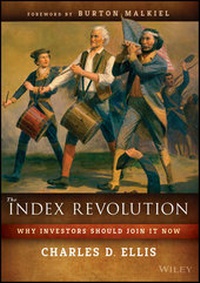
The Index Revolution
Description

The Index Revolution argues that active investing is a loser's game, and that a passive approach is more profitable in today's market. By adjusting your portfolio asset weights to match a performance index, you consistently earn higher rates of returns and come out on top in the long run. This book explains why, and describes how individual investors can take advantage of indexing to make their portfolio stronger and more profitable. By indexing investment operations at a very low cost, and trusting that active professionals have set securities prices as correctly as possible, you will achieve better long-term results than those who look down on passive approaches while following outdated advice that no longer works.
"Beating the market" is much harder than it used to be, and investors who continue to approach the market with that mindset populate the rolls of market losers time and time again. This book explains why indexing is the preferred approach in the current investment climate, and destroys the popular perception of passive investing as a weak market strategy.
* Structure your portfolio to perform better over the long term
* Trust in the pricing and earn higher rates of return
* Learn why a passive approach is more consistent and worthwhile
* Ignore overblown, outdated advice that is doomed to disappoint
All great investors share a common secret to success: rational decision-making based on objective information. The Index Revolution shows you a more rational approach to the market for a more profitable portfolio.
More details
Other editions
Additional editions
Persons
He served as a Successor Trustee at Yale University and on the Yale investment committee for 16 years. He has served on the governing boards of the Stern School of Business, Phillips Exeter Academy, and the Robert Wood Johnson Foundation, and chairs the board of the Whitehead Institute. He has served on 14 investment committees. One of 12 people honored by the profession for lifetime contributions, he was chair of the CFA Institute.
Content
Introduction xvii
Acknowledgments xxxvii
Part One Over 50 Years of Learning to Index 1
1 My Half-Century Odyssey 3
Part Two The 10 Good Reasons to Index 73
2 The Stock Markets of the World Have Changed Extraordinarily 75
3 Indexing Outperforms Active Investing 83
4 Low Fees Are an Important Reason to Index 97
5 Indexing Makes It Much Easier to Focus on Your Most Important Investment Decisions 125
6 Your Taxes Are Lower When You Index 147
7 Indexing Saves Operational Costs 151
8 Indexing Makes Most Investment Risks Easier to Live With 153
9 Indexing Avoids "Manager Risk" 157
10 Indexing Helps You Avoid Costly Troubles with Mr. Market 161
11 You Have Much Better Things to Do with Your Time 169
12 Experts Agree Most Investors Should Index 171
Appendix A: How About "Smart Beta"? 177
Appendix B: How to Get Started with Indexing 185
Appendix C: How Index Funds Are Managed 193
About the Author 197
Index 199
Foreword
As a person who has believed in indexing all my life, I am delighted to add my voice in support of the important message of this book. The Index Revolution is not only a history of the growth of indexing over the past 40 years, but also a call to those who may have been slow to accept this revolutionary method of portfolio management. If you are still attracted to high-expense, actively managed mutual funds (or, worse, if you have chosen to invest in hedge funds), Charley Ellis's succinct arguments as well as his marvelous anecdotes should leave no lingering doubts in your mind: index investing represents a superior investment strategy, and everyone should use index funds as the core of their investment portfolios.
Every year, mutual-fund advertisements proudly declare that "this year will be a stock-pickers' market." They may admit that during the previous year it was all right to be invested in a simple index fund, but they say that the value of professional investment management will become apparent in the current year. Barron's ran a cover story in 2015 and made the same case in 2016 that "active" portfolio managers would "recapture their lost glory." In early 2014 The Wall Street Journal ran an article predicting that 2014 would be a stock-pickers' market. Money managers have a number of clichés they use to promote their high-priced services, and "stock-pickers' market" is one of their favorites. But year after year, when the results come in, low-cost index funds prove their worth as the optimal way to invest.
Indexing outperforms in both bull and bear markets. Active management will not protect you by moving out of stocks when markets decline. No one can consistently time the market. There is no evidence to support the claim that active managers do better when there is more or less dispersion in the returns for individual stocks. Nor is it the case that indexing does worse during periods of rising interest rates. While in every year there will always be some actively managed funds that beat the market, the odds of your finding one are stacked against you. And there is little persistence in mutual fund returns. The fact that a fund is an outperformer in one year is no guarantee that it will be a winner in the next. Indeed, Morningstar, the mutual fund rating company, found that its ratings, based on past performance, were not useful in predicting future returns. Their five-star-rated funds, the top performers, actually did worse over the next year than the lowest one-star-rated Morningstar Funds.
Morningstar found that the only variable that was reliably correlated with the next year's performance was the fund's expense ratio. Funds with low expense ratios and low turnover tend to outperform funds with high turnover and high expenses (even before considering the adverse tax effects of high-turnover funds). Of course, the quintessential low-turnover, low-expense funds are index funds, which simply buy and hold all the stocks in a particular market and do not trade from stock to stock.
Standard & Poor's Dow Jones Indices published a statistical analysis in 2016 detailing the dismal record of "active" portfolio managers: As is typically the case, about two-thirds of active large-capitalization managers underperformed the S&P 500 large-cap index during 2015. Nor were managers any better in the supposedly less efficient, small-capitalization universe. Almost three-quarters of small-cap managers underperformed the S&P Small-Cap Index. When S&P measured performance over a longer time period, the results got worse. Over 80 percent of large-cap managers and almost 90 percent of small-cap managers underperformed their benchmark indexes over a ten-year period through December 2015.
The same findings have been documented in international markets. Even in the less efficient emerging markets, index funds regularly outperform active funds. The very inefficiency of emerging markets (including large bid-asked spreads, market impact costs, and a variety of stamp taxes on transactions) makes the strategy of simply buying and holding a broad indexed portfolio an optimal strategy in these markets, too. And indexing has proved its merit in the bond markets as well. The high-yield bond market is often considered to be best accessed via active investing, as passive vehicles have structural constraints that limit their flexibility and ability to deal with credit risk. Nevertheless, Standard & Poor's found that the 10-year results through 2015 for the actively managed high-yield funds category show that over 90 percent of funds underperformed their broad-based benchmarks.
It is true that in every period there are some managers who do outperform. But there is little consistency. The best managers in one period are usually not the same as the outperformers in the next. And even celebrity managers like William Miller, who racked up market-beating returns over a decade, underperformed over the next several years. Your chances of picking the best managers for the next decade are virtually nil. You are far more likely to end up with a typical underperforming, high-priced manager who will produce returns for you that are lower than index returns by an amount about equal to the difference in the fees that are charged. Buying a low-cost index fund or exchange-traded fund (ETF) is the superior investment strategy. Trying to predict the next star manager is, in Charley Ellis's famous words, "a loser's game."
Do you want more proof? In this slim volume, Charley presents a compendium of dismal results showing the futility of trying to beat the market. He also presents a number of additional arguments for indexing such as its simplicity and tax efficiency. And if you don't believe me or even Charley, remember that Warren Buffett, perhaps the greatest investor of our time, has opined that all investors would be better off if their portfolio contained a diversified group of index funds.
In this readable volume, Charley describes how indexing was originally thought to be an inferior way to invest and even "un-American." But as time went on and the evidence became stronger and stronger, the case for indexing became air tight. Indeed, the Ellis thesis, brilliantly explained in these pages, is that changes in the structure of the stock market now make it virtually impossible for money managers to outperform the market. Perhaps 50 years ago when our stock markets were dominated by individual investors, professionals, who visited companies to talk with management and were the first to know about company prospects, might have been able to select the best stocks and beat the market. But now we have fair disclosure regulations that require companies to make public announcements of any material facts that could influence their share price. And perhaps 98 percent of the trading is done by professionals with equally superb information and technology rather than by individuals. The irony is that in such an environment it is increasingly difficult for any professional to beat the market by enough to cover the extra fees and costs involved in trying.
The Index Revolution is not only a historical explanation of the growing acceptance of indexing over the past 50 years, but also an account of the personal evolution of a former believer in active management. Charley Ellis began his career as a firm believer in the usefulness of traditional security analysis and the potential superiority of professional management of common stock portfolios. He founded the firm Greenwich Associates that provides advisory services to the financial industry, and particularly to major investment managers. As a firsthand participant in the growth of the industry, Charley was in the perfect position to understand how vast changes in the environment made the traditional services of active portfolio managers increasingly less effective.
The paradox of security analysis and active stock selection is that as their practitioners become more professional and skilled, markets become more efficient and the search for mispriced securities becomes increasingly more difficult. Whenever information now becomes available about an industry or an individual stock, it gets reflected in the prices of individual stocks without delay. That does not mean that prices are always "correct." Indeed, we know after the fact that prices are frequently "wrong." But at any point in time, no one knows for sure whether they are too high or too low. And betting against the collective wisdom of many thousands of professional market participants is likely to be a "loser's game." Correct perceptions of mispricing are no more likely than incorrect perceptions, and active management adds considerable costs to the process as well as being extremely tax inefficient for taxable investors.
When Vanguard launched the first index, its chairman, John Bogle, hoped to raise $150 million in the fund's initial public offering. In fact, only $11.4 million was raised, and the new fund was called "Bogle's Folly." The fund grew only slowly over the next several years and was denigrated by professional investment advisers and dismissed as "settling for...
