

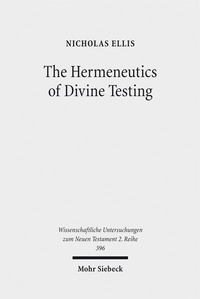
The Hermeneutics of Divine Testing
Cosmic Trials and Biblical Interpretation in the Epistle of James and Other Jewish Literature
1st Edition
Published on 29. June 2015
275 pages
978-3-16-153492-8 (ISBN)
Description

Nicholas Ellis untersucht das Wechselspiel in früher jüdischer Literatur zwischen theologischen Voraussetzungen über Gottes Beteiligung am Bösen und dem Zugang dieser Autoren zu den biblischen Erzählungen über göttliche Prüfungen. Er beginnt beim
Jakobusbrief
und vergleicht dieses frühchristliche Werk mit anderen Beispielen antiker jüdischer Interpretation. Ellis versammelt eine Auswahl antiker Standpunkte zu den göttlichen, satanischen und menschlichen Rollen der Prüfung und untersucht dann, wie diese Variationen auf die dramatis personae des kosmischen Gerichtssaals die Interpretation populärer biblischer Erzählungen über Prüfungen direkt beeinflussten. Der Autor zeigt, dass die Darstellung der göttlichen Prüfung bei Jakobus sehr eng mit der Theologie und Hermeneutik der sogenannten "Rewritten Bible"-Tradition verbunden ist. Für das kosmische Drama des Jakobusbriefes ist Gott der gerechte Richter gegenüber dem satanischen Ankläger, der sowohl Gottes Integrität als auch die religiöse Loyalität der Menschen angreift.
More details
Other editions
Additional editions
Nicholas Ellis
The Hermeneutics of Divine Testing
Cosmic Trials and Biblical Interpretation in the Epistle of James and Other Jewish Literature
Book
06/2015
1st Edition
Mohr Siebeck
€104.00
Article exhausted; check different version
Person
Author
Born 1982; 2004 BA in Biblical Languages; 2006 MA in Biblical Studies; 2010 MST in Theology; 2013 DPhil in Theology; 2009-13 College Lecturer of NT and Hellenistic Greek at Wycliffe Hall, University of Oxford and Managing Greek Editor of the BibleMesh Greek Language distance education curriculum; 2013 Visiting Research Scholar at Tyndale House, Cambridge; since 2014 Visiting Research Scholar at Duke University.
ISNI:
ISNI:
Content
- Cover
- Preface
- Table of Contents
- Introduction
- Part I: The Problem of Probation in the Epistle of James and Other Jewish Literature
- Chapter 1: The Epistle of James and the Discourse of Probation
- 1.1. The Semantics of Probation in James
- 1.1.1. The Semantics of Probation
- 1.1.2. The Exegesis of Probation
- 1.1.3. Summary of the Problem of Probation
- 1.2. History of Scholarship
- 1.2.1. James and the History of the Semantics of Probation
- 1.2.2. Probation and Biblical Hermeneutics
- 1.3. The Problem with the Semantics in Jas 1:2-14
- 1.3.1. The Problem of Semantic Controls
- 1.3.2. The Value of Semantic Ambiguity for Author and Reader
- 1.4. A Way Forward: Cosmic Drama and Biblical Hermeneutics
- 1.4.1. The Metaphor of Cosmic Drama
- 1.4.2. Biblical Interpretation
- 1.4.3. Instantiations of Jewish Interpretation
- Chapter 2: Comparative Methodology and Historical Models
- 2.1. The Debated Historical Situation of the Epistle of James
- 2.1.1. Historical Silence on the Epistle of James
- 2.1.2. James in Apostolic Conflict: The Legacy of 18th-19th Century Protestant Thought
- 2.1.3. James in Apostolic Communion
- 2.1.4. James and Popular Hellenistic Philosophy
- 2.1.5. Blurring the Boundary Lines
- 2.1.6. Conclusions on the Historical Analysis of James
- 2.2. Assessing Comparative Literature
- 2.2.1. Additional Considerations on Ancient Sources
- 2.3. Conclusions on a Methodology and a Structure for the Investigation
- Chapter 3: Current Conversations in Jewish Cosmology
- 3.1. Heavenly Trials and Inversions of the Divine Courtroom
- 3.2. Debates on Jewish Anthropology
- 3.2.1. The Human Yetzer in the Old Testament
- 3.2.2. Translating Yetzer
- 3.2.3. Scholarly Debates on the Significance and Development of the Yetzer
- Summary of Chapter 3
- Part II: Divine Probation in Jewish Literature
- Chapter 4: Rewritten Bible and Demonic Paradigms
- 4.1. The Book of Jubilees
- 4.1.1. God in the Courtroom
- 4.1.2. Satan as Prosecutor and the Demonic Paradigm
- 4.1.3. Human Weakness and Divine Intervention
- 4.1.4. Apotropaic Prayers in Jubilees
- 4.1.5. Summary of Theological Cosmology in Jubilees
- 4.1.6. Exegetical Solutions to Divine Probation in Jubilees
- 4.1.6.1. Words in Heaven at the Aqedah
- 4.1.6.2. God on Trial at the Aqedah
- 4.1.6.3. The Hermeneutic of the Aqedah in Jubilees
- 4.2. Further Examples from Rewritten Bible in Qumran
- 4.3. Conclusions to Rewritten Bible
- Chapter 5: The Wisdom of Ben Sira and Human Ability
- 5.1. Probation and Divine Responsibility in Sirach
- 5.2. Ben Sira's Internalised Cosmology
- 5.2.1. Ben Sira and the Human Inclination
- 5.3. Ben Sira's Hermeneutic of Probation
- 5.3.1. Abraham's Unblemished Glory
- 5.3.2. Adam's Glory and the Image of God
- 5.3.3. Abraham the Law-Keeper
- 5.3.4. Abraham Tested, Faithful, and Unblemished
- 5.4. Conclusions to Sirach's Internalised Cosmology
- Chapter 6: Philo and Hellenistic Philosophy
- 6.1. Cosmic Drama and the Problem of Evil In Philo
- 6.1.1. Defending God
- 6.1.2. The Role of Intermediaries in Philo's Cosmology
- 6.1.3. On the Suppression of Demonic Forces
- 6.2. Philo and the Anthropology of Probation
- 6.2.1. Human Nature and Base Desire
- 6.2.2. Ascent to the Divine Mind
- 6.2.3. Summary of Philo's Cosmology
- 6.3. Philo's Philosophical Hermeneutic
- 6.3.1. Philo's Hermeneutic of the Letter and Spirit
- 6.3.2. The Probation of Adam and Eve
- 6.3.3. The Probations of Abraham and the Patriarchs
- 6.3.4. Conclusion to Philo's Hermeneutic of Probation
- Chapter 7: The Pseudo-Clementine Homilies
- 7.1. Probation within the Pseudo-Clementine Homilies
- 7.2. The Cosmic Drama of the Pseudo-Clementine Homilies
- 7.2.1. Demonic Cosmology and Subordinate Dualism
- 7.2.2. Demonic Anthropology
- 7.2.3. Summary of the Cosmic Drama of the Pseudo-Clementines
- 7.3. The Hermeneutic of Rejection
- 7.4. Conclusions to the Pseudo-Clementine Homilies
- Chapter 8: Rabbinic Traditions and Demonic Anthropology
- 8.1. The Divine Council and the Rabbinic Courtroom
- 8.2. Satan and Demons as Cosmic Agents
- 8.3. The Evil Yetzer in Rabbinic Anthropology
- 8.3.1. The Single Yetzer and the School of R. Akiva
- 8.3.2. The Single Yetzer and the School of R. Ishmael
- 8.3.3. The Double Yetzer
- Excursus 1: The Development of the Yetzer
- 8.3.4. The Yetzer as Cosmic Enemy
- 8.4. Rabbinic Hermeneutics of Probation
- 8.4.1. Kivyakhol Texts and Divine Intermediation
- 8.4.2. The Probations of Job and Abraham
- 8.5. Conclusions to the Rabbinic Literature
- Excursus 2: Additional Diversity within Jewish Thought
- Summary of Part II: Convergence and Divergence in Jewish Theological Cosmologies
- Part III: A Hermeneutic of Probation in the Epistle of James
- Chapter 9: A Theology of Probation in the Epistle of James
- 9.1. James and Divine Agency
- 9.1.1. The Law Court with Human and Divine Judges
- 9.1.2. Distinctions of Religious Loyalty
- 9.1.3. Humans Judging God's Character
- 9.1.4. Divine Acquittal
- 9.1.5. Conclusion to James' Theology of Probation
- 9.2. James and External Cosmic Agents
- 9.3. James and Anthropology
- 9.3.1. Primary Anthropological Passages in James
- 9.3.2. James' Anthropology: Scholarly Models
- 9.3.3. Reevaluating James' Anthropology
- 9.3.4. Human Desire as the Target of Satanic Attack
- 9.4. James and the Cosmic Drama of Probation
- Chapter 10: The Epistle of James and a Hermeneutic of Testing
- 10.1. The First Temptation: The Creation in James 1:14-18
- 10.1.1. Exegesis of James 1:13-18
- 10.1.2. James 1:13-16 and its Surrounding Context
- 10.1.3. Jas 1:13-16 and the Protological Testing Narratives
- 10.1.4. Conclusion to the Protological Temptation
- 10.2. Tested Abraham
- 10.2.1. Genesis 15 and Genesis 22
- 10.2.2. The Piety of Abraham in Other Jewish Discourses
- 10.2.3. Traditional Problems with Abraham and the Aqedah
- 10.3. Patient Job
- 10.3.1. James, Job, and the Contemporary Exegetical Discourse
- 10.3.2. The Extra-Canonical Stories of Job
- 10.4. Abraham and Job as Interwoven Narratives
- 10.4.1. Job and Abraham as Parallel Figures
- 10.4.2. Was Job or Abraham the Greater Patriarch?
- 10.4.3. Abraham and Job within Assimilated Narratives
- 10.5. Two Examples of the 'Jobraham' Hermeneutic in Jewish Literature
- 10.5.1. The Testament of Abraham
- 10.5.2. The Testament of Job
- 10.6. Constructing 'Jobraham'
- 10.6.1. 'Jobraham' and the Hermeneutic of James
- 10.6.2. James and 'Jobraham'
- 10.6.3. Additional Considerations from Broader Discourses
- Conclusions
- James and Anthropology: The Perfect Tested Man
- James and Cosmology: The Perfect Tested God
- James and the Semantics of Probation
- Bibliography
- Index of Ancient Sources
- A. Hebrew Bible and Septuagint
- B. Apocryphal/Deutero-Canonical Books
- C. Old Testament Pseudepigrapha
- D. Qumran
- E. New Testament
- F. Philo
- G. Early Christian Texts
- H. Other Early Jewish Texts
- Index of Modern Authors
- Index of Subjects
