

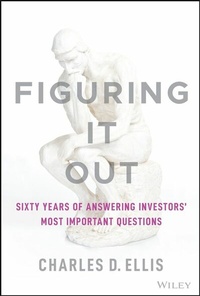
Figuring It Out
Description

In Figuring It Out: Answers to the Most Difficult Investment Questions, world-renowned investing and finance guru Charles D. Ellis delivers a robust collection of incisive essays on an array of perennial and contemporary investing issues, from the rise and fall of performance investing to a compilation of essential investing guidelines.
In the book, you'll also find eye-opening discussions of:
* Whether bonds are an appropriate investment vehicle for long-term investors
* The costs of excessive liquidity in the typical portfolio
* The characteristics of successful investment firms, and how to spot them
A can't-miss resource for the everyday retail investor, author Charles Ellis draws on a lifetime of distinguished client service in the financial markets to reward readers with common-sense and accessible advice that deserves to be followed by anyone with an interest in maximizing their investment returns over the long haul.
More details
Other editions
Additional editions
Person
Content
Note on the Text xi
Introduction xiii
1 The Changing Game 1
2 The Loser's Game 35
3 The Winners' Game 47
4 The Winner's Game II 61
5 The Rise and Fall of Performance Investing 73
6 Seven Rules for More Innovative Portfolio Management in an Age of Discontinuity 89
7 Will Success Spoil Performance Investing? 93
8 To Get Performance, You Have to Be Organized for It 99
9 Investing Success in Two Easy Lessons 107
10 The End of Active Investing? 111
11 In Defense of Active Investing 119
12 Murder on the Orient Express: The Mystery of Underperformance 127
13 Best Practice Investment Committees 141
14 Levels of the Game 157
15 An Invitation to Winning 163
16 Small Slam! 167
17 A Lesson from Seaside Cemetery 171
18 Tommy Armour on Investing 173
19 Ted Williams' Great Lessons for Investors 177
20 Symptoms and Signs 181
21 Lessons from the Warwick and Château Chambord 191
22 Investment Management Fees Are Higher Than We Think 199
23 Computer People May Be Planning a Revolution 203
24 Characteristics of Successful Investment Firms 207
25 A New Paradigm of Investment Management 215
26 Lessons on Grand Strategy 221
27 Pension Funds Need MORE Management MANAGEMENT 227
28 The Significance of 65 233
29 Where Were We? 237
30 Hard Choices: Where Are We Now? 243
31 Bonds for Long-Term Investors? 251
32 What Role Should Bonds Play? 261
33 Too Much Liquidity Will Cost You 265
34 Letter to My Grandkids: 12 Essential Investing Guidelines 269
35 Miss Sally's Attic 277
36 Ben Graham: Ideas as Mementos 281
37 The Corporate Tax Cut 291
38 Repurchase Stock to Revitalize Equity 295
39 Anti-Trust, Bank Mergers, and the PNB Decision 315
Index 325
1
The Changing Game
Examples of major changes in the whole system of a major industry are few and far between, except in technology. Virtually every aspect of investment management-fees, competitors, technology, regulators-and information have changed over the last half-century. Even the speed of change has changed.
Charles Darwin lamented that his innovative theory of evolution would not be accepted by the scientific community until his friends and colleagues had died or retired. His peers would have to be replaced by others whose careers were not so invested in or based on and devoted to pre-Darwinian concepts that they had become unwitting captives of their prior work and stature as traditional biologists.1
The stock market itself is Darwinian-always evolving. And as increasing numbers of investment professionals with more training and better tools and more access to more information and as investors move money toward more capable managers and as managers compete to attract more business, fund executives promote their best performing portfolio managers and analysts, it cannot be surprising that the effectiveness of active investors as a group continues to increase. That's why we say, "Markets are always learning." And that's why securities markets have been unrelenting in their increasing efficiency-and harder and harder to beat or even match-particularly after covering the higher fees now being charged. The fees may well have been justified in the early or middle years of a 50-year transformation, but a rich variety of charges have combined to bring to an end the era of successful active management.
In his classic book, Scientific Revolutions, Thomas Kuhn explained why the problem Darwin faced was not confined to biology or science: It is universal. Those who have succeeded greatly and have risen to the top positions in their fields naturally resist-often quite imaginatively and often quite stubbornly-any new, "revolutionary" or disruptive concept. There are two main reasons for resistance: First, most of the new hypotheses, when rigorously tested, will not prove valid. So, over time, leading members of the Establishment can get over-confident and dismissive of all new ideas. Second, the members of the Establishment in any field have too much to lose in institutional stature, their carefully developed reputations as experts, the value of their many years of past work, and their earning power-all dependent on the status quo-their status quo. So they defend against the "new." Usually, they are proven right-so they win. But not always.
Dynamics of Innovation
There is a remarkably consistent iterative process by which the best innovations overcome resistance and eventually gain acceptance. The process of change follows a repeating pattern although the pace of change can differ markedly from one innovation to another.2 Two kinds of actors play key roles: Innovators and Influentials. Innovators tinker and experiment all the time, looking for the next new thing. Unlike most people, they are so keen to find and use the latest innovation and they enjoy being first so much that they do not mind the costs in time, energy, or expense of most innovations not proving out, so they continue experimenting with what's new. Figure 1.1 shows how Innovators are the first to try things out.
Influentials are different. While they like finding new and better ways, they dislike the cost, bother, and frustrations of "new way" failures. So their strategy is to watch the Innovators and their experiments closely and, when the Innovators' experiments work, selectively adopt the most promising successes. As a result, Influentials learn about successes early and develop considerable skill at evaluating which Innovators have the best innovation records and are most repeatedly successful. And this is why they become Influentials.
Figure 1.1 Incremental and Cumulative Acceptance
While Influentials are monitoring the Innovators for successful innovations, many Followers are monitoring the Influentials. When Influentials adopt a new way, the Followers3 will then-in increasing numbers and with increasing commitment-follow their lead. (Of course, that's why they are called Influentials.)
In his scholarly book, Diffusion of Innovations, Everett Rogers established the classic paradigm by which innovation reaches a "tipping point" and then spreads exponentially through a large social group. Most members of a social system rely on observing the decisions of others when making their own decisions.4 Decisions to adopt a new way repeatedly follow a five-step process:
- Awareness of the new way.
- Evaluation: forming a favorable (or unfavorable) opinion.
- Deciding whether or not to change to the innovation.
- Action: Adopting (or rejecting) the innovation.
- Confirmation: evaluating the results of the innovation.
Deciding, the third step, depends on the decider's confidence in the benefits, the decision's compatibility with current habits and norms, and how the decider anticipates others will perceive the decision and whether they will approve.
The speed with which new and better ways of doing things are adopted is a function of several contributing factors: how large and how visible are the benefits; the speed with which benefits become visible; the ease and low cost of experimentation; the ease and low cost of reversing a mistaken decision; and the quality of the channels or networks by which information and social influences get communicated and expressed. Resistance to change, on the other hand, is a function of uncertainty about the benefits of the innovation or the ease of adoption; the risk of social approbation the new adopter may experience; the risk tolerance of the prospective adopter; the speed with which rewards and benefits will be received; etc.
Diffusion is the social process by which individual adopters influence others to adopt. Opinion leaders are important in any social movement, so diffusion will be retarded by any stigma attached to adoption. As an example of social stigma, Rogers cites the failure of a public heath campaign in Peru because local culture held that only "unwell" people would drink boiled water. So healthy people refused to boil theirs. Significantly, index investing was attacked, several years ago, as a haven for "wimps without skill," just "settling for just average," and even dismissed as "unAmerican."
Combining Kuhn's and Rogers' theories on innovation together provides a way of understanding how and why the inevitable triumph of indexing is steadily advancing and how and why its advance is still being resisted or even ignored by many practitioners devoted to active management. The distribution of an innovation and its adoption works through the interaction of a social system5 and its opinion leaders. The speed of distribution varies with the strength of the social system. The informal social system for the selection of investment managers is remarkably weak. For individual investors, three inhibiting characteristic factors dominate: the all-too human desire among individuals to "do better" by trying harder; the "yes, you can" encouragements of investment advisors, consultants, and other perceived experts who make their living as advocates of trying harder to do better; and the media advertising, articles, and program content that focus on and celebrate winning.6 You will, or course, hear little about the numbing consistency with which a majority of active managers fall short of the index or how seldom past years' "winners" are winners again over the next few years or longer.
The iterative process of social acceptance and resistance can seem glacially slow as they work their way through many layers and kinds of social resistance-particularly the resistance by those with a lot to lose if substantial acceptance develops. But impatient observers might consider the difficult pathway of, for example, the theory of evolution. Texas still requires public schools to treat evolution and creationism as equally serious alternatives. Persuading Americans to use seat belts-even when the historical data was powerful-took years and lots of public service advertisements, deliberately annoying noises, and local police enforcement.7
Early "Performance Investing"
In his General Theory, J. M. Keynes wrote: "The game of professional investment is intolerably boring and over-exacting to anyone who is entirely exempt from the gambling instinct; whilst he who has it must pay to this propensity the appropriate toll." Note the word "game" as coined for all time in 'Adam Smith's8 mid-1960s best seller, The Money Game, where he chronicled and explained with delightfully sardonic humor the amazing new world of "performance" investing. It was, as he said, "an exercise in mass psychology, in trying to guess better than the crowd how the crowd would behave."9 The author went on to explain, "The true professionals in the Game-the professional portfolio managers-grow more skilled all the time. They are human and they make mistakes,...
