

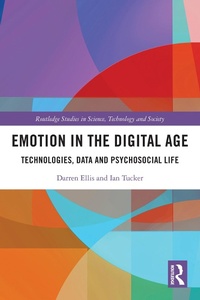
Emotion in the Digital Age
Technologies, Data and Psychosocial Life
1st Edition
Published on 8. October 2020
142 pages
978-1-351-60972-2 (ISBN)
Description

Emotion in the Digital Age examines how emotion is understood, researched and experienced in relation to practices of digitisation and datafication said to constitute a digital age. The overarching concern of the book is with how emotion operates in, through, and with digital technologies. The digital landscape is vast, and as such, the authors focus on four key areas of digital practice: artificial intelligence, social media, mental health, and surveillance. Interrogating each area shows how emotion is commodified, symbolised, shared and experienced, and as such operates in multiple dimensions. This includes tracing the emotional impact of early mass media (e.g. cinema) through to efforts to programme AI agents with skills in emotional communication (e.g. mental health chatbots). This timely study offers theoretical, empirical and practical insight regarding the ways that digitisation is changing knowledge and experience of emotion and affective life. Crucially, this involves both the multiple versions of digital technologies designed to engage with emotion (e.g. emotional-AI) through to the broader emotional impact of living in digitally saturated environments. The authors argue that this constitutes a psycho-social way of being in which digital technologies and emotion operate as key dimensions of the ways we simultaneously relate to ourselves as individual subjects and to others as part of collectives. As such, Emotion in the Digital Age will prove important reading for students and researchers in emotion studies, psychology, science and technology studies, sociology, and related fields.
Reviews / Votes
"In this book, the authors delve deep into the affective vibrancies and forces of digital life. As they show, feelings are the foundation of many online interactions and content. Feelings are aroused with and through the internet and compel us to want to stay engaged online - to upload, like, comment, share and post photos, videos, emojis, GIFs and memes. This book provides important insights into these processes."Prof. Deborah Lupton, author of Data Selves: More-than-Human Perspectives (Polity) and Digital Food Cultures (Routledge)
"From affective atmospheres to woebots, from artificial intelligence to the emojification of the everyday, Darren Ellis and Ian Tucker pursue how bodies, collective and individual, are continually shifting in conjunction with technological and digital processes. Always empirically situated, Ellis and Tucker's nuanced psycho-social approach to affect and emotion reveals possibilities for critical intervention into our contemporary moment while simultaneously opening pathways for future-oriented analyses to undertake."
Prof. Gregory J. Seigworth, co-editor of the Affect Theory Reader (Duke University Press, 2010) and co-editor of Capacious: Journal for Emerging Affect Inquiry
More details
Series
Edition
1. Auflage
Language
English
Place of publication
London
United Kingdom
Publishing group
Taylor & Francis Ltd
Target group
College/higher education
ISBN-13
978-1-351-60972-2 (9781351609722)
Copyright in bibliographic data and cover images is held by Nielsen Book Services Limited or by the publishers or by their respective licensors: all rights reserved.
Schweitzer Classification
Other editions
Additional editions
Book
04/2022
1st Edition
Routledge
€64.60
Shipment within 15-20 days
Book
10/2020
1st Edition
Routledge
€207.00
Shipment within 10-20 days
Book
09/2020
Taylor & Francis
Unfortunately, price unknown
Available (delivery time upon request)
Persons
Darren Ellis is Senior Lecturer in the Department of Social Sciences at the University of East London, UK, and co-author of Social Psychology of Emotion.
Ian Tucker is Professor in the School of Psychology at the University of East London, UK, and co-author of Social Psychology of Emotion.
Ian Tucker is Professor in the School of Psychology at the University of East London, UK, and co-author of Social Psychology of Emotion.
Content
1. Emotion in the Digital Age 2. The History and Emergence of Emotion-Technology Relations 3. Artificial Intelligence and Emotion 4. Social Media and Emotion 5. Digital Mental Health 6. Surveillance and Emotion 7. Digital Futures and Emotion
