

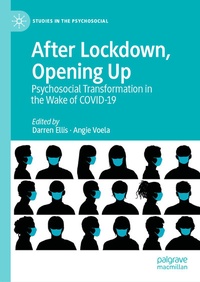
After Lockdown, Opening Up
Description

This edited volume examines the psychosocial transformations experienced during the COVID-19 pandemic and lockdown, and envisions those that might lead to a more equitable society as we 'open up'. The book integrates psychoanalysis, sociology, cultural studies, and psychology to address three main areas: personal experiences of the lockdown, new formations of power and desire that the lockdown has shaped, and global concerns related to the pandemic. Within those three areas, the chapters discuss key themes that include the uses of space during lockdown; experiences of death, loss, and domestic violence; race and the pandemic; technology, media, and viral media; chronic illness; handwashing and COVID-19; and conspiracy theories.
Drawing together academics and practitioners with a common vision of social justice and active pedagogy, the contents of this volume combine experiential writing with cutting-edge, theoretically-informed interdisciplinary debates. The book advancesand demonstrates the productive diversity of psychosocial studies, drawing on psychoanalytic theories, critical psychologies, critical theories, critical race theories, process philosophies, affect theories, and critical pedagogy. In doing so, it will appeal to scholars across the social sciences.
Reviews / Votes
"Psychoanalysis negotiates an irresolvable tension between the universal and the particular, the general and the singular. ... Psychoanalysis acknowledges the satisfaction that can be gained from seemingly miserable life arrangements. Covid was available to all as social symptom and could serve a multitude of functions." (Conor McCormack, Psychoanalysis, Culture & Society, Vol. 29 (1), 2024)
More details
Other editions
Additional editions
Persons
Darren Ellis is Senior Lecturer and Course Leader of Psychosocial Community Work at the University of East London, UK.
Angie Voela is a Reader in Social Sciences at the University of East London, UK.
Content
1 . Introduction: For a Psychosocial approach to the lockdown (Darren Ellis and Angie Voela).- 2. Sharing space - not sharing space: narcissism and object relations in the pandemic (Stephen Briggs).- 3. Death, loss and limbo in times of pandemic (Elizabeth McMullan and Rebecca Reynolds).- 4. The world is slowing down: reflection on time during lockdown and pregnancy (Marija Lobanova).- 5. Conceptualising the lockdown form the point of view of chronic illness (Sharon Gallagher and Angie Voela).- 6. Locked-in, log-in and slog-on: a technocratic dystopia? (Darren Ellis).- 7. "It's genetic, innit?" Racializing the lockdown (Lurraine Jones and Marcia Wilson).- 8. Addressing the safety and criminal exploitation of vulnerable young people- before, during and after COVID-19 and lockdown (Andrew Ravenscroft et al.).- 9. Being trapped in relational systems of narcissistic abuse during lockdown (Elizabeth McMullan).- 10. Leaving home: safer beyond the neoliberal family (Debra Benita Shaw).- 11. 'Hands, face, space': Psychoanalysis, secular rituals and magical thinking in COVID-19 times (Marita Vyrgioti).- 12. Separation, connection and the anticipation of uncertain (digital) futures: care, lockdown and mental health (Ian Tucker).- 13. The new logics of viral media (Tony Sampson & Jussi Parikka).- 14. Lockdown and conspiracy theories: inaction, transmission, stupidity (Angie Voela).- 15. Afterword (Corinne Squire).
