

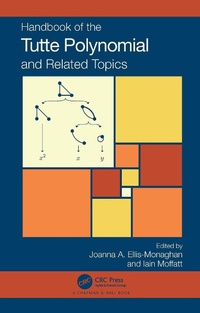
Handbook of the Tutte Polynomial and Related Topics
1st Edition
Published on 6. July 2022
804 pages
978-1-4822-4063-4 (ISBN)
Description

The Tutte Polynomial touches on nearly every area of combinatorics as well as many other fields, including statistical mechanics, coding theory, and DNA sequencing. It is one of the most studied graph polynomials.
Handbook of the Tutte Polynomial and Related Topics is the first handbook published on the Tutte Polynomial. It consists of thirty-four chapters written by experts in the field, which collectively offer a concise overview of the polynomial's many properties and applications. Each chapter covers a different aspect of the Tutte polynomial and contains the central results and references for its topic. The chapters are organized into six parts. Part I describes the fundamental properties of the Tutte polynomial, providing an overview of the Tutte polynomial and the necessary background for the rest of the handbook. Part II is concerned with questions of computation, complexity, and approximation for the Tutte polynomial; Part III covers a selection of related graph polynomials; Part IV discusses a range of applications of the Tutte polynomial to mathematics, physics, and biology; Part V includes various extensions and generalizations of the Tutte polynomial; and Part VI provides a history of the development of the Tutte polynomial.
Features
Written in an accessible style for non-experts, yet extensive enough for experts
Serves as a comprehensive and accessible introduction to the theory of graph polynomials for researchers in mathematics, physics, and computer science
Provides an extensive reference volume for the evaluations, theorems, and properties of the Tutte polynomial and related graph, matroid, and knot invariants
Offers broad coverage, touching on the wide range of applications of the Tutte polynomial and its various specializations
Handbook of the Tutte Polynomial and Related Topics is the first handbook published on the Tutte Polynomial. It consists of thirty-four chapters written by experts in the field, which collectively offer a concise overview of the polynomial's many properties and applications. Each chapter covers a different aspect of the Tutte polynomial and contains the central results and references for its topic. The chapters are organized into six parts. Part I describes the fundamental properties of the Tutte polynomial, providing an overview of the Tutte polynomial and the necessary background for the rest of the handbook. Part II is concerned with questions of computation, complexity, and approximation for the Tutte polynomial; Part III covers a selection of related graph polynomials; Part IV discusses a range of applications of the Tutte polynomial to mathematics, physics, and biology; Part V includes various extensions and generalizations of the Tutte polynomial; and Part VI provides a history of the development of the Tutte polynomial.
Features
Written in an accessible style for non-experts, yet extensive enough for experts
Serves as a comprehensive and accessible introduction to the theory of graph polynomials for researchers in mathematics, physics, and computer science
Provides an extensive reference volume for the evaluations, theorems, and properties of the Tutte polynomial and related graph, matroid, and knot invariants
Offers broad coverage, touching on the wide range of applications of the Tutte polynomial and its various specializations
Reviews / Votes
"This is a comprehensive reference text on the Tutte polynomial, including its applications and extensions. The book consists of 34 relatively short chapters written by different contributing authors. The individual contributors present the most important theorems in their respective fields and illustrate them with examples. Each chapter ends with a list of open problems. Two brief introductory chapters by the editors-Ellis-Monaghan (Univ. of Amsterdam) and Moffatt (Royal Holloway, University of London)-cover the basic definitions and computational results for Tutte polynomials. The next two-thirds of the book are devoted to applications and extensions, that is, uses and occurrences of Tutte polynomials outside graph theory or matroid theory. Hyperplane arrangements, quantum field theory, network reliability, the sandpile model, and chipfiring games are a few examples of the topics treated. The book concludes with a chapter on the history of the subject written by Graham Farr. It follows from the nature of the volume (i.e., no proofs, no exercises, very broad topical coverage, and more than 50 authors) that classroom use of the book is unlikely. Nonetheless, this work is likely to become the most frequently consulted reference on Tutte polynomials."Summing Up: Highly recommended. Graduate students and faculty.
-Choice Review
More details
Edition
1. Auflage
Language
English
Place of publication
Philadelphia, PA
United States
Publishing group
Taylor & Francis Inc
Target group
College/higher education
Illustrations
16 Tables, black and white; 164 Line drawings, black and white; 164 Illustrations, black and white
ISBN-13
978-1-4822-4063-4 (9781482240634)
Copyright in bibliographic data and cover images is held by Nielsen Book Services Limited or by the publishers or by their respective licensors: all rights reserved.
Schweitzer Classification
Other editions
Additional editions
Joanna A. Ellis-Monaghan | Iain Moffatt
Handbook of the Tutte Polynomial and Related Topics
Book
08/2024
1st Edition
Chapman & Hall/CRC
€77.30
Shipment within 10-20 days
Joanna A. Ellis-Monaghan | Iain Moffatt
Handbook of the Tutte Polynomial and Related Topics
Book
07/2022
1st Edition
Chapman & Hall/CRC
€315.50
Article not available for order
Persons
Joanna A. Ellis-Monaghan is a professor of discrete mathematics at the Korteweg - de Vries Instituut voor Wiskunde at the Universiteit van Amsterdam. Her research focuses on algebraic combinatorics, especially graph polynomials, as well as applications of combinatorics to DNA self-assembly, statistical mechanics, computer chip design, and bioinformatics. She also has an interest in mathematical pedagogy. She has published over 50 papers in these areas.
Iain Moffatt is a professor of mathematics in Royal Holloway, University of London. His main research interests lie in the interactions between topology and combinatorics. He is especially interested in graph polynomials, topological graph theory, matroid theory, and knot theory. He has written more than 40 papers in these areas and is also the author of the book An Introduction to Quantum and Vassiliev Knot invariants.
Ellis-Monaghan and Moffatt have authored several papers on the Tutte polynomial and related graph polynomials together as well as the book Graphs on surfaces: Dualities, Polynomials, and Knots.
Iain Moffatt is a professor of mathematics in Royal Holloway, University of London. His main research interests lie in the interactions between topology and combinatorics. He is especially interested in graph polynomials, topological graph theory, matroid theory, and knot theory. He has written more than 40 papers in these areas and is also the author of the book An Introduction to Quantum and Vassiliev Knot invariants.
Ellis-Monaghan and Moffatt have authored several papers on the Tutte polynomial and related graph polynomials together as well as the book Graphs on surfaces: Dualities, Polynomials, and Knots.
Content
I. Fundamentals. 1. Graph theory. 2. The Tutte Polynomial for Graphs. 3. Essential Properties of the Tutte Polynomial. 4. Matroid theory. 5. Tutte polynomial activities. 6. Tutte Uniqueness and Tutte Equivalence.
II. Computation. 7. Computational Techniques. 8. Computational resources. 9. The Exact Complexity of the Tutte Polynomial. 10. Approximating the Tutte Polynomial. III. Specializations. 11. Foundations of the Chromatic Polynomial. 12. Flows and Colorings. 13. Skein Polynomials and the Tutte Polynomial when x = y. 14. The Interlace Polynomial and the Tutte-Martin Polynomial. IV. Applications. 15. Network Reliability. 16. Codes. 17. The Chip-Firing Game and the Sandpile Model. 18. The Tutte Polynomial and Knot Theory. 19. Quantum Field Theory Connections. 20. The Potts and Random-Cluster Models. 21. Where Tutte and Holant meet: a view from Counting Complexity. 22. Polynomials and Graph Homomorphisms. V. Extensions. 23. Digraph Analogues of the Tutte Polynomial. 24. Multivariable, Parameterized, and Colored Extensions of the Tutte Polynomial. 25. Zeros of the Tutte Polynomial. 26. The U, V and W Polynomials. 27. Valuative invariants on matroid basis polytopes Topological Extensions of the Tutte Polynomial. 28. The Tutte polynomial of Matroid Perspectives. 29. Hyperplane Arrangements and the Finite Field Method. 30. Some Algebraic Structures related to the Tutte Polynomial. 31. The Tutte Polynomial of Oriented Matroids. 32. Valuative Invariants on Matroid Basis Polytopes. 33. Non-matroidal Generalizations. VI. History. 34. The History of Tutte-Whitney Polynomials.
II. Computation. 7. Computational Techniques. 8. Computational resources. 9. The Exact Complexity of the Tutte Polynomial. 10. Approximating the Tutte Polynomial. III. Specializations. 11. Foundations of the Chromatic Polynomial. 12. Flows and Colorings. 13. Skein Polynomials and the Tutte Polynomial when x = y. 14. The Interlace Polynomial and the Tutte-Martin Polynomial. IV. Applications. 15. Network Reliability. 16. Codes. 17. The Chip-Firing Game and the Sandpile Model. 18. The Tutte Polynomial and Knot Theory. 19. Quantum Field Theory Connections. 20. The Potts and Random-Cluster Models. 21. Where Tutte and Holant meet: a view from Counting Complexity. 22. Polynomials and Graph Homomorphisms. V. Extensions. 23. Digraph Analogues of the Tutte Polynomial. 24. Multivariable, Parameterized, and Colored Extensions of the Tutte Polynomial. 25. Zeros of the Tutte Polynomial. 26. The U, V and W Polynomials. 27. Valuative invariants on matroid basis polytopes Topological Extensions of the Tutte Polynomial. 28. The Tutte polynomial of Matroid Perspectives. 29. Hyperplane Arrangements and the Finite Field Method. 30. Some Algebraic Structures related to the Tutte Polynomial. 31. The Tutte Polynomial of Oriented Matroids. 32. Valuative Invariants on Matroid Basis Polytopes. 33. Non-matroidal Generalizations. VI. History. 34. The History of Tutte-Whitney Polynomials.
