

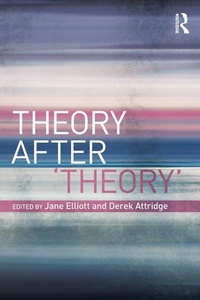
Theory After 'Theory'
1st Edition
Published on 25. March 2011
336 pages
978-1-136-82740-2 (ISBN)
Description

This volume argues that theory, far from being dead, has undergone major shifts in order to come to terms with the most urgent cultural and political questions of today. Offering an overview of theory's new directions, this groundbreaking collection includes essays on affect, biopolitics, biophilosophy, the aesthetic, and neoliberalism, as well as examinations of established areas such as subaltern studies, the postcolonial, and ethics.
Influential figures such as Agamben, Badiou, Arendt, Deleuze, Derrida and Meillassoux are examined in a range of contexts. Gathering together some of the top thinkers in the field, this volume not only speculates on the fate of theory but shows its current diversity, encouraging conversation between divergent strands. Each section places the essays in their contexts and stages a comparison between different but ultimately related ways in which key thinkers are moving beyond poststructuralism.
Contributors: Amanda Anderson, Ray Brassier, Adriana Cavarero, Eva Cherniavsky, Rey Chow, Claire Colebrook, Laurent Dubreuil, Roberto Esposito, Simon Gikandi, Martin Haggluend, Peter Hallward, Brian Massumi, Peter Osborne, Elizabeth Povinelli, William Rasch, Henry Staten, Bernard Stiegler, Eugene Thacker, Cary Wolfe, Linda Zerilli.
Influential figures such as Agamben, Badiou, Arendt, Deleuze, Derrida and Meillassoux are examined in a range of contexts. Gathering together some of the top thinkers in the field, this volume not only speculates on the fate of theory but shows its current diversity, encouraging conversation between divergent strands. Each section places the essays in their contexts and stages a comparison between different but ultimately related ways in which key thinkers are moving beyond poststructuralism.
Contributors: Amanda Anderson, Ray Brassier, Adriana Cavarero, Eva Cherniavsky, Rey Chow, Claire Colebrook, Laurent Dubreuil, Roberto Esposito, Simon Gikandi, Martin Haggluend, Peter Hallward, Brian Massumi, Peter Osborne, Elizabeth Povinelli, William Rasch, Henry Staten, Bernard Stiegler, Eugene Thacker, Cary Wolfe, Linda Zerilli.
Reviews / Votes
'Arguably the most significant contribution of the volume Theory After 'Theory' to the increasingly deterritorialized debates surrounding the future of critical theory across the disciplines is to have brought before the public radical probings into fundamental concepts and modes of thinking that expose the gaps and neuralgic points both of "high theory" and of the mainstays in contemporary thought, soliciting a re-thinking of vital areas addressed by ethcial, political, and aesthetic criticism.' -Hungarian Journal of English and American StudiesMore details
Edition
1. Auflage
Language
English
Place of publication
London
United Kingdom
Publishing group
Taylor & Francis Ltd
Target group
College/higher education
Product notice
Reflowable
File size
2,27 MB
ISBN-13
978-1-136-82740-2 (9781136827402)
Copyright in bibliographic data and cover images is held by Nielsen Book Services Limited or by the publishers or by their respective licensors: all rights reserved.
Schweitzer Classification
Other editions
Additional editions
Jane Elliott | Derek Attridge
Theory After 'Theory'
Book
03/2011
1st Edition
Routledge
€207.10
Shipment within 15-20 days
Jane Elliott | Derek Attridge
Theory After 'Theory'
Book
03/2011
1st Edition
Routledge
€63.70
Shipment within 15-20 days
Persons
Jane Elliott is Lecturer in the Department of English and Related Literature at the University of York. She is the author of Popular Feminist Fiction as American Allegory: Representing National Time (Palgrave 2008), and her essays have appeared in Cultural Critique, Modern Fiction Studies, Novel and the PMLA. She is currently at work on a project on neoliberalism, choice and the novel.
Derek Attridge is Professor in the Department of English and Related Literature at the University of York. Among his books are Peculiar Language: Literature as Difference from the Renaissance to James Joyce (Routledge, 1988), The Singularity of Literature (Routledge, 2004), J. M. Coetzee and the Ethics of Reading: Literature in the Event (Chicago, 2004), and Reading and Responsibility: Deconstruction's Traces (Edinburgh, 2010). Edited and co-edited volumes include Post-structuralist Joyce: Essays from the French (Cambridge, 1984), Post-structuralism and the Question of History (Cambridge, 1987), and Acts of Literature by Jacques Derrida (Routledge, 1992).
Derek Attridge is Professor in the Department of English and Related Literature at the University of York. Among his books are Peculiar Language: Literature as Difference from the Renaissance to James Joyce (Routledge, 1988), The Singularity of Literature (Routledge, 2004), J. M. Coetzee and the Ethics of Reading: Literature in the Event (Chicago, 2004), and Reading and Responsibility: Deconstruction's Traces (Edinburgh, 2010). Edited and co-edited volumes include Post-structuralist Joyce: Essays from the French (Cambridge, 1984), Post-structuralism and the Question of History (Cambridge, 1987), and Acts of Literature by Jacques Derrida (Routledge, 1992).
Content
Introduction - Jane Elliott and Derek Attridge Assessing the Field 1. Philosophy After Theory: Transdisciplinarity and the New - Peter Osborne 2. Theory as a Research Program-the Very Idea - Cary Wolfe 3. Theory after Critical Theory - William Rasch 4. Extinct Theory - Claire Colebrook Between theory and practice: affect, will, judgment 5. Perception Attack: The Force to Own Time - Brian Massumi 6. The Will of the People: Dialectical Voluntarism and the Subject of Politics
Peter Hallward 7. The Persistence of Hope: Critical Theory and Enduring in Late Liberalism - Elizabeth Povinelli 8. The Practice of Judgement: Hannah Arendt's 'Copernican Revolution' - Linda Zerilli Rethinking the politics of representation 9. When Reflexivity Becomes Porn: Mutations of a Modernist Theoretical Practice
Rey Chow 10. The Canny Subaltern - Eva Cherniavsky 11. 'Theory After Postcolonial Theory: Rethinking the Work of Mimesis'- Simon Gikandi Biopolitics and ethics 12. After Life: Swarms, Demons, and the Antinomies of Immanence - Eugene Thacker 13. Inclining the Subject: Natality, Alterity, Ethics - Adriana Cavarero 14. The Person and Human Life- Roberto Esposito Renewing the aesthetic 15. The Wrong Turn of Aesthetics - Henry Staten 16. Literature after theory, or: the intellective turn
Laurent Dubreuil 17. The Liberal Aesthetic - Amanda Anderson Philosophy after theory 18. The Arche-Materiality of Time: Deconstruction, Speculative Materialism, and Radical Atheism - Martin Haggluend 19. Concepts, Objects, Gems - Ray Brassier 20. The Pharmacology of the Spirit - Bernard Stiegler
Peter Hallward 7. The Persistence of Hope: Critical Theory and Enduring in Late Liberalism - Elizabeth Povinelli 8. The Practice of Judgement: Hannah Arendt's 'Copernican Revolution' - Linda Zerilli Rethinking the politics of representation 9. When Reflexivity Becomes Porn: Mutations of a Modernist Theoretical Practice
Rey Chow 10. The Canny Subaltern - Eva Cherniavsky 11. 'Theory After Postcolonial Theory: Rethinking the Work of Mimesis'- Simon Gikandi Biopolitics and ethics 12. After Life: Swarms, Demons, and the Antinomies of Immanence - Eugene Thacker 13. Inclining the Subject: Natality, Alterity, Ethics - Adriana Cavarero 14. The Person and Human Life- Roberto Esposito Renewing the aesthetic 15. The Wrong Turn of Aesthetics - Henry Staten 16. Literature after theory, or: the intellective turn
Laurent Dubreuil 17. The Liberal Aesthetic - Amanda Anderson Philosophy after theory 18. The Arche-Materiality of Time: Deconstruction, Speculative Materialism, and Radical Atheism - Martin Haggluend 19. Concepts, Objects, Gems - Ray Brassier 20. The Pharmacology of the Spirit - Bernard Stiegler
