

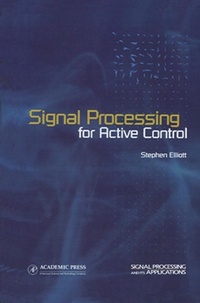
Signal Processing for Active Control
Published on 26. September 2000
511 pages
978-0-08-051713-1 (ISBN)
Description

Signal Processing for Active Control sets out the signal processing and automatic control techniques that are used in the analysis and implementation of active systems for the control of sound and vibration. After reviewing the performance limitations introduced by physical aspects of active control, Stephen Elliott presents the calculation of the optimal performance and the implementation of adaptive real time controllers for a wide variety of active control systems.Active sound and vibration control are technologically important problems with many applications. 'Active control' means controlling disturbance by superimposing a second disturbance on the original source of disturbance. Put simply, initial noise + other specially-generated noise or vibration = silence [or controlled noise]. This book presents a unified approach to techniques that are used in the analysis and implementation of different control systems. It includes practical examples at the end of each chapter to illustrate the use of various approaches.This book is intended for researchers, engineers, and students in the field of acoustics, active control, signal processing, and electrical engineering.
More details
Other editions
Additional editions
Stephen Elliott
Signal Processing for Active Control
Book
09/2000
Academic Press
€149.80
Shipment within 15-20 days
Content
- Front Cover
- Signal Processing for Active Control
- Copyright Page
- Contents
- Series Preface
- Dedication
- Preface
- Glossary
- Chapter 1. The Physical Basis for Active Control
- 1.1. Introduction
- 1.2. Control of wave transmission
- 1.3. Control of power in infinite systems
- 1.4. Strategies of control in finite systems
- 1.5. Control of energy in finite systems
- 1.6. Control of sound radiation from structures
- 1.7. Local control of sound and vibration
- Chapter 2. Optimal and Adaptive Digital Filters
- 2.1. Introduction
- 2.2. Structure of digital filters
- 2.3. Optimal filters in the time domain
- 2.4. Optimal filters in the transfortn Domain
- 2.5. Multichannel optimal filters
- 2.6. The LMS algorithm
- 2.7. The RLS algorithm
- 2.8. Frcquency-dornain adaptation
- 2.9. Adaptive IIR filters
- Chapter 3. Single-Channel Feedforward Control
- 3.1. Introduction
- 3.2. Control of deterministic disturbances
- 3.3. Optimal control of stochastic disturbances
- 3.4. Adaptive FIR controllers
- 3.5. Frequency-domain adaptation of FIR controllers
- 3.6. Plant identification
- 3.7. Adaptive IIR controllers
- 3.8. Practical applications
- Chapter 4. Multichannel Control of Tonal Disturbances
- 4.1. Introduction
- 4.2. Optinlal control of tonal disturbances
- 4.3. Steepest-descent algorithms
- 4.4. Robustness to plant uncertainties and plant tnodel errors
- 4.5. Iterative least-squares algorithms
- 4.6. Feedback control interpretation of adaptive feedforward systems
- 4.7. Minimisation of the maximum level at any sensor
- 4.8. Applications
- Chapter 5. Multichannel Control of Stochastic Disturbances
- 5.1. Introduction
- 5.2. Optimal control in the time domain
- 5.3. Optimal control in the transfom domain
- 5.4. Adaptive algorithms in the time domain
- 5.5. The preconditioned LMS algorithm
- 5.6. Adaptive algorithms in the frequency domain
- 5.7. Application: controlling road noise in vehicles
- Chapter 6. Design and Perfomance of Feedback Controllers
- 6.1. Introduction
- 6.2. Analogue controllers
- 6.3. Digital controllers
- 6.4. Internal model control (IMC)
- 6.5. Optimal control in the titne domain
- 6.6. Optimal control in the transform domain
- 6.7. Multichannel feedback controllers
- 6.8. Robust stahility for multichannel systems
- 6.9. Optimal multichannel control
- 6.10. Application: active headrest
- Chapter 7. Adaptive Feedback Controllers
- 7.1. Introduction
- 7.2. Tirne-domain adaptation
- 7.3. Frequency-domain adaptation
- 7.4. Combined feedback and feedforward control
- 7.5. Combined analogue and digital controllers
- 7.6. Application: active headsets
- Chapter 8. Active Control of Nonlinear Systems
- 8.1. Introduction
- 8.2. Analytical descriptions of nonlinear systems
- 8.3. Neural networks
- 8.4. Adaptive feedforward control
- 8.5. Chaotic systems
- 8.6. Control of chaotic behaviour
- Chapter 9. Optimisation of Transducer Location
- 9.1. The optilnisation problcnl
- 9.2. Optimisation of secondary source and error sensor location
- 9.3. Application of genetic algorithms
- 9.4. Application of simulated annealing
- 9.5. Practical optimisation of source location
- Chapter 10. Hardware for Active Control
- 10.1. Introduction
- 10.2. Anti-aliasing filters
- 10.3. Reconstruction filters
- 10.4. Filter delay
- 10.5. Data converters
- 10.6. Data quantisation
- 10.7. Processor requirements
- 10.8. Finite-precision effects
- Appendix: Linear Algebra and the Description of Multichannel Systems
- A.l. Vectors
- A.2. Matrices
- A.3. Determinants and the inverse matrix
- A.4. Trace of a matrix and its derivatives
- A.5. Outer products and spectral density matrices
- A.6. Matrix and vector quadratic equations
- A.7. Eigenvalue/eigenvector decomposition
- A.8. Singular value decomposition
- A.9. Vector and matrix norms
- References
- Index
