

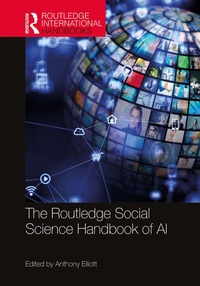
The Routledge Social Science Handbook of AI
1st Edition
Published on 12. July 2021
386 pages
978-0-429-58396-4 (ISBN)
Description

The Routledge Social Science Handbook of AI is a landmark volume providing students and teachers with a comprehensive and accessible guide to the major topics and trends of research in the social sciences of artificial intelligence (AI), as well as surveying how the digital revolution - from supercomputers and social media to advanced automation and robotics - is transforming society, culture, politics and economy.
The Handbook provides representative coverage of the full range of social science engagements with the AI revolution, from employment and jobs to education and new digital skills to automated technologies of military warfare and the future of ethics. The reference work is introduced by editor Anthony Elliott, who addresses the question of relationship of social sciences to artificial intelligence, and who surveys various convergences and divergences between contemporary social theory and the digital revolution.
The Handbook is exceptionally wide-ranging in span, covering topics all the way from AI technologies in everyday life to single-purpose robots throughout home and work life, and from the mainstreaming of human-machine interfaces to the latest advances in AI, such as the ability to mimic (and improve on) many aspects of human brain function.
A unique integration of social science on the one hand and new technologies of artificial intelligence on the other, this Handbook offers readers new ways of understanding the rise of AI and its associated global transformations. Written in a clear and direct style, the Handbook will appeal to a wide undergraduate audience.
The Handbook provides representative coverage of the full range of social science engagements with the AI revolution, from employment and jobs to education and new digital skills to automated technologies of military warfare and the future of ethics. The reference work is introduced by editor Anthony Elliott, who addresses the question of relationship of social sciences to artificial intelligence, and who surveys various convergences and divergences between contemporary social theory and the digital revolution.
The Handbook is exceptionally wide-ranging in span, covering topics all the way from AI technologies in everyday life to single-purpose robots throughout home and work life, and from the mainstreaming of human-machine interfaces to the latest advances in AI, such as the ability to mimic (and improve on) many aspects of human brain function.
A unique integration of social science on the one hand and new technologies of artificial intelligence on the other, this Handbook offers readers new ways of understanding the rise of AI and its associated global transformations. Written in a clear and direct style, the Handbook will appeal to a wide undergraduate audience.
Reviews / Votes
"As expected from a handbook with the goal of summarizing current debates, questions are posed and controversies noted more often than answers are offered in this collection of 21 essays. However, surveying so many different angles on artificial intelligence (AI) allows some insight-inducing themes to emerge. AI and machine learning (ML) are everywhere, from a cellphone's virtual assistant to tech support chatbots, including in the machines that decipher handwritten addresses for the US Postal Service. Many AI systems are assisted by small armies of humans who fill in when the software fails. Such technology remains invisible to most people yet shapes their understandings of the world and themselves. People think and categorize, work, play, and govern themselves differently because of AI-they adopt algorithmic thinking, see new value in inferential reasoning because of big data, and treat anthropomorphic robots like persons. Sometimes these changes are obvious or can be articulated, but some seem to influence human experience and expectations of the world itself, as in the debatable but widespread idea that minds are computers, and computers are (so far fairly limited) minds. Many will use this book, though specialists are likely to be most interested. Summing Up: Highly recommended. Lower- and upper-division undergraduates. Graduate students and faculty. General readers."Matthew J. Moore, Professor of Political Science, California Polytechnic State University, San Luis Obispo, USA
More details
Series
Edition
1. Auflage
Language
English
Place of publication
London
United Kingdom
Publishing group
Taylor & Francis Ltd
Target group
College/higher education
Illustrations
3 Tables, black and white; 1 Line drawings, black and white; 6 Halftones, black and white; 7 Illustrations, black and white
File size
4,11 MB
ISBN-13
978-0-429-58396-4 (9780429583964)
Copyright in bibliographic data and cover images is held by Nielsen Book Services Limited or by the publishers or by their respective licensors: all rights reserved.
Schweitzer Classification
Other editions
Additional editions
Anthony Elliott
The Routledge Social Science Handbook of AI
Book
01/2023
1st Edition
Routledge
€69.40
Shipment within 10-20 days
Anthony Elliott
The Routledge Social Science Handbook of AI
Book
07/2021
1st Edition
Routledge
€311.50
Shipment within 15-20 days
Person
Anthony Elliott is Dean of External Engagement at the University of South Australia, where he is Research Professor of Sociology and Executive Director of the Jean Monnet Centre of Excellence and Network. He is Super-Global Professor of Sociology (Visiting) at Keio University, Japan; Fellow of the Academy of Social Sciences in the UK; Fellow of the Academy of the Social Sciences in Australia; and, Senior Member of King's College, Cambridge. He is the General Editor of the Routledge Key Ideas book series and the author and editor of over 40 books, including most recently The Culture of AI: Everyday Life and the Digital Revolution (Routledge, 2019), Reinvention, 2nd edition (Routledge, 2021) and Making Sense of AI: Our Algorithmic World (Polity, 2021).
Content
Part I: Social Science Approaches to Artificial Intelligence 1. The Complex Systems of AI: Recent Trajectories of Social Theory 2. Geographies of AI 3. Artificial Intelligence and Psychology 4. AI in the Age of Technoscience: On the Rise of Data-Driven AI and its Epistem-Ontological Foundations 5. Work, Employment and Unemployment After AI 6. Affects After AI: Sociological Perspectives on Artificial Companionship 7. Anthropology, AI and Robotics 8. Ethics of Artificial Intelligence 9. Human-Machine Interaction and Design Methods Part II: Fields of Artificial Intelligence in Social Science Research 10. Management and Organisation in the Age of AI 11. Ambivalent Places of Politics: The Social Construction of Certainties in Automated Mobilities and Artificial Intelligence 12. Smart Environments 13. Models of Law and Regulation for AI 14. Artificial Intelligence and Cyber-security 15. Lethal Autonomous Weapons Systems 16. AI and Worldviews in the Age of Computational Power 17. Technogenarians: Ageing and Robotic Care 18. Big Data and Data Analytics 19. AI, Culture Industries and Entertainment 20. AI, Robotics, Medicine and Health Sciences 21. AI, Smart Borders and Migration
