

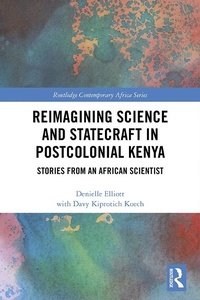
Reimagining Science and Statecraft in Postcolonial Kenya
Stories from an African Scientist
1st Edition
Published on 3. September 2018
240 pages
978-1-351-67237-5 (ISBN)
Description

This book examines the development of medical sciences in postcolonial Kenya, through the adventures and stories of the controversial Kalenjin scientist Davy Kiprotich Koech. As a collaborative life story project, it privileges African voices and retellings, re-centring the voice of African scientists from the peripheries of storytelling about science, global health research collaborations, national politics, international geopolitical alliances, and medical research.
Focusing largely on the development of the Kenya Medical Research Institute (KEMRI) and its collaborations with the US Centers for Disease Control, the Walter Reed Project, Japan's International Cooperation Agency, the Wellcome Trust, and other international partners, Denielle Elliott and Davy Koech challenge euro-dominant representations of African science and global health in both the contemporary and historical and offer an unconventional account which aims to destabilize colonial and neo-colonial narratives about African science, scientists, and statecraft. The stories force readers to contend with a series of questions including: How do imperial effects shape contemporary medical research and national sovereignty? In which ways do the colonial ghosts of early medical research infuse the struggles of postcolonial scientists to build national scientific projects? How were postcolonial nation-building projects tied up with the dreams and visions of African scientists? And lastly, how might we reimagine African medicine and biosciences?
The monograph will be of interest to students, educators, and scholars working in African Studies, Science and Technology Studies, Postcolonial Studies, Global Health, Cultural Anthropology, and Medical Anthropology.
Focusing largely on the development of the Kenya Medical Research Institute (KEMRI) and its collaborations with the US Centers for Disease Control, the Walter Reed Project, Japan's International Cooperation Agency, the Wellcome Trust, and other international partners, Denielle Elliott and Davy Koech challenge euro-dominant representations of African science and global health in both the contemporary and historical and offer an unconventional account which aims to destabilize colonial and neo-colonial narratives about African science, scientists, and statecraft. The stories force readers to contend with a series of questions including: How do imperial effects shape contemporary medical research and national sovereignty? In which ways do the colonial ghosts of early medical research infuse the struggles of postcolonial scientists to build national scientific projects? How were postcolonial nation-building projects tied up with the dreams and visions of African scientists? And lastly, how might we reimagine African medicine and biosciences?
The monograph will be of interest to students, educators, and scholars working in African Studies, Science and Technology Studies, Postcolonial Studies, Global Health, Cultural Anthropology, and Medical Anthropology.
Reviews / Votes
Stories attest to the profoundly relational nature of human experience and achievement. With these engaging tales from the life of one of Kenya's most prominent scientists, Denielle Elliott's book reveals the intricate web of relationship and heritage through which postcolonial citizens here and elsewhere pursue knowledge, negotiate statecraft, and navigate the promises and pitfalls of transcontinental connection.Anand Pandian, Johns Hopkins University, USA
This book delivers a rare first-person account of international research by an African scientist. It is a book about experiments, by medical researchers facing a terrible plague, by an ambitious man in post-colonial Kenya, and by an anthropologist looking for new ways to narrate stories about African science. Davy Kiprotich Koech bravely recalled his memories of a sometimes controversial life in interviews with Denielle Elliott. Elliott's sensitive framing of Koech's testimony offers critical insight into the politics of knowledge in Africa, of power in Kenya, and of the ways that stories make selves.
Nancy J. Jacobs, Brown University, USA
More details
Series
Edition
1. Auflage
Language
English
Place of publication
London
United Kingdom
Publishing group
Taylor & Francis Ltd
Target group
College/higher education
Professional and scholarly
Illustrations
22 Halftones, black and white; 22 Illustrations, black and white
File size
18,16 MB
ISBN-13
978-1-351-67237-5 (9781351672375)
Copyright in bibliographic data and cover images is held by Nielsen Book Services Limited or by the publishers or by their respective licensors: all rights reserved.
Schweitzer Classification
Other editions
Additional editions
Denielle Elliott
Reimagining Science and Statecraft in Postcolonial Kenya
Stories from an African Scientist
Book
09/2020
1st Edition
Routledge
€52.07
Shipment within 15-20 days
Denielle Elliott
Reimagining Science and Statecraft in Postcolonial Kenya
Stories from an African Scientist
Book
08/2018
1st Edition
Routledge
€207.60
Shipment within 10-20 days
Person
Denielle Elliott is an Associate Professor in the Departments of Social Science and Anthropology at York University in Toronto, Canada with cross-appointments in the graduate programs of International Development Studies, and Science, Technology and Studies. She is a founder and co-curator of the Centre for Imaginative Ethnography, and writes on questions relating to social suffering, colonialism, morality, and the politics of medicine.
Content
List of Illustrations
Preface
The Art of Storytelling / Stories of Science: An introduction
Daudi
Colonial Administration
Soliat Primary School
Growing up During Independence
Hospitalization
Student Life and Education Reforms
Kericho Tea Hotel
On Becoming a Scientist
Siberia
HLA tissue-typing and kidney transplants in Kenya
Science and Technology Amendment Act
Daniel arap Moi
National Politics
The Kenya Medical Research Institute
Japan
Division of Vector Borne Diseases
Wellcome Trust
Walter Reed Project / US Army Research Unit
The US Embassy and the CDC
The KEMRON Trial
Saba Saba and the KEMRON Results
Kinshasa and Racial Politics
A Son's Death
Collaborative agreements and fiscal irregularities
The Accusations
Ethics and Anti-Corruption Commission
The Arrest
Corporate executive
Faith
Epilogue by Davy Kiprotich Koech
Preface
The Art of Storytelling / Stories of Science: An introduction
Daudi
Colonial Administration
Soliat Primary School
Growing up During Independence
Hospitalization
Student Life and Education Reforms
Kericho Tea Hotel
On Becoming a Scientist
Siberia
HLA tissue-typing and kidney transplants in Kenya
Science and Technology Amendment Act
Daniel arap Moi
National Politics
The Kenya Medical Research Institute
Japan
Division of Vector Borne Diseases
Wellcome Trust
Walter Reed Project / US Army Research Unit
The US Embassy and the CDC
The KEMRON Trial
Saba Saba and the KEMRON Results
Kinshasa and Racial Politics
A Son's Death
Collaborative agreements and fiscal irregularities
The Accusations
Ethics and Anti-Corruption Commission
The Arrest
Corporate executive
Faith
Epilogue by Davy Kiprotich Koech
