

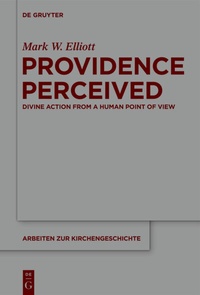
Providence Perceived
Divine Action from a Human Point of View
1st Edition
Published on 24. April 2015
VIII, 334 pages
978-3-11-031064-1 (ISBN)
Description

This book will offer an account not so much of God's Providence an sich, but rather of divine providence as experienced by believers and unbelievers. It will not ask questions about whether and how God knows the future, or how suffering can be accounted for (as is the case in the treatments by William Lane Craig, Richard Swinburne, or J. Sanders), but will focus on prayer and decision-making as a faithful and/or desperate response to the perception of God as having some controlling influence. The following gives an idea of the ground to be covered: The patristic foundations of the Christian view of Providence; The medieval synthesis of 'objective' and 'subjective' views; Reformational and Early Modern: the shift towards piety; Modern Enlightenment: Providence and Ethics; Barth and the Sceptics; The sense of Providence in the Modern Novel and World.
More details
Other editions
Additional editions
E-Book
04/2015
1st Edition
De Gruyter
€149.95
Available for download
Book
03/2015
1st Edition
De Gruyter
€149.95
Shipment within 7-9 days
Person
Mark W. Elliott, University of St Andrews, Scotland, United Kingdom.
Content
- Intro
- Contents
- Introduction
- Chapter One: Providence in the early Christian Church's Theology
- Ecumenical Beginnings after the Apostolic Era
- The Western development
- Political History
- Chapter Two: The Medieval Account of Providence
- Boethius first
- Medieval Historiography
- Byzantium and Eastern Christianity
- The Western High Middle Ages
- Chapter Three: Later Medieval Developments
- Alternatives to the High Medieval Consensus
- More radical traditions
- Chapter Four: Reformation Providence
- The impact of Luther
- Calvin and the Swiss-Dutch tradition
- The Heidelberg Catechism and Bullinger
- And the Lutherans?
- Catholic voices
- Chapter Five: The Doctrine's Fortunes in the Early Modern Era
- Protestant and Catholic perceptions
- Philosophical Moves
- Theological responses in the Early Enlightenment
- Chapter Six: The Enlightenment's ongoing Challenge to the Doctrine of Providence
- Later Enlightenment voices
- Hegel and Beyond
- Chapter Seven: Providence in twentieth-century theological discussion
- The major contribution of Barth: renewing the tradition
- Reactions to Barth on Providence
- Providence in post-confessional German theology from 1960 onwards
- English-speaking discussion
- Recent Catholic contribution to the Doctrine
- The place of the historical in God's purposes
- Chapter Eight: Coming up to date: works in the last five years
- Conclusion
- Bibliography
- Index of Scripture References
- Index of Key Figures
