

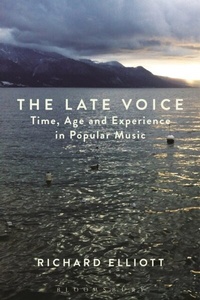
The Late Voice
Time, Age and Experience in Popular Music
1st Edition
Published on 22. October 2015
320 pages
978-1-62892-083-3 (ISBN)
Description

Popular music artists, as performers in the public eye, offer a privileged site for the witnessing and analysis of ageing and its mediation. The Late Voice undertakes such an analysis by considering issues of time, memory, innocence and experience in modern Anglophone popular song and the use by singers and songwriters of a 'late voice'. Lateness here refers to five primary issues: chronology (the stage in an artist's career); the vocal act (the ability to convincingly portray experience); afterlife (posthumous careers made possible by recorded sound); retrospection (how voices 'look back' or anticipate looking back); and the writing of age, experience, lateness and loss into song texts.
There has been recent growth in research on ageing and the experience of later stages of life, focusing on physical health, lifestyle and psychology, with work in the latter field intersecting with the field of memory studies. The Late Voice seeks to connect age, experience and lateness with particular performers and performance traditions via the identification and analysis of a late voice in singers and songwriters of mid-late twentieth century popular music.
There has been recent growth in research on ageing and the experience of later stages of life, focusing on physical health, lifestyle and psychology, with work in the latter field intersecting with the field of memory studies. The Late Voice seeks to connect age, experience and lateness with particular performers and performance traditions via the identification and analysis of a late voice in singers and songwriters of mid-late twentieth century popular music.
Reviews / Votes
Elliott (popular music, Univ. of Sussex, UK) has written a complex analysis of 'the late voice' of a number of musicians. The first chapter, "Time, Age, Experience, and Voice," is analytical, drawing on numerous theoretical studies. In chapter 2, Elliot provides an interesting discussion of Ralph Stanley, known now for his performance of "O Death" in the film O Brother, Where Art Thou? (2000) but whose country music recording career began in the 1940s. Elliott places Stanley within the southern musical tradition of 'cultural isolation that preserved the old ways and the old songs and that projected the region onto the national imaginary as a place of backwardness.' Subsequent chapters discuss a variety of performers -Frank Sinatra, Leonard Cohen, Bob Dylan, Joni Mitchell, Neil Young, Judy Collins-focusing on the substance and meaning of their songs and providing some biographical background. In his conclusion, Elliott writes that his aim in writing the book was 'not so much to remove value from the metaphysics of age but to locate it at various points in the life course.' Summing Up: Recommended. Upper-division undergraduates through faculty. * CHOICE * Engagingly written, carefully thought through, and characterised by exemplary scholarship, Richard Elliott's book navigates with great elegance some complex theoretical waters. Through a selection of rich case studies, Elliott offers a powerful contribution to a growing body of work on ageing, nostalgia, and memory, particularly in relation to music. * Freya Jarman, Senior Lecturer, Department of Music, University of Liverpool, UK * This thoughtful intervention to the interdisciplinary area of popular music and ageing brings sustained critical attention to the aesthetic concerns of the 'late voice' by offering a range of distinctive case studies of singers, songwriters and songs. The result is an impressive synthesis of theory and analysis that bridges popular music studies and traditional musicology as an approach to understand music, ageing and experience. * Ros Jennings, Director of the Research Centre for Women, Ageing and Media, University of Gloucestershire, UK * Through a series of illuminating case studies of particular singers, Richard Elliott shows how age, memory, temporal distance and loss are displayed in vocal quality as well as lyrical content. This is an original book: theoretically informed, and full of insight into the process of assimilating and evaluating what time, age and experience bring to us, it breaks new ground in studies of popular music, and deserves to be widely read. * Michael Pickering, Professor of Media and Cultural Analysis, Loughborough University, UK *More details
Edition
1. Auflage
Language
English
Place of publication
New York
United States
Publishing group
Bloomsbury Publishing PLC (Digital)
Target group
Professional and scholarly
ISBN-13
978-1-62892-083-3 (9781628920833)
Copyright in bibliographic data and cover images is held by Nielsen Book Services Limited or by the publishers or by their respective licensors: all rights reserved.
Schweitzer Classification
Other editions
Additional editions
Book
05/2017
Bloomsbury Academic USA
€57.10
Shipment within 15-20 days
Book
10/2015
Bloomsbury Academic USA
€193.70
Shipment within 3-4 weeks
Person
Richard Elliott is Senior Lecturer in Music at Newcastle University, UK. He is the author of Fado and the Place of Longing (2010).
Content
Introduction
Chapter 1: Time, Age, Experience and Voice
Chapter 2: Won't You Spare Me Over till Another Year? Ralph Stanley's Late Voice
Chapter 3: September of My Years: Age and Experience in the Work of Frank Sinatra and Leonard Cohen
Chapter 4: Time Out of Mind: Bob Dylan, Age and Those Same Distant Places
Chapter 5: Both Sides Now: Joni Mitchell, Neil Young and the Innocence and Experience of the Singer-Songwriter
Conclusion: Late Thoughts
Bibliography
Discography
Filmography
Index
Chapter 1: Time, Age, Experience and Voice
Chapter 2: Won't You Spare Me Over till Another Year? Ralph Stanley's Late Voice
Chapter 3: September of My Years: Age and Experience in the Work of Frank Sinatra and Leonard Cohen
Chapter 4: Time Out of Mind: Bob Dylan, Age and Those Same Distant Places
Chapter 5: Both Sides Now: Joni Mitchell, Neil Young and the Innocence and Experience of the Singer-Songwriter
Conclusion: Late Thoughts
Bibliography
Discography
Filmography
Index
