

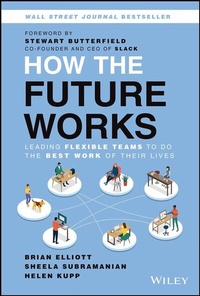
How the Future Works
Description

Unlock the power of flexible work with this practical 'how-to' guide from the leadership of Slack and Future Forum
The way we work has changed. The era of toiling from nine-to-five, five-days-a-week in the office is now a relic of the past, and is being replaced by a better way-flexible work. But flexibility means a lot more than a day or two a week to 'work from home': 93% of your employees want more flexibility in when, not just where, they work. They want choice and they are leaving their roles to find it. The most successful leaders will go much further than offering occasional remote workdays-they will redesign every aspect of how work gets done, from defining how they measure organizational success to training their managers to make it happen.
How the Future Works: Leading Flexible Teams to Do The Best Work of Their Lives offers a blueprint for using flexible work to unlock the potential of your people. The book offers the steps necessary to building the new principles and guardrails to empower flexible, high-performing teams. And it teaches readers to lead with purpose, to manage and measure differently, and to believe that by letting go, they'll get more back than they thought possible.
How the Future Works explains how to:
- Establish leadership principles, commitments, and outcomes for truly flexible teamwork
- Measure and assess productivity in a flexible workplace
- Reskill managers to ensure a level playing field for all employees
- Implement the infrastructure necessary to make flexible work successful
Using original research from Future Forum, a consortium by Slack, and global case studies from leading companies such as Levi Strauss & Co., Genentech, Royal Bank of Canada, and IBM, How the Future Works offers concrete solutions and practical steps for building high functioning teams of talented, engaged people by providing them with the flexibility and choice they need to do their best work.
BRIAN ELLIOTT is Executive Leader of Future Forum, a consortium backed by Slack and founding partners Boston Consulting Group, MillerKnoll, and Management Leadership for Tomorrow. Future Forum enables leaders to redesign work to be better for people and organizations. He has spent three decades leading teams and building companies as a startup CEO, at Google, and now at Slack where he is a Senior VP. Brian's a proud father of two young men.
SHEELA SUBRAMANIAN is Vice President and co-founder of Future Forum. She has 20 years of experience building high-growth global teams across Google, Slack, and startup organizations. As a champion for workplace equity, her work is cited in the Wall Street Journal, New York Times, Fast Company, and other top-tier publications. Sheela earned her BA from Stanford and MBA from Harvard Business School and is the mother to two magical daughters.
HELEN KUPP is a co-founder and Senior Director of Future Forum. She has led many of Slack's largest cross-functional and growth initiatives, and is the creator of many of Future Forum's playbooks, tapping Future Forum's research and networks along with her experiences at Slack, Bain & Company, startups, and her MBA from Harvard Business School. She's also the lucky mom of two wonderful children.
More details
Other editions
Additional editions
Persons
SHEELA SUBRAMANIAN is Vice President and co-founder of Future Forum. She has 20 years of experience building high-growth global teams across Google, Slack, and startup organizations. As a champion for workplace equity, her work is cited in the Wall Street Journal, New York Times, Fast Company, and other top-tier publications. Sheela earned her BA from Stanford and MBA from Harvard Business School and is the mother to two magical daughters.
HELEN KUPP is a co-founder and Senior Director of Future Forum. She has led many of Slack's largest cross-functional and growth initiatives, and is the creator of many of Future Forum's playbooks, tapping Future Forum's research and networks along with her experiences at Slack, Bain & Company, startups, and her MBA from Harvard Business School. She's also the lucky mom of two wonderful children.
Content
Introduction: The 9-to-5 Just Doesn't Work for Us Anymore (and Maybe Never Did)
Why Flexible Work Works
How the Future Works: The 7 Steps to Getting There
Step 1: Stand for Something: Agree on Purpose and Principles
Step 2: Level the Playing Field: Create Guardrails for Behavior
Step 3: Commit to How You'll Work: Develop Team-Level Agreements
Step 4: Experiment, Experiment, Experiment: Normalize a Culture of Learning
Step 5: Create a Culture of Connection from Anywhere: Reimagine Your Headquarters
Step 6: Train Your Leaders to Make It Work: Soft Skills Matter More Than Ever
Step 7: Focus on the Outcomes: Avoid the Doom Loop and Embrace the Boom Loop
Conclusion
Resources: Your Flexible Work Toolkit
Acknowledgments
Cast of Experts
About the Authors
