

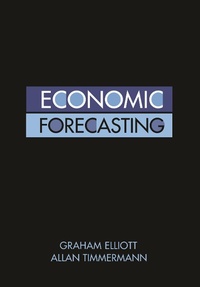
Economic Forecasting
Description

A comprehensive and integrated approach to economic forecasting problems
Economic forecasting involves choosing simple yet robust models to best approximate highly complex and evolving data-generating processes. This poses unique challenges for researchers in a host of practical forecasting situations, from forecasting budget deficits and assessing financial risk to predicting inflation and stock market returns. Economic Forecasting presents a comprehensive, unified approach to assessing the costs and benefits of different methods currently available to forecasters.
This text approaches forecasting problems from the perspective of decision theory and estimation, and demonstrates the profound implications of this approach for how we understand variable selection, estimation, and combination methods for forecasting models, and how we evaluate the resulting forecasts. Both Bayesian and non-Bayesian methods are covered in depth, as are a range of cutting-edge techniques for producing point, interval, and density forecasts. The book features detailed presentations and empirical examples of a range of forecasting methods and shows how to generate forecasts in the presence of large-dimensional sets of predictor variables. The authors pay special attention to how estimation error, model uncertainty, and model instability affect forecasting performance.
- Presents a comprehensive and integrated approach to assessing the strengths and weaknesses of different forecasting methods
- Approaches forecasting from a decision theoretic and estimation perspective
- Covers Bayesian modeling, including methods for generating density forecasts
- Discusses model selection methods as well as forecast combinations
- Covers a large range of nonlinear prediction models, including regime switching models, threshold autoregressions, and models with time-varying volatility
- Features numerous empirical examples
- Examines the latest advances in forecast evaluation
- Essential for practitioners and students alike
More details
Other editions
Additional editions
Person
Content
- Cover
- Title
- Copyright
- Dedication
- Contents
- Preface
- I Foundations
- 1 Introduction
- 1.1 Outline of the Book
- 1.2 Technical Notes
- 2 Loss Functions
- 2.1 Construction and Specification of the Loss Function
- 2.2 Specific Loss Functions
- 2.3 Multivariate Loss Functions
- 2.4 Scoring Rules for Distribution Forecasts
- 2.5 Examples of Applications of Forecasts in Macroeconomics and Finance
- 2.6 Conclusion
- 3 The Parametric Forecasting Problem
- 3.1 Optimal Point Forecasts
- 3.2 Classical Approach
- 3.3 Bayesian Approach
- 3.4 Relating the Bayesian and Classical Methods
- 3.5 Empirical Example: Asset Allocation with Parameter Uncertainty
- 3.6 Conclusion
- 4 Classical Estimation of Forecasting Models
- 4.1 Loss-Based Estimators
- 4.2 Plug-In Estimators
- 4.3 Parametric versus Nonparametric Estimation Approaches
- 4.4 Conclusion
- 5 Bayesian Forecasting Methods
- 5.1 Bayes Risk
- 5.2 Ridge and Shrinkage Estimators
- 5.3 Computational Methods
- 5.4 Economic Applications of Bayesian Forecasting Methods
- 5.5 Conclusion
- 6 Model Selection
- 6.1 Trade-Offs in Model Selection
- 6.2 Sequential Hypothesis Testing
- 6.3 Information Criteria
- 6.4 Cross Validation
- 6.5 Lasso Model Selection
- 6.6 Hard versus Soft Thresholds: Bagging
- 6.7 Empirical Illustration: Forecasting Stock Returns
- 6.8 Properties of Model Selection Procedures
- 6.9 Risk for Model Selection Methods: Monte Carlo Simulations
- 6.10 Conclusion
- 6.11 Appendix: Derivation of Information Criteria
- II Forecast Methods
- 7 Univariate Linear Prediction Models
- 7.1 ARMA Models as Approximations
- 7.2 Estimation and Lag Selection for ARMA Models
- 7.3 Forecasting with ARMA Models
- 7.4 Deterministic and Seasonal Components
- 7.5 Exponential Smoothing and Unobserved Components
- 7.6 Conclusion
- 8 Univariate Nonlinear Prediction Models
- 8.1 Threshold Autoregressive Models
- 8.2 Smooth Transition Autoregressive Models
- 8.3 Regime Switching Models
- 8.4 Testing for Nonlinearity
- 8.5 Forecasting with Nonlinear Univariate Models
- 8.6 Conclusion
- 9 Vector Autoregressions
- 9.1 Specification of Vector Autoregressions
- 9.2 Classical Estimation of VARs
- 9.3 Bayesian VARs
- 9.4 DSGE Models
- 9.5 Conditional Forecasts
- 9.6 Empirical Example
- 9.7 Conclusion
- 10 Forecasting in a Data-Rich Environment
- 10.1 Forecasting with Factor Models
- 10.2 Estimation of Factors
- 10.3 Determining the Number of Common Factors
- 10.4 Practical Issues Arising with Factor Models
- 10.5 Empirical Evidence
- 10.6 Forecasting with Panel Data
- 10.7 Conclusion
- 11 Nonparametric Forecasting Methods
- 11.1 Kernel Estimation of Forecasting Models
- 11.2 Estimation of Sieve Models
- 11.3 Boosted Regression Trees
- 11.4 Conclusion
- 12 Binary Forecasts
- 12.1 Point and Probability Forecasts for Binary Outcomes
- 12.2 Density Forecasts for Binary Outcomes
- 12.3 Constructing Point Forecasts for Binary Outcomes
- 12.4 Empirical Application: Forecasting the Direction of the Stock Market
- 12.5 Conclusion
- 13 Volatility and Density Forecasting
- 13.1 Role of the Loss Function
- 13.2 Volatility Models
- 13.3 Forecasts Using Realized Volatility Measures
- 13.4 Approaches to Density Forecasting
- 13.5 Interval and Quantile Forecasts
- 13.6 Multivariate Volatility Models
- 13.7 Copulas
- 13.8 Conclusion
- 14 Forecast Combinations
- 14.1 Optimal Forecast Combinations: Theory
- 14.2 Estimation of Forecast Combination Weights
- 14.3 Risk for Forecast Combinations
- 14.4 Model Combination
- 14.5 Density Combination
- 14.6 Bayesian Model Averaging
- 14.7 Empirical Evidence
- 14.8 Conclusion
- III Forecast Evaluation
- 15 Desirable Properties of Forecasts
- 15.1 Informal Evaluation Methods
- 15.2 Loss Decomposition Methods
- 15.3 Efficiency Properties with Known Loss
- 15.4 Optimality Tests under Unknown Loss
- 15.5 Optimality Tests That Do Not Rely on Measuring the Outcome
- 15.6 Interpreting Efficiency Tests
- 15.7 Conclusion
- 16 Evaluation of Individual Forecasts
- 16.1 The Sampling Distribution of Average Losses
- 16.2 Simulating Out-of-Sample Forecasts
- 16.3 Conducting Inference on the Out-of-Sample Average Loss
- 16.4 Out-of-Sample Asymptotics for Rationality Tests
- 16.5 Evaluation of Aggregate versus Disaggregate Forecasts
- 16.6 Conclusion
- 17 Evaluation and Comparison of Multiple Forecasts
- 17.1 Forecast Encompassing Tests
- 17.2 Tests of Equivalent Expected Loss: The Diebold-Mariano Test
- 17.3 Comparing Forecasting Methods: The Giacomini-White Approach
- 17.4 Comparing Forecasting Performance across Nested Models
- 17.5 Comparing Many Forecasts
- 17.6 Addressing Data Mining
- 17.7 Identifying Superior Models
- 17.8 Choice of Sample Split
- 17.9 Relating the Methods
- 17.10 In-Sample versus Out-of-Sample Forecast Comparison
- 17.11 Conclusion
- 18 Evaluating Density Forecasts
- 18.1 Evaluation Based on Loss Functions
- 18.2 Evaluating Features of Distributional Forecasts
- 18.3 Tests Based on the Probability Integral Transform
- 18.4 Evaluation of Multicategory Forecasts
- 18.5 Evaluating Interval Forecasts
- 18.6 Conclusion
- IV Refinements and Extensions
- 19 Forecasting under Model Instability
- 19.1 Breaks and Forecasting Performance
- 19.2 Limitations of In-Sample Tests for Model Instability
- 19.3 Models with a Single Break
- 19.4 Models with Multiple Breaks
- 19.5 Forecasts That Model the Break Process
- 19.6 Ad Hoc Methods for Dealing with Breaks
- 19.7 Model Instability and Forecast Evaluation
- 19.8 Conclusion
- 20 Trending Variables and Forecasting
- 20.1 Expected Loss with Trending Variables
- 20.2 Univariate Forecasting Models
- 20.3 Multivariate Forecasting Models
- 20.4 Forecasting with Persistent Regressors
- 20.5 Forecast Evaluation
- 20.6 Conclusion
- 21 Forecasting Nonstandard Data
- 21.1 Forecasting Count Data
- 21.2 Forecasting Durations
- 21.3 Real-Time Data
- 21.4 Irregularly Observed and Unobserved Data
- 21.5 Conclusion
- Appendix
- A.1 Kalman Filter
- A.2 Kalman Filter Equations
- A.3 Orders of Probability
- A.4 Brownian Motion and Functional Central Limit Theory
- Bibliography
- Index
