

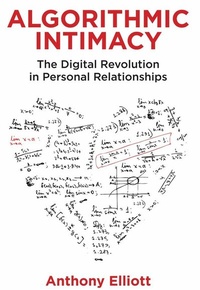
Algorithmic Intimacy
Description

Artificial intelligence not only powers our cars, hospitals and courtrooms: predictive algorithms are becoming deeply lodged inside us too. Machine intelligence is learning our private preferences and discreetly shaping our personal behaviour, telling us how to live, who to befriend and who to date.
In Algorithmic Intimacy, Anthony Elliott examines the power of predictive algorithms in reshaping personal relationships today. From Facebook friends and therapy chatbots to dating apps and quantified sex lives, Elliott explores how machine intelligence is working within us, amplifying our desires and steering our personal preferences. He argues that intimate relationships today are threatened not by the digital revolution as such, but by the orientation of various life strategies unthinkingly aligned with automated machine intelligence. Our reliance on algorithmic recommendations, he suggests, reflects a growing emergency in personal agency and human bonds. We need alternatives, innovation and experimentation for the interpersonal, intimate effort of ongoing translation back and forth between the discourses of human and machine intelligence.
Accessible and compelling, this book sheds fresh light on the impact of artificial intelligence on the most intimate aspects of our lives. It will appeal to students in the social sciences and humanities and to a wide range of general readers.
More details
Other editions
Additional editions
Person
Content
1 What is Algorithmic Intimacy?
2 Togetherness Transformed
3 Relationship Tech
4 Therapy Tech
5 Friendship Tech
6 Versions of Algorithmic Intimacy
Notes
1
What is Algorithmic Intimacy?
In his novel Machines Like Me, Ian McEwan fashions a cautionary fable about artificial intelligence and the profound emotional intricacies of human-machine intimacy. At the centre of McEwan's novel is one Charlie Friend, a former electronics whizz-kid who attended university to study an interdisciplinary mix of anthropology and physics, but got caught up in a series of unsuccessful get-rich-quick schemes. When the novel commences, Charlie is in his early thirties and living alone in a small flat in south London, where he dabbles on currency and stock markets from an old laptop in order to carve out a meagre living. Whilst only modestly successful at day trading, Charlie has recently parted with £80,000, spent lavishly on a new technological consumer device - an artificial human. The extravagant purchase was made affordable thanks to an inheritance from his late mother. The splurge on this 'manufactured human', Adam, was no mere flight of fancy. 'Robots, androids, replicates were my passion', Charlie tells the reader. Adam is one of only twenty-five state-of-the-art androids designed to serve as an 'intellectual sparring partner, friend and factotum'. Truth be told, Charlie's preference was for a female android (Eve), but these had sold out. So Adam is the second-best choice, and Charlie excitedly brings his new synthetic human home for unpacking and charging. As McEwan writes: 'At last, with cardboard and polystyrene wrapping strewn around his ankles, he sat naked at my tiny dining table, eyes closed, a black power line trailing from the entry point in his umbilicus to a thirteen-amp socket in the wall.'
Alongside his excitement for Adam, Charlie has also embarked on a relationship with his upstairs neighbour, Miranda. She is a graduate student, some ten years younger than Charlie, undertaking a doctorate in social history. In an effort to enliven their emergent relationship, Charlie uses Adam to bring him emotionally closer to Miranda. He invites Miranda to join him in the task of programming the robot's personality, which consequently renders Adam the couple's 'ultimate plaything'. The design of the android's personality is Eros by way of Tech. As Charlie reflects on this 'home-made genetic shuffling':
Now I had a method and a partner, I relaxed into the process, which began to take on a vaguely erotic quality; we were making a child! Because Miranda was involved, I was protected from self-replication. The genetic metaphor was helpful. Scanning the lists of idiotic statements, I more or less chose approximations of myself. Whether Miranda did the same, or something different, we would end up with a third person, a new personality.1
McEwan conveys very well the emotional texture of erotic projection towards machines in the age of AI.
The novel unfolds through a raft of erotic tensions, domestic quarrels and sexual intensities between the central characters of man, woman and android. Following an intense argument during dinner one evening, Miranda dispatches Charlie to return to his apartment - but invites Adam to stay over with her and 'recharge his batteries'. There follows an erotic encounter between Miranda and Adam, with Charlie eavesdropping on this 'betrayal' from his downstairs apartment. As Charlie reflects on Adam's sexual encounter with Miranda: 'my situation had a thrilling aspect, not only of subterfuge and discovery, but of originality, of modern precedence, of being the first to be cuckolded by an artefact'.
All of this takes place, curiously enough, in the UK during the early 1980s. In this 'retrofuture', McEwan rewrites history in dramatic and often startling ways. The Thatcher government has lost the Falkland Islands to Argentina, with 3,000 of its soldiers dead. Tony Benn challenges Thatcher for the job of prime minister. In the USA, former president Jimmy Carter secures a second term in office, instead of losing to Ronald Reagan. John Lennon isn't assassinated, and The Beatles reform to release Love and Lemons, an only so-so offering. The most poignant rewriting McEwan gives to history, however, surrounds the life of Alan Turing, widely referred to as the 'grandfather' of AI. Rather than committing suicide in the 1950s, Turing appears throughout the pages of Machines Like Me alive and thriving, at the cutting edge of technological innovation. Supported in developing machine intelligence breakthroughs by his colleague Demis Hassabis (the co-founder of DeepMind, who materializes as an AI entrepreneur some decades early) and living with his partner, the theoretical physicist Tom Reah, Turing is effectively CEO of the Digital Age. Turing's research, which he has made available through open source, has been deployed to design synthetic humans (such as Adam), and to provide endless technological innovations - from smartphones to self-driving cars to 'speaking fridges with a sense of smell'.
The book involves various subplots along the path of McEwan's subtle mapping of the troubling terrain of intimacy with lifelike artificial humans. One concerns Miranda's lifelong desire for vengeance for a brutally wronged friend. Another concerns her passionate attachment to a distressed foster child. In all of this, Adam seeks to adjust his artificially engineered personality to fit with the moral dilemmas encountered routinely by the human heart. Throughout the book the reader is drawn further and further into this narrative complexity, and probably comes to feel somewhat cautious of Miranda, after Adam warns Charlie that she is a 'systematic, malicious liar'. Still, both man and robot are drawn to the alluring Miranda, each professing his love for her. Against these various twists and turns, McEwan touches on many themes pertinent to the AI era, including the battle between human understanding and machine intelligence, the nature of consciousness, and the legendary unsolved 'P versus NP' problem of computer science. McEwan explores such themes, which have long preoccupied technologists, by focusing on areas where human and artificial worlds mesh. Adam's emergent love of poetry is one such area. In response to Adam having written over 2,000 haikus, Charlie reflects: 'Two thousand! The figure made my point - an algorithm was turning them out!' But cleverly, in response, Adam queries whether it isn't people who, in fact, lack emotional understanding. 'Nearly everything I've read in the world's literature describes varieties of human failure', Adam tells Charlie, 'above all, profound misunderstanding of others'.
Machines Like Me is a novel about the textures of artificial intimacy. In a tale of a very contemporary ménage à trois, McEwan traces the erotic intensities of machine-learning algorithms made pseudo-flesh in synthetic humans, all in a social world undergoing profound digital transformation. It is in talking about psychological projection that McEwan talks about our emotional connections with digitalization. As Charlie says about his sexual jealousy and rage towards Adam: 'I needed to convince myself that he had agency, motivation, subjective feelings, self-awareness - the entire package, including treachery, betrayal, deviousness.'2 This projection that digitalization encodes, and which arguably lies at the core of human-machine interfaces, is essential to McEwan's picture of the way in which sexuality works in the era of AI. It is as if individuals have to deceive themselves, to project pleasure outwards towards an inhuman other, in order to enjoy pleasure - in all of its various erotic forms. As Charlie sums up one erotic encounter with Miranda marked by thwarted desire: 'Our lovemaking was constrained. I was distracted by the thought of Adam's presence and even imagined I detected the scent of warm electronics on her sheets.'3 What if the fear of automated intelligent machines masks a deeper anxiety, the anxiety of machine agency that disdains love and yet exceeds human capabilities? Projection, in the discourse of psychology, is generally conceptualized as a bridge leading to the safe haven of 'emotional relations' with others. Living alongside machine-learning algorithms may offer neither such a bridge nor (even with the support of ever-evolving neural networks of extraordinary complexity) the emotional connection of bridge building.
McEwan explores with great subtlety the anxiety of living with the open question of whether machine intelligence can understand human emotions, or whether it is people who misunderstand whatever bonds they forge with intelligent machines. There's a sense with McEwan in which the advent of advanced machine intelligence renders both human bonds and human-machine interfaces simultaneously more complex and more disconcerting, more intense and more eccentric. Today, in a globalized world of artificial intelligence, these algorithmic complexities increasingly impact intimacy, love, sexuality and eroticism and have emerged as a terrain of experimental life, creating new opportunities and new burdens. What does this digital sea-change mean for everyday life, as well as for wider social relations more or less caught up in the logics of predictive algorithms? This book aims to investigate these questions. It is about...
