

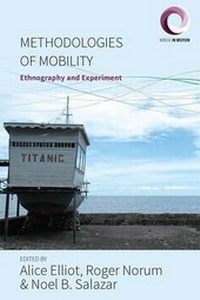
Methodologies of Mobility
Ethnography and Experiment
1st Edition
Published on 1. May 2017
216 pages
978-1-78533-481-8 (ISBN)
Description

Research into mobility is an exciting challenge for the social sciences that raises novel social, cultural, spatial and ethical questions. At the heart of these empirical and theoretical complexities lies the question of methodology: how can we best capture and understand a planet in flux? Methodologies of Mobility speaks beyond disciplinary boundaries to the methodological challenges and possibilities of engaging with a world on the move. With scholars continuing to face different forms and scales of mobility, this volume strategically traces innovative ways of designing, applying and reflecting on both established and cutting-edge methodologies of mobility.
Reviews / Votes
"Whilst wide-ranging, the diversity of chapters makes this edited volume a pleasure to read. Its strengths lie in the insights it provides for understanding mobility on a number of levels, ranging from questions of space, scale, and time to bodies and materiality... Read this volume for its excellent ethnographic coverage of a complex set of methodological and conceptual challenges at the forefront of mobility research." * Journal of the Royal Anthropological Institute (JRAI)"I recommend this book to anyone interested in the field of mobilities and in particular to ethnographers of movement to all of them really, not only to the ones more aligned with anthropology. Also, my bet is that a volume such as this has the potential to become an important handbook for all graduate students chasing after mobile fields and the realms of movement." * Anthropos
"This timely book provides welcome material for reflection on classic, contemporary and future research practices, particularly for anthropologists due to its engagement with the distinctive history of the discipline. The chapters can be read independently, which make them attractive readings for any methodology class. Considering the central role of mobility in ethnographic research, an argument put forward very convincingly in the book, one would hope that these conversations on mobility and anthropology will soon be integrated within the conventional methodology handbooks." * Social Anthropology/Anthropologie Sociale
"A treasury of rich insights into methods on the move that will inspire a new generation of mobility researchers in our burgeoning field." * Nick van Hear, Centre on Migration, Policy and Society (COMPAS), University of Oxford
"This book offers a thought-provoking and timely revision of anthropological methods on mobility. The focus these authors assume, fruitfully pushes and fine-tunes methodological engagements with mobility and ethnographic practice." * Alison Macdonald, University College London
"Methodologies of Mobility is a concrete inquiry into how specific research techniques, tightly linked to research questions, can address issues regarding mobility. This work makes a valuable contribution to social science research that concerns itself with how experiences of human movement and stasis are imbued with meaning." * Kiran C. Jayaram, York College, CUNY
More details
Series
Language
English
Place of publication
Oxford
United Kingdom
Target group
Professional and scholarly
Illustrations
Bibliography; Index; 2 Figures; 17 Illustrations
ISBN-13
978-1-78533-481-8 (9781785334818)
DOI
10.3167/9781785334801
Copyright in bibliographic data and cover images is held by Nielsen Book Services Limited or by the publishers or by their respective licensors: all rights reserved.
Schweitzer Classification
Other editions
Additional editions
Book
10/2018
1st Edition
Berghahn Books
€41.40
Shipment within 3-4 weeks
Book
05/2017
1st Edition
Berghahn Books
€146.80
Shipment within 3-4 weeks
Persons
Alice Elliot is a Lecturer in Social Anthropology at the University of Bristol, UK.
Content
List of Illustrations
Acknowledgements
Introduction: Studying Mobilities: Theoretical Notes and Methodological Queries?
Noel B. Salazar, Alice Elliot, and Roger Norum
Chapter 1. 'Few are the Roads I Haven't Travelled': Mobility as Method in Early Finland-Swedish Ethnographic Expeditions
Susanne OEsterlund-Poetzsch
Chapter 2. Inventorying Mobility: Methodology on Wheels
?Hege Hoyer Leivestad
Chapter 3. Becoming, There? In Pursuit of Mobile Methods
Chris Vasantkumar
Chapter 4. From Radar Systems to Rickety Boats: Borderline Ethnography in Europe's 'Illegality Industry'
Ruben Andersson
Chapter 5. Idleness as Method: Hairdressers and Chinese Urban Mobility in Tokyo
Jamie Coates
Chapter 6. Meeting a Friend of a Friend: Snowballing with Mr. Hansen in Naples
Hans Lucht
Chapter 7. 'Being There Where?' Designing Digital-Visual Methods for Moving With/In Iran
Shireen Walton
Chapter 8. Fixating a Fluid Field: Photography as Anthropology in Migration Research
Christian Vium
Afterword: Im/mobile Method/ologies
Simone Abram
Index
Acknowledgements
Introduction: Studying Mobilities: Theoretical Notes and Methodological Queries?
Noel B. Salazar, Alice Elliot, and Roger Norum
Chapter 1. 'Few are the Roads I Haven't Travelled': Mobility as Method in Early Finland-Swedish Ethnographic Expeditions
Susanne OEsterlund-Poetzsch
Chapter 2. Inventorying Mobility: Methodology on Wheels
?Hege Hoyer Leivestad
Chapter 3. Becoming, There? In Pursuit of Mobile Methods
Chris Vasantkumar
Chapter 4. From Radar Systems to Rickety Boats: Borderline Ethnography in Europe's 'Illegality Industry'
Ruben Andersson
Chapter 5. Idleness as Method: Hairdressers and Chinese Urban Mobility in Tokyo
Jamie Coates
Chapter 6. Meeting a Friend of a Friend: Snowballing with Mr. Hansen in Naples
Hans Lucht
Chapter 7. 'Being There Where?' Designing Digital-Visual Methods for Moving With/In Iran
Shireen Walton
Chapter 8. Fixating a Fluid Field: Photography as Anthropology in Migration Research
Christian Vium
Afterword: Im/mobile Method/ologies
Simone Abram
Index
