

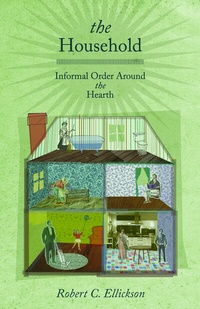
The Household
Informal Order around the Hearth
1st Edition
Published on 2. August 2010
272 pages
978-1-4008-3415-0 (ISBN)
Description

Some people dwell alone, many in family-based households, and an adventuresome few in communes. The Household is the first book to systematically lay bare the internal dynamics of these and other home arrangements. Legal underpinnings, social considerations, and economic constraints all influence how household participants select their homemates and govern their interactions around the hearth. Robert Ellickson applies transaction cost economics, sociological theory, and legal analysis to explore issues such as the sharing of household output, the control of domestic misconduct, and the ownership of dwelling units.
Drawing on a broad range of historical and statistical sources, Ellickson contrasts family-based households with the more complex arrangements in medieval English castles, Israeli kibbutzim, and contemporary cohousing communities. He shows that most individuals, when structuring their home relationships, pursue a strategy of consorting with intimates. This, he asserts, facilitates informal coordination and tends ultimately to enhance the quality of domestic interactions. He challenges utopian critics who seek to enlarge the scale of the household and legal advocates who urge household members to rely more on written contracts and lawsuits. Ellickson argues that these commentators fail to appreciate the great advantages in the home setting of informally associating with a handful of trusted intimates.
The Household is a must-read for sociologists, economists, lawyers, and anyone interested in the fundamentals of domestic life.
Drawing on a broad range of historical and statistical sources, Ellickson contrasts family-based households with the more complex arrangements in medieval English castles, Israeli kibbutzim, and contemporary cohousing communities. He shows that most individuals, when structuring their home relationships, pursue a strategy of consorting with intimates. This, he asserts, facilitates informal coordination and tends ultimately to enhance the quality of domestic interactions. He challenges utopian critics who seek to enlarge the scale of the household and legal advocates who urge household members to rely more on written contracts and lawsuits. Ellickson argues that these commentators fail to appreciate the great advantages in the home setting of informally associating with a handful of trusted intimates.
The Household is a must-read for sociologists, economists, lawyers, and anyone interested in the fundamentals of domestic life.
More details
Other editions
Additional editions
Book
08/2010
1st Edition
Princeton University Press
€26.60
Shipment within 10-20 days
Person
Robert C. Ellickson is the Walter E. Meyer Professor of Property and Urban Law at Yale Law School. His books include Order without Law: How Neighbors Settle Disputes.
Content
Preface xi
Chapter 1: how households differ from families 1
Chapter 2: household formation and
dissolution in a liberal society 10
Three Distinct Relationships that May Exist within a Household 10
Foundational Liberal Rights that Enable Individuals to Fashion Their Own Households 13
Household Surplus and Its Distribution among Members 22
Chapter 3: The predominant strategy: consorting with intimates 27
Favoring Those with Whom One Will
Have Continuing Relations 29
Limiting the Number of Persons in the Relationship 32
Favoring Homogeneity of Tastes and Stakes 32
Chapter 4: a historical overview of household forms 35
Occupants of Households: The Predominance of Small, Kin-Based Clusters 35
Owners of Dwelling Units 41
Residential Landlord-Tenant Relationships 44
Chapter 5: are the household forms that endure necessarily best? 46
Utopian Designs of Unconventional Households 46
Possible Imperfections, from a Liberal Perspective, in the Process of Household Formation 47
Is Liberalism Overly Destructive of Solidarity? 51
The Unpromising History of Experiments with Unconventional Household Forms 53
Chapter 6: choosing which of a household's participants should serve as i ts owners 60
Basic Concepts in the Theory of the Ownership of Enterprise 60
Why Suppliers of a Household's At-Risk Capital Tend to End Up Owning It 64
Chapter 7: The mixed blessings of joining with others 76
Adding Co-Occupants 76
Adding Co-Owners 85
Choosing between Owning and Renting a Home 86
Chapter 8: order without law in an ongoing household 92
The Tendency toward Welfare-Maximizing Substantive and Procedural Rules 94
Sources of Household Rules: In General 101
Rules for Co-Occupants 109
Rules for Co-Owners 120
Rules to Govern the Landlord-Tenant Relationship 123
Chapter 9: The challenge of unpacking the household 128
Appendix A: Data on Intentional Communities 137
Appendix B: Data on Co-housing Communities 145
Notes 147
Works Cited 199
Index 237
Chapter 1: how households differ from families 1
Chapter 2: household formation and
dissolution in a liberal society 10
Three Distinct Relationships that May Exist within a Household 10
Foundational Liberal Rights that Enable Individuals to Fashion Their Own Households 13
Household Surplus and Its Distribution among Members 22
Chapter 3: The predominant strategy: consorting with intimates 27
Favoring Those with Whom One Will
Have Continuing Relations 29
Limiting the Number of Persons in the Relationship 32
Favoring Homogeneity of Tastes and Stakes 32
Chapter 4: a historical overview of household forms 35
Occupants of Households: The Predominance of Small, Kin-Based Clusters 35
Owners of Dwelling Units 41
Residential Landlord-Tenant Relationships 44
Chapter 5: are the household forms that endure necessarily best? 46
Utopian Designs of Unconventional Households 46
Possible Imperfections, from a Liberal Perspective, in the Process of Household Formation 47
Is Liberalism Overly Destructive of Solidarity? 51
The Unpromising History of Experiments with Unconventional Household Forms 53
Chapter 6: choosing which of a household's participants should serve as i ts owners 60
Basic Concepts in the Theory of the Ownership of Enterprise 60
Why Suppliers of a Household's At-Risk Capital Tend to End Up Owning It 64
Chapter 7: The mixed blessings of joining with others 76
Adding Co-Occupants 76
Adding Co-Owners 85
Choosing between Owning and Renting a Home 86
Chapter 8: order without law in an ongoing household 92
The Tendency toward Welfare-Maximizing Substantive and Procedural Rules 94
Sources of Household Rules: In General 101
Rules for Co-Occupants 109
Rules for Co-Owners 120
Rules to Govern the Landlord-Tenant Relationship 123
Chapter 9: The challenge of unpacking the household 128
Appendix A: Data on Intentional Communities 137
Appendix B: Data on Co-housing Communities 145
Notes 147
Works Cited 199
Index 237
