

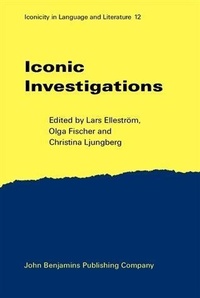
Iconic Investigations
1st Edition
Published on 28. March 2013
X, 357 pages
978-90-272-7223-2 (ISBN)
Description

The contributions to Iconic Investigations deal with linguistic or literary aspects of language. While some studies analyze the cognitive structures of language, others pay close attention to the sounds of spoken language and the visual characteristics of written language. In addition this volume also contains studies of media types such as music and visual images that are integrated into the overall project to deepen the understanding of iconicity - the creation of meaning by way of similarity relations. Iconicity is a fundamental but relatively unexplored part of signification in language and other media types. During the last decades, the study of iconicity has emerged as a vital research area with far-reaching interdisciplinary scope and the volume should be of interest for students and researchers interested in scholarly fields such as semiotics, cognitive linguistics, conceptual metaphor studies, poetry, intermediality, and multimodality.
More details
Other editions
Additional editions
Lars Ellestroem | Olga Fischer | Christina Ljungberg
Iconic Investigations
Book
03/2013
John Benjamins Publishing Co
€111.30
Shipment within 10-15 days
Persons
Content
- Iconic Investigations
- Editorial page
- Title page
- LCC data
- Table of contents
- List of contributors
- Introduction
- References
- Part I. Iconicity and conceptualization
- Iconicity by blending
- 1. From similarity to blending
- 2. From blending to similarity
- 3. Conclusion
- References
- The Basho code
- 1. Introduction
- 2. Texts
- 2.1 The frog poem
- 2.2 The cicada poem
- 3. Semantic and thematic similarity
- 3.1 Frog and cicada: Initiators of the 'sound' of nature
- 3.2 A new meaning of silence
- 3.3 Exterior lines
- 4. Similarities in the revising process
- 5. Syntactic similarity
- 5.1 A - B - A structure
- 5.2 Kireji and syntactic loosening
- 5.3 A-B-A structure with a compound verb in the middle
- 6. Phonological similarity
- 6.1 Shared morae patterns
- 6.2 Shared morae: [ka-wa-zu] ('frog')
- 6.3 Shared morae: [mi-zu]('water')
- 6.4 Shared morae: [i-wa] ('rock')
- 6.5 Shared morae: [i-ru]('enter')
- 6.6 Doubled morae: [zu],[to] and [shi], [mi]
- 7. Discussion
- 8. Conclusion
- References
- Iconicity in gotoochi-kitii 'localized Hello Kitty'
- 1. Introduction
- 2. 'Kitty' in the compound noun gotoochi-kitii and 'Hello Kitty'
- 3. Three factors of diversification
- 3.1 On the term gotoochi '(your) local area'
- 3.2 Blending gotoochi and Kitty
- 3.2.1 The Agent-Undergoer continuum
- 3.3 Kitty neutralized
- 4. Conclusion
- References
- Grammar-internal mimicking and analogy
- 1. Mimicking
- 2. Disrupted inflection and mimicking
- 3. Mimicking in compounding and derivation
- 4. Syntax to syntax mimicking
- 5. Analogy and mimicking compared
- References
- To draw a bow ?
- 1. Introduction ?
- 2. Theoretical insights
- 3. To draw a bow ?
- References
- Spatiotemporal aspects of iconicity
- 1. Multimodal iconicity
- 2. Image, diagram, and metaphor
- 3. Spatiotemporal aspects of iconicity
- References
- Part II. Visual iconicity
- From diagrams to poetry
- 1. Introduction: Peircean iconicity
- 2. Diagrammatical reasoning
- 3. Klaus Høeck's elaboration of diagram poetry
- The cutting out of a poetic surface of assertion
- Graphic shape mirroring object shape
- Vertical - horizontal depiction
- Self-reference
- Paths describing themselves
- 4. Sequence experimenting and diagrammatical reasoning
- References
- The iconized letter
- 1. Introduction
- 2. The context
- 3. Lettrisme's iconized letters
- 4. Conclusion
- References
- The semantics of structure
- 1. Introduction
- 2. E. E. Cummings: The hidden sonnet
- 3. William Carlos Williams: Image vs. metaphor
- References
- Visual iconicity in Latin poetry
- 1. Introduction
- 2. Ancient testimonies on iconicity
- 3. A semiotic equivalence: Long line and framing hyperbaton
- 3.1 Statistical evidence
- 4. Enclosing word order indicating length
- 4.1 'Snake' lines
- 4.2 Weapons: Swords, spears, arrows and javelins
- 4.3 Lines containing the flow of rivers and streams
- 5. Enclosing word order used for centering, containment and enclosure
- 5.1 The icon of enclosure and cover
- 5.2 The icon of winding, containing, encirclement
- 6. Some further types of word order icons
- 6.1 'Spatial hyperbaton'
- 6.2 Icon of percolation or passing through: ()
- 6.3 Icon of separation or opposition
- 6.4 The abAB type: An icon of 'mixture'
- 7. Concluding remarks
- References
- Shared and direct experiential iconicity in digital reading games
- 1. Introduction
- 2. Terminology
- 3. Case study: Examples of shared experiential iconicity in the adapted narrative of Carroll's (1865) Alice's Adventures in Wonderland in Weir's (2009) Silent Conversation
- 3.1 Game mechanics
- 3.2 Analysis of examples of shared experiential iconicity in the adaptation of Carroll's (1865) Alice's Adventures in Wonderland
- 4. Discussion
- 5. Further research
- 6. Concluding remarks
- Acknowledgements
- References
- Iconicity, intermediality, and interpersonal meanings in a Social Semiotic Space
- 1. Introduction
- 2. A written interactive context
- 3. Some markers of mediated context of interaction
- 4. 'Process-sharing' in a mediated context
- 5. Abbreviations and initialisms as iconic and indexical
- 6. Mediated interactivity markers
- 7. Emoticons
- 8. Summary and conclusion
- References
- Model and icon
- 1. Model as icon and index
- 2. The mirror analogy
- 3. Modernism and the model
- 4. Art as communication
- 5. The return of the model and beauty
- 6. Role reversals and collaborations
- 7. The model and interactive beauty
- References
- Degrees of indetermination in intersemiotic translation
- 1. Intersemiotic translation
- 2. Levels of pertinence, equivalence and translatability
- 3. Degrees of indeterminacy
- 3.1 Between the verbal and the iconic
- 4. The finale of Smoke
- 5. Concluding remarks
- References
- Part III. Auditory iconicity
- Sound, image and fake realism
- 1. Reading grids and impression of likeness
- 2. Wall-e: Sound figures between human and non-human
- 3. Last Days: strategies of dissociation between visual and sound narrations
- 4. Paranoid Park: fake realism and sound-based mise-en-abyme
- 5. Sound figures and surrogate stimuli
- 6. Conclusions
- References
- Opera, oratorio, and iconic strategies
- 1. Introduction
- 2. Italian drama
- 3. Opera and oratorio
- 4. The libretto
- 5. The Italian opera
- 6. Iconic strategies in recitatives and arias
- 7. Operatic iconicity as a mirror of human fears and desires
- References
- Appendix 1
- Appendix 2
- Appendix 3
- On some iconic strategies in concept albums within the Italian singer-songwriter tradition
- 1. Introduction
- 2. Imagic iconicity. Simulation of explosions: The motif of the bomb
- 3. The iconic value of the musical theme and its variations as a modular tale
- 3.1 La bomba in testa
- 3.2 Il bombarolo
- 3.3 Nella mia ora di libertà
- 4. The musical theme as a container of stories: The theme of alternation
- 5. Il giorno aveva cinque teste
- 5.1 'La bambina (l'inverno è neve, l'estate è sole)'. The instruments of power: The rapid and cyclical nature of time perception in neo-capitalist society
- 6. Conclusion
- References
- Discography
- Iconically expressible meanings in Proto-Indo-European roots and their reflexes in daughter branches
- 1. Introduction
- 2. PIE roots and their structure
- 3. Reduplication
- 4. Concluding remarks
- Acknowledgements
- Symbols and Abbreviations
- Dictionaries
- References
- The lexical iconicity hierarchy and its grammatical correlates
- 1. Introduction
- 2. Linguistic iconicity
- 3. Lexical availability
- 4. Morphophonology
- 4.1 Root length
- 4.2 Flexibility/Templaticity
- 4.3 Phoneme distribution
- 4.4 Orthography
- 5. Syntax
- 6. Semantics
- 7. Lexical acquisition
- 8. Conclusion
- References
- Author index
- Subject index
