

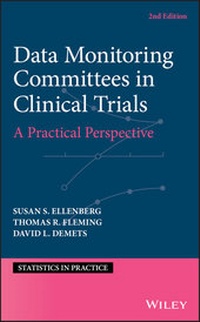
Data Monitoring Committees in Clinical Trials
Description

More details
Other editions
Additional editions
Persons
SUSAN S. ELLENBERG, PHD, is Professor of Biostatistics, Department of Biostatistics, Epidemiology and Informatics, University of Pennsylvania Perelman School of Medicine, USA.
THOMAS R. FLEMING, PHD, is Professor of Biostatistics and Statistics, Department of Biostatistics, School of Public Health, University of Washington, USA.
DAVID L. DEMETS, PHD, is Professor Emeritus and Founding Chair of the Department of Biostatistics and Medical Informatics, University of Wisconsin-Madison, USA.
Content
Preface to the Second Edition xiii
Preface to the First Edition xv
1 Introduction 1
1.1 Motivation 1
1.2 History of data monitoring committees in government-sponsored trials 8
1.3 Data monitoring committees in trials sponsored by the pharmaceutical industry 15
1.4 Statistical methods for interim monitoring 18
1.5 When are data monitoring committees needed? 21
1.6 Models for data monitoring committees 22
1.7 Where we are today 24
1.8 Fundamental principles of data monitoring 25
References 27
2 Responsibilities of the Data Monitoring Committee and Motivating Illustrations 35
2.1 Fundamental charges 36
2.2 Specific tasks of the data monitoring committee 39
2.2.1 Initial review 40
2.2.1.1 Review of the study protocol 40
2.2.1.2 Review of procedures to ensure quality of study conduct 45
2.2.2 Evaluating the quality of ongoing study conduct 47
2.2.3 Assessing safety and efficacy data 56
2.2.3.1 Termination due to favorable benefit-to-risk 58
2.2.3.2 Termination due to unfavorable benefit-to-risk 63
2.2.3.3 Termination due to inability to answer trial questions 65
2.2.3.4 Continuation of ongoing clinical trials 68
2.2.3.5 Consideration of the overall picture: primary and secondary analyses 72
2.2.3.6 Modifying sample sizes based on ongoing assessment of event rates 76
2.2.4 Reviewing the final results 80
2.3 The data monitoring committee charter 83
References 84
3 Composition of a Data Monitoring Committee 89
3.1 Introduction 89
3.2 Required areas of expertise 90
3.3 Other relevant characteristics of committee members 96
3.4 Committee size 98
3.5 Selecting the committee chair 102
3.6 Responsibility for appointing committee members 102
3.7 Representation of other study components on the committee 104
3.8 Preparation for service on a committee 106
References 109
4 Independence of the Data Monitoring Committee: Avoiding Conflicts of Interest 113
4.1 Introduction 113
4.2 Rationale for independence 114
4.3 Financial independence 116
4.3.1 Commercial sponsors 117
4.3.2 Government sponsors 118
4.3.3 Academic investigators 118
4.4 Intellectual independence 125
4.5 Emotional conflicts 131
4.6 Best practices to address challenges to the DMC's independence 132
4.6.1 Adequate training/experience in the DMC process 133
4.6.2 Indemnification of DMC members 135
4.6.3 Maintaining confidentiality of interim data 136
4.6.4 Flexibility of procedures 138
4.6.5 DMC meeting format 139
4.6.6 Creating independent relationships and reducing conflicts of interest 141
4.6.7 Adequately informative DMC reports 142
4.7 Summary 143
References 144
5 Confidentiality Issues Relating to the Data Monitoring Committee 147
5.1 Rationale 147
5.2 Limits of confidentiality 159
5.2.1 Interim analysis reports 159
5.2.2 Access to aggregate data on efficacy and safety outcomes 161
5.2.3 Providing access to interim data on a "need-to-know" basis 164
5.2.4 Settings and procedures allowing broader unblinding of safety data 166
5.2.5 Consequences of unblinding interim data for regulatory review in ongoing trials 168
5.2.6 Some illustrations of broader unblinding 175
5.2.7 The steering committee and maintaining confidentiality 187
5.2.8 Indirect challenges to confidentiality 189
5.3 The need for the DMC to review unblended data 190
5.4 Conclusions: consensus regarding confidentiality 195
References 198
6 Data Monitoring Committee Meetings 203
6.1 Introduction 203
6.2 Specific objectives and timing of meetings 204
6.2.1 Organizational meeting 205
6.2.2 Early safety/trial integrity reviews 208
6.2.3 Formal interim efficacy analyses 212
6.2.4 End-of-trial debriefing 213
6.3 Preparation of meeting reports 214
6.3.1 Currentness of data in the report 217
6.3.2 Inclusion of unadjudicated data 220
6.4 Format for meetings 221
6.4.1 The initial closed session 223
6.4.2 The open session 224
6.4.3 The final closed session 227
6.4.4 Various formats for holding the open and closed sessions 227
6.4.5 Meeting duration and venue 229
6.5 DMC meeting minutes and the DMC recommendations 230
6.5.1 The DMC recommendations, the open minutes, and the closed minutes 230
6.5.2 The level of detail 232
6.5.3 The authorship of the minutes and the sign-off by committee members 233
References 235
7 Data Monitoring Committee Interactions with Other Trial Components or Related Groups 237
7.1 Introduction 238
7.2 Study sponsors 238
7.2.1 Industry sponsors 239
7.2.2 Government sponsors 241
7.3 Study steering committee/principal investigator 243
7.4 Study investigators 247
7.5 Trial statisticians and statistical centers 247
7.5.1 The independent statistical center 248
7.5.2 Ensuring optimal data presentations 253
7.6 Institutional review boards 253
7.7 Regulatory agencies 256
7.8 Study participants and/or advocacy groups 257
7.9 Other data monitoring committees 259
References 262
8 Statistical, Philosophical, and Ethical Issues in Data Monitoring 265
8.1 The need for statistical approaches to monitoring accumulating data 266
8.2 Overview of statistical methods 270
8.2.1 Group sequential methods 271
8.2.1.1 Some group sequential boundaries for establishing benefit 273
8.2.1.2 Group sequential alpha spending functions 277
8.2.1.3 Some group sequential boundaries when early results are unfavorable 280
8.2.2 Triangular boundaries 284
8.2.3 Stochastic curtailment/conditional power 286
8.2.4 Bayesian monitoring 290
8.2.5 The general approach to sequential stopping boundaries 293
8.2.6 Software packages for sequential clinical trial designs 294
8.2.7 Adaptive clinical trial designs 294
8.3 Protocol specification of the monitoring plan 299
8.4 Other statistical considerations in monitoring trial data 300
8.4.1 Primary versus secondary endpoints 300
8.4.2 Short-term versus long-term treatment effects 302
8.4.3 Results in subgroups 303
8.4.4 Taking external information into account 307
8.4.5 Evaluating safety in the context of evidence about efficacy: role of boundaries 309
8.4.6 Ensuring proper robustness when defining boundaries for establishing benefit 311
8.5 Ethical considerations 313
8.5.1 Early termination philosophies 313
8.5.1.1 Responding to early beneficial trends 314
8.5.1.2 Responding to early unfavorable trends 318
8.5.1.3 Responding to unexpected safety concerns 324
8.5.2 Other ethical considerations 325
References 326
9 Determining When a Data Monitoring Committee is Needed 335
9.1 Introduction 336
9.2 Typical settings for an independent data monitoring committee 336
9.3 Other settings in which an independent data monitoring committee may be valuable 339
9.3.1 Early trials of high-risk treatments 339
9.3.2 Trials in vulnerable populations 340
9.3.3 Trials with potentially large public health impact 341
9.4 An alternative monitoring approach: the internal monitoring committee 342
9.5 A decision model assessing need for an independent DMC or an internal monitoring committee 346
9.6 Settings with little need for an independent or internal monitoring committee 351
9.7 Summary 352
References 353
10 Regulatory Considerations for the Operation of Data Monitoring Committees 355
10.1 Introduction 356
10.2 Data monitoring committees in government regulations 356
10.3 Regulatory guidance 357
10.3.1 US Food and Drug Administration 357
10.3.2 International regulatory guidance 360
10.3.2.1 European Union 360
10.3.2.2 International Conference on Harmonization 361
10.3.2.3 The World Health Organization 363
10.4 Regulatory approaches relevant to data monitoring committee operation: the US FDA 364
10.5 Policies of funding agencies regarding DMC operations 367
10.5.1 National Institutes of Health 367
10.5.2 Other federal agencies 369
10.5.3 Funding agencies outside the US 369
10.6 Involvement of FDA staff in data monitoring committee deliberations 370
10.7 Examples of regulatory authority interaction with data monitoring committees 372
References 379
11 Legal Considerations for DMCs 383
11.1 DMC indemnification 383
11.1.1 Motivating examples 385
11.1.2 Emergence of DMCs and heightened awareness of their existence 388
11.1.3 Further motivation for indemnification to protect the DMC 390
11.1.4 Some specific concerns from current experiences with indemnification 392
11.1.5 Potential solutions to indemnification issues 394
11.1.6 Confidential disclosure agreement (CDA) 397
11.1.7 Summary of indemnification, liability, and contracting issues 399
11.2 Balancing legal and ethical responsibilities: a need for a mediator? 400
11.2.1 A case study: the setting of Actimmune in patients with idiopathic pulmonary fibrosis 402
11.2.2 IMMUNE response AIDS clinical trial 405
References 406
Appendix A The Data Monitoring Committee Charter 411
Appendix B Performance Standards Document 431
Statistics in Practice 451
Index 455
Preface to the First Edition
The randomized clinical trial has been recognized as the gold standard for evaluation of medical interventions for only half a century (Doll, 1998). Over the past several decades, the increasingly central position of randomized clinical trials in medical research has led to continual advances in the development of methodology for the design, conduct, and analysis of these studies. An enormous body of literature relating to clinical trials methodology is now available, a professional society focusing on clinical trials has been established (Roth, 1980; www.sctweb.org), and a large number of statisticians, clinicians, and epidemiologists consider clinical trials as their primary area of research and/or application.
One area of clinical trials that has received relatively little attention but that can be critical to the ethics, efficiency, integrity, and credibility of clinical trials and the conclusions of such trials is the process of interim monitoring of the accumulating data. To an increasing extent, interim monitoring is becoming the province of formally established committees. While a great deal has been written about statistical methods for interim data monitoring, the practical aspects of who should serve on data monitoring committees (s) or otherwise be involved in the monitoring process, what data should be monitored and how frequently, and what are the necessary and appropriate lines of communication have received limited discussion. Since DMCs are given major responsibilities for ensuring the continuing safety of trial participants, relevance of the trial question, appropriateness of the treatment protocol, and integrity of the accumulating data, it is important to understand the ways in which these committees meet such responsibilities.
A word about terminology. Committees to monitor accumulating data from clinical trials go by a variety of names. The two most frequent of these are probably "data and safety monitoring board" and "data monitoring committee," but there are many other variations (Ellenberg, 2001). We have arbitrarily selected "data monitoring committee," in part because of its simplicity and in part because this is the term used by international regulatory authorities (http://www.ifpma.org/ich1.html).
From time to time, papers describing the experience of particular DMCs, as well as papers addressing general approaches for operating and serving on such committees, have been published; a number of these are referenced in Chapter 1.
These papers have provided some valuable insights into the monitoring process. In 1992 an international workshop was held at the National Institutes of Health to discuss different approaches to data monitoring that had been or were being used in a variety of settings, and the proceedings were published as a special issue of the journal Statistics in Medicine (Ellenberg et al., 1993). At this workshop, individuals with substantial practical experience in interim data monitoring reported on their preferred operating models, and there was substantial discussion of the advantages and disadvantages of the different approaches presented. Up to now, those workshop proceedings plus the aforementioned papers have constituted the primary references for those interested in learning about the various operating models in use for DMCs, as well as the diversity of issues these committees may consider.
The use of DMCs has continued to grow, especially with respect to trials sponsored by pharmaceutical companies. The demand for individuals to serve on these committees is high; it is increasingly difficult to ensure that any DMC will include at least some members with prior experience on other DMCs. As individuals with extensive experience coordinating and/or serving on such committees, the authors of this book are frequently asked for advice concerning their operation (from trial organizers/sponsors) and the scope of responsibilities of committee members (from new members of such committees). The increasing interest in these issues led us to believe that a comprehensive reference on the practice of interim data monitoring and the structure and operation of DMCs was needed; that was our primary motivation for writing this book.
The book is intended for those involved with or otherwise interested in the clinical trials process. We expect this group will include statisticians, physicians and nurses, trial administrators and coordinators, regulatory affairs professionals, bioethicists, and patient advocates. The issues are relevant to trials sponsored by government funding agencies as well as by pharmaceutical and medical device companies, although approaches taken may differ in different contexts.
We also believe this book should be of interest to those involved in the evaluation and reporting of trial results - for example, medical journal editors and science journalists for lay publications - as the process of trial monitoring has important implications for the interpretation of results. We have attempted to keep the material non-technical, so as to make it accessible to as large a part of the clinical trials community as possible.
Every chapter in the book addresses an issue that has been debated among those with DMC experience in different settings. Our intent is to describe the issues clearly as well as to describe the arguments that have been made for and against different approaches that might be taken. We will identify areas where there appears to be a general consensus, and occasionally recommend a particular approach even when there is no widespread consensus on that issue. For the most part, however, our goal is to clarify the types of decisions that must be made in implementing DMCs and not to provide a prescription for their operation. There is no "one size fits all" for DMCs; different models may be needed for different situations.
We begin with some introductory background and some historical notes on the use of DMCs in different contexts. Next, we address the scope of responsibilities that may be assigned to a DMC. Some committees are charged with reviewing outcome data only (or even safety data only); others are asked to review the initial protocol, monitor the conduct of the study by assessing accrual, eligibility, compliance with protocol, losses to follow-up, and other issues that are ultimately relevant to the value and credibility of a trial. The specific responsibilities delegated to a committee monitoring a particular trial will influence other operational aspects, such as committee composition.
In Chapter 3 we consider the committee membership: what types of expertise should be represented on all committees, other relevant factors in selecting committee members, optimal committee size, methods of selecting committees (and committee chairs). An important issue regarding committee membership that we discuss in some detail is conflict of interest.
Chapter 4 continues the consideration of conflicts of interest in the broader context of the independence of the committee. We discuss what is meant by an "independent" committee, and the potential consequences for the trial and its credibility when the committee's independence is called into question. We also discuss the various types of trials for which independence of the DMC may be most critical.
Chapter 5 deals with one of the most controversial issues relating to the interim monitoring of clinical trial data: the extent to which any interim data, and unblinded interim data in particular, should be released to individuals or groups other than the committee itself. It has been argued that there may be a "need to know" for some groups such as the sponsor or the regulatory authority; it has also been argued there is a "right to know" for participating investigators, study subjects, and the general public. Others believe that limiting access to interim results is essential to the successful completion of clinical trials. This chapter focuses on such debates, and their potential implications for trial integrity.
In Chapter 6 we deal with the logistical issues - how often a committee should meet, how long the meetings need to be, how they are conducted, the content of the report the committee is to consider, the preparation and content of meeting minutes, and a number of other issues. Many groups who regularly sponsor and/or coordinate clinical trials have developed their own approaches to these issues, but these approaches can be quite different, even for similar types of clinical trials. Some might consider these types of issues part of the "minutiae" of clinical trials; our experience, however, is that the quality and reliability of the monitoring process may depend very heavily on just these types of issues.
Chapter 7 addresses the very important but little discussed topic of how the DMC interacts with other trial components. There are many constituencies involved in any given trial, including the sponsor(s), the investigators, the statistical coordinating center, the study steering committee, the institutional review board(s), and of course the patients. There is also a variety of modes of interaction, both formal (e.g. submitting reports) and informal (e.g. attending meetings of other components where unstructured discussion may take place).
Chapter 8 provides an overview of the various statistical approaches for interim monitoring of clinical trial data, and some discussion of why some approaches...
