

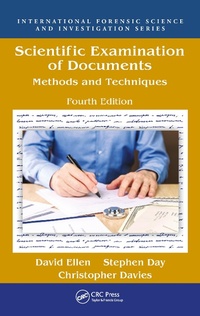
Scientific Examination of Documents
Methods and Techniques, Fourth Edition
4th Edition
Published on 3. May 2018
266 pages
978-0-429-95933-2 (ISBN)
Description

Revised and expanded to reflect the most recent innovations in the field, The Scientific Examination of Documents, Fourth Edition is a handy, accessible volume detailing current best-practices for forensic document examination.
Since the first edition published in 1989, there have been drastic changes in the field of forensic document examination-both from the use of the analytic techniques available to the professional examiner-and the changes to technology in office and printing equipment and inks. The purpose of analyzing any material used in the production of a questioned document, such as an ink or a piece of paper, is to compare it with another material elsewhere in the questioned document itself-or on another document-to determine whether or not they share a common origin. There may also be a need to provide information for the investigator about the possible origins of the document.
This latest edition reflects the myriad changes and advances that have occurred in the last 10 to 15 years. Topics covered include: current thinking on handwriting interpretation; accidental and deliberate modification of handwriting; the proper collection of samples; a discussion of shredded documents; professional accreditation standards, qualifications, and training; and modern digital imaging and analysis of documents and handwriting utilizing software and imaging, including reconstruction of an image from erasures, obliteration and other document altering methods. A new section addresses cognitive bias and Chapter 8 is completely updated to cover the advances in print and photocopied documents, based on current technology, and analytical developments in the comparison of such documents.
Key features:
Discusses issues regarding handwritten, photocopied, and printed documents-including inkjet versus digital printing
Presents the advances and capabilities modern office fax, photocopy, and printing technologies-and implications for document examination
Details and reinforces the importance of ensuring proper scientific methods during an examination
Addresses current Raman spectroscopy, UV-VIS, mass spectroscopy, and SEM analysis techniques
Highlights the importance, and implications, of biological and fingerprint evidence from documents that can be collected, examined, and utilized in a case
The Scientific Examination of Documents, Fourth Edition serves as an invaluable resource to established professionals, those just entering the field, and legal and investigative professionals outside the discipline who have a professional interest dealing with questioned documents in the course of their work.
Since the first edition published in 1989, there have been drastic changes in the field of forensic document examination-both from the use of the analytic techniques available to the professional examiner-and the changes to technology in office and printing equipment and inks. The purpose of analyzing any material used in the production of a questioned document, such as an ink or a piece of paper, is to compare it with another material elsewhere in the questioned document itself-or on another document-to determine whether or not they share a common origin. There may also be a need to provide information for the investigator about the possible origins of the document.
This latest edition reflects the myriad changes and advances that have occurred in the last 10 to 15 years. Topics covered include: current thinking on handwriting interpretation; accidental and deliberate modification of handwriting; the proper collection of samples; a discussion of shredded documents; professional accreditation standards, qualifications, and training; and modern digital imaging and analysis of documents and handwriting utilizing software and imaging, including reconstruction of an image from erasures, obliteration and other document altering methods. A new section addresses cognitive bias and Chapter 8 is completely updated to cover the advances in print and photocopied documents, based on current technology, and analytical developments in the comparison of such documents.
Key features:
Discusses issues regarding handwritten, photocopied, and printed documents-including inkjet versus digital printing
Presents the advances and capabilities modern office fax, photocopy, and printing technologies-and implications for document examination
Details and reinforces the importance of ensuring proper scientific methods during an examination
Addresses current Raman spectroscopy, UV-VIS, mass spectroscopy, and SEM analysis techniques
Highlights the importance, and implications, of biological and fingerprint evidence from documents that can be collected, examined, and utilized in a case
The Scientific Examination of Documents, Fourth Edition serves as an invaluable resource to established professionals, those just entering the field, and legal and investigative professionals outside the discipline who have a professional interest dealing with questioned documents in the course of their work.
More details
Edition
4th edition
Language
English
Place of publication
London
United Kingdom
Publishing group
Taylor & Francis Ltd
Target group
Professional and scholarly
Illustrations
3 Line drawings, black and white; 27 Halftones, black and white; 30 Illustrations, black and white
ISBN-13
978-0-429-95933-2 (9780429959332)
Copyright in bibliographic data and cover images is held by Nielsen Book Services Limited or by the publishers or by their respective licensors: all rights reserved.
Schweitzer Classification
Other editions
Additional editions
David Ellen | Stephen Day | Christopher Davies
Scientific Examination of Documents
Methods and Techniques, Fourth Edition
Book
03/2021
4th Edition
CRC Press
€111.00
Shipment within 15-20 days
David Ellen | Stephen Day | Christopher Davies
Scientific Examination of Documents
Methods and Techniques, Fourth Edition
Book
05/2018
4th Edition
CRC Press
€202.50
Shipment within 15-20 days
Persons
Stephen Day has a BSc. and PhD from the University of Bristol. He began his career as a Document Examiner at the Metropolitan Police Forensic Science Laboratory in 1981, transferring to the UK Home Office Forensic Science Service in 1993 to become head of their Questioned Documents team. He has examined thousands of documents and appeared in Court on numerous occasions as an expert witness. He acted as the Lead Scientist for the discipline within the Forensic Science Service between the years of 1999 and 2006, during which time he chaired the European Questioned Documents Working Group for the European Network of Forensic Science Institutes from 2002 to 2004. In 2011 Steve joined the University of East Anglia to become course director for the Forensic and Investigative Chemistry MChem. degree program. This has meant broadening his knowledge in all aspects of forensic science. He still lectures at UEA as a senior lecturer in Forensic Chemistry.
David Ellen was in the field of Forensic Science for 43 years. For 29 of these years he specialised in the forensic examination of questioned documents, mostly in the Metropolitan Police Forensic Science Laboratory, London, England, and also in the Forensic Science Centre in Adelaide, South Australia, then in private practice in London. He was secretary of the Questioned Document Section of the meeting of the International Association of Forensic Sciences in Adelaide in 1990 and has trained and inspired a generation of new Document Examiners. He is now retired.
Christopher Davies started work in the Metropolitan Police Forensic Science Laboratory in 1981 where he was trained in questioned document examination. He continued to work in London when the Metropolitan Police Laboratory became part of the Forensic Science Service in 1996. He became one of the senior document examiners responsible for dealing with serious crime, including counter-terrorism, cases. In 2010 he left the London Laboratory when the Questioned Documents Section there was closed and continues to work as an independent consultant. He is also the ISO/IEC 17025 technical assessor for questioned documents for the United Kingdom Accreditation Service.
David Ellen was in the field of Forensic Science for 43 years. For 29 of these years he specialised in the forensic examination of questioned documents, mostly in the Metropolitan Police Forensic Science Laboratory, London, England, and also in the Forensic Science Centre in Adelaide, South Australia, then in private practice in London. He was secretary of the Questioned Document Section of the meeting of the International Association of Forensic Sciences in Adelaide in 1990 and has trained and inspired a generation of new Document Examiners. He is now retired.
Christopher Davies started work in the Metropolitan Police Forensic Science Laboratory in 1981 where he was trained in questioned document examination. He continued to work in London when the Metropolitan Police Laboratory became part of the Forensic Science Service in 1996. He became one of the senior document examiners responsible for dealing with serious crime, including counter-terrorism, cases. In 2010 he left the London Laboratory when the Questioned Documents Section there was closed and continues to work as an independent consultant. He is also the ISO/IEC 17025 technical assessor for questioned documents for the United Kingdom Accreditation Service.
Content
Preface 1 Introduction; Scientific Method, Analytical Methods, Documents, Document Examiners, Qualifications and Training Objects of This Book, Literature on Document Examination, Books, Journals, Research and Development 2 Handwriting: The Variations between Normal Writings 3 Handwriting: Accidental and Deliberate Modification 4 Handwriting: The Purposes and Principles of Scientific Examination 5 Handwriting: The Collection of Samples 6 Typewriting and Typescripts 7 The Materials of Handwritten Documents: Substances and Techniques 8 The Examination of Printed and Photocopied 9 Incidental Marks and Other Scientific 10 The Functions of Imaging in Document 11 Document Examination in Court
