

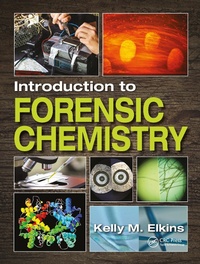
Introduction to Forensic Chemistry
1st Edition
Published on 3. September 2018
354 pages
978-0-429-84599-4 (ISBN)
Description

Chemistry/Forensic Science
Forensic chemistry is a subdiscipline of forensic science, its principles guide the analyses performed in modern forensic laboratories. Forensic chemistry's roots lie in medico-legal investigation, toxicology and microscopy and have since led the development of modern forensic analytic techniques and practices for use in a variety of applications.
Introduction to Forensic Chemistry is the perfect balance of testing methods and application. Unlike other competing books on the market, coverage is neither too simplistic, nor overly advanced making the book ideal for use in both undergraduate and graduate courses. The book introduces chemical tests, spectroscopy, advanced spectroscopy, and chromatography to students. The second half of the book addresses applications and methods to analyze and interpret controlled substances, trace evidence, questioned documents, firearms, explosives, environmental contaminants, toxins, and other topics. The book looks at innovations in the field over time including the latest development of new discernible chemical reactions, instrumental tools, methods, and more.
Key features:
Nearly 300 full-color figures illustrating key concepts and over 20 case studies
Addresses all the essential topics without extraneous or overly advanced coverage
Includes full pedagogy of chapter objectives, key terms, lab problems, end of chapter questions, and additional readings to emphasize key learning points
Includes chemical structures and useful spectra as examples
Fulfils the forensic chemistry course requirement in FEPAC-accredited programs
Includes a chapter on Chemical, Biological, Radiological, Nuclear, and Explosive (CBRNE) materials
Comprehensive and accessible, without being overly technical, Introduction to Forensic Chemistry will be a welcome addition to the field and an ideal text designed for both the student user and professor in mind.
Course ancillaries including an Instructor's Manual with Test Bank and chapter PowerPoint (R) lecture slides are available with qualified course adoption.
Forensic chemistry is a subdiscipline of forensic science, its principles guide the analyses performed in modern forensic laboratories. Forensic chemistry's roots lie in medico-legal investigation, toxicology and microscopy and have since led the development of modern forensic analytic techniques and practices for use in a variety of applications.
Introduction to Forensic Chemistry is the perfect balance of testing methods and application. Unlike other competing books on the market, coverage is neither too simplistic, nor overly advanced making the book ideal for use in both undergraduate and graduate courses. The book introduces chemical tests, spectroscopy, advanced spectroscopy, and chromatography to students. The second half of the book addresses applications and methods to analyze and interpret controlled substances, trace evidence, questioned documents, firearms, explosives, environmental contaminants, toxins, and other topics. The book looks at innovations in the field over time including the latest development of new discernible chemical reactions, instrumental tools, methods, and more.
Key features:
Nearly 300 full-color figures illustrating key concepts and over 20 case studies
Addresses all the essential topics without extraneous or overly advanced coverage
Includes full pedagogy of chapter objectives, key terms, lab problems, end of chapter questions, and additional readings to emphasize key learning points
Includes chemical structures and useful spectra as examples
Fulfils the forensic chemistry course requirement in FEPAC-accredited programs
Includes a chapter on Chemical, Biological, Radiological, Nuclear, and Explosive (CBRNE) materials
Comprehensive and accessible, without being overly technical, Introduction to Forensic Chemistry will be a welcome addition to the field and an ideal text designed for both the student user and professor in mind.
Course ancillaries including an Instructor's Manual with Test Bank and chapter PowerPoint (R) lecture slides are available with qualified course adoption.
More details
Edition
1. Auflage
Language
English
Place of publication
London
United Kingdom
Publishing group
Taylor & Francis Ltd
Target group
College/higher education
Product notice
Reflowable
Illustrations
52 Tables, color; 109 Line drawings, color; 217 Halftones, color; 326 Illustrations, color
File size
24,78 MB
ISBN-13
978-0-429-84599-4 (9780429845994)
Copyright in bibliographic data and cover images is held by Nielsen Book Services Limited or by the publishers or by their respective licensors: all rights reserved.
Schweitzer Classification
Other editions
Additional editions
Kelly M. Elkins
Introduction to Forensic Chemistry
Book
06/2021
1st Edition
CRC Press
€128.40
Shipment within 10-20 days
Kelly M. Elkins | Elkins M. Kelly
Introduction to Forensic Chemistry
Book
10/2018
1st Edition
CRC Press
€167.50
Shipment within 15-20 days
Person
Kelly Elkins earned a BS in Biology and BA in Chemistry from Keene State College in Keene, New Hampshire. She went on to earn MA and PhD degrees in Chemistry from Clark University in Worcester, Massachusetts. She was a Fulbright Scholar in Heidelberg, Germany from 2001-2002 and a Cancer Research Institute Postdoctoral Fellow in the Biology Department at MIT in Cambridge, Massachusetts from 2003-2004. She was a Temporary Assistant Professor of Chemistry at Armstrong Atlantic State University in Savannah, Georgia, for two years and an Assistant Professor of Chemistry at Metropolitan State College of Denver in Denver, Colorado, for five years, where she served as Director of the Criminalistics Program (2010-2012), a Forensic Science Education Programs Accreditation Commission (FEPAC)-accredited program, supervised undergraduate research and internships, and developed the curriculum for their Criminalistics II (Forensic Biology) course. She joined the Towson University Chemistry Department and FEPAC-accredited Forensic Sciences program in 2012 where she is currently Assistant Professor of Chemistry and Graduate Faculty in the Masters of Science in Forensic Science Program. She teaches undergraduate and graduate forensic chemistry courses including Forensic Chemistry, Forensic Serology, and Weapons of Mass Destruction. Her research interests include the development of new methodologies and course materials to support forensic science. Her research focuses on the development of new real-time high resolution melt PCR assays for species identification of "legal high" plants, controlled species, and food-borne pathogens.
Content
1 An introduction to forensic chemistry and physical evidence 2 Chemical tests 3 The microscope 4 Light spectroscopy 5 Advanced spectroscopy 6 Chromatography 7 Inorganic poisons and contaminants 8 Controlled substances 9 Toxicology 11 Questioned documents and impression evidence 12 Latent print development 13 Firearms 14 Fire, arson, and explosives 15 Chemical, biological, radiological, nuclear, and explosives (CBRNE) 16 Environmental forensics, Index
