

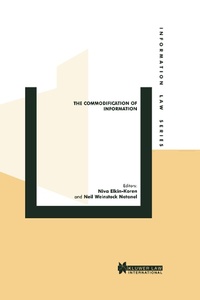
The Commodification of Information
Published on 1. November 2002
530 pages
978-90-411-7686-8 (ISBN)
Description

Information and the marketplace are uneasy bedfellows. The dissemination of information via media can have many different and overlapping purposes, including entertainment, art, ideology, and research. It is particularly among groups that need to share information - the academic and scientific communities, for example - that viewing it as something that can be bought and sold is intrusive and even damaging. There are many other reasons why the commodification of information, which continues to move from strength to strength with the expansion of international free trade, must be carefully scrutinized.
A conference of specialists - with expertise encompassing the area of law and practice where intellectual property, communications, privacy, free speech, collaborative research, and international trade all intersect - met under the auspices of the University of Haifa Faculty of Law, in May 1999. This book presents the penetrating analyses and recommendations that emerged from that conference. As one might expect, a broad spectrum of views is expressed, from commercialism as the liberator of free speech to commodification as de facto censorship. Among the vital topics discussed, the reader will find the following:
- how market-driven doctrine and rhetoric jeopardize the cultural commons;
- market control as copyright's new paradigm;
- the free software movement;
- how the ECHR may impose limits on EU copyright law, especially property rights in databases;
- the conflict between availability of domestic media and international free trade;
- tracking and manipulation of personal Internet use;
- patenting DNA sequences and DNA molecules; and
- how "commercial" speech trumps "free" speech.
Several contributors examine the Digital Millennium Copyright Act (DMCA) and its redefinition of such traditional IP concepts as "fair use" and "market failure".
The Commodification of Information will prove a landmark work for all those involved with this complex area of knowledge and activity. Software developers, academic and research institutions, corporate counsel, government policymakers and regulators - all these and more will benefit enormously from the thoughtful and incisive discussion presented here.
A conference of specialists - with expertise encompassing the area of law and practice where intellectual property, communications, privacy, free speech, collaborative research, and international trade all intersect - met under the auspices of the University of Haifa Faculty of Law, in May 1999. This book presents the penetrating analyses and recommendations that emerged from that conference. As one might expect, a broad spectrum of views is expressed, from commercialism as the liberator of free speech to commodification as de facto censorship. Among the vital topics discussed, the reader will find the following:
- how market-driven doctrine and rhetoric jeopardize the cultural commons;
- market control as copyright's new paradigm;
- the free software movement;
- how the ECHR may impose limits on EU copyright law, especially property rights in databases;
- the conflict between availability of domestic media and international free trade;
- tracking and manipulation of personal Internet use;
- patenting DNA sequences and DNA molecules; and
- how "commercial" speech trumps "free" speech.
Several contributors examine the Digital Millennium Copyright Act (DMCA) and its redefinition of such traditional IP concepts as "fair use" and "market failure".
The Commodification of Information will prove a landmark work for all those involved with this complex area of knowledge and activity. Software developers, academic and research institutions, corporate counsel, government policymakers and regulators - all these and more will benefit enormously from the thoughtful and incisive discussion presented here.
More details
Other editions
Additional editions
Niva Elkin-Koren
The Commodification of Information
Book
11/2002
1st Edition
Kluwer Law International
€144.45
Shipment within 10-20 days
Content
- Cover
- Half Title Page
- Editorial Board
- Title Page
- Copyright Page
- Table of Contents
- Introduction: The Commodification of Information
- I. FOUNDATIONS
- Incomplete Commodification in the Computerized World
- Introduction: Commodification in Cyberspace
- II. THE QUESTION OF OVERPROPERTIZATION AND THE VISION OF DYSTOPIA
- III. COMMODIFICATION AND THE DISAPPEARANCE OF FAIR USE
- IV. THE OPEN SOURCE MOVEMENT AND ITS COMMODIFIED LEGAL INFRASTRUCTURE
- V. DATA PRIVACY: HUMAN RIGHT OR PROPERTY RIGHT?
- Conclusion
- Electronic Commerce and Free Speech
- I.
- II.
- III.
- IV.
- V.
- Two Cheers for the Commodification of Information
- 1. Introduction
- 2. The Meaning of Commodification
- 3. Why transactions in information are essential
- 4. CONCLUSION
- II. COPYRIGHT AND COMMODIFICATION: BROAD TRENDS
- Copyright, Commodification, and Censorship: Past as Prologue - But to What Future?
- It's All About Control: Rethinking Copyright in the New Information Landscape
- Introduction
- I. The New Copyright Regime
- II. Strategic Use of Copyrights: It's All About Control
- IV. On Copyright Laws and Centralization in Information Markets
- V. Centralized Information Markets and the Information Society
- Summary
- Anarchism Triumphant: Free Software and the Death of Copyright
- Software as Property: The Theoretical Paradox
- Software as Property: The Practical Problem
- How We Created the Microbrain Mess
- Software Wants to Be Free
- or, How We Stopped Worrying and Learned to Love the Bomb
- Anarchism as a Mode of Production
- The Legal Theory of Free Software
- Because It's There: Faraday's Magnet and Human Creativity
- Their Lordships Die in the Dark?
- Intellectual Property and the Internet: The Share of Sharing
- A. The classical picture of intellectual property
- B. Sharing
- Conclusion
- III. COPYRIGHT AND COMMODIFICATION: DOCTRINE AND DOCTRINAL DEVELOPMENTS
- Excuse and Justification in the Law of Fair Use: Commodification and Market Perspectives
- Introduction
- Excuse and justification
- Three tiers of inquiry
- Market limitations and the vocabulary of commodification
- Examples of justifying and excusing
- The justification of self-defense and its potential role regarding parody
- Pricelessness and private censorship
- Reconsidering the "substantial injury" hurdle to fair use
- What happens to fair use when transaction costs decrease
- A possible danger of my approach
- Post Script: thoughts on the issue of full fair use versus compensation
- Conclusion
- How Much Solicitude for Fair Use is There in the Anti-Circumvention Provision of the Digital Millennium Copyright Act?
- I. The Digital Millennium Copyright Act
- II. Fair Use
- Conclusion
- Copyright Developments in Europe: The Good, the Bad and the Harmonized
- I. Background
- II. Some Recent Developments
- III. Some Observations on Harmonization
- Copyright and Freedom of Expression in Europe
- 1. Free Speech and the Copyright Paradigm
- 2. Limits to Copyright Imposed by Free Speech Considerations
- Conclusion
- IV. MEDIA AND TELECOMMUNICATIONS
- International Trade in Media Products
- Non-Rivalrous Use and Monopolistic Competition
- Positive and Negative Externalities
- Identifying and Weighing Audience Preferences
- Conclusion
- A Speakers' Corner Under the Sun
- Introduction
- Part I: A Commons in the Air
- Part II: The Stakes of Communications and Information Law
- Part III: A Simple Model of Ownership and Autonomy Comparing
- Part IV: Alternative Models of Ownership and Control Compared to A Commons
- Part V: Conclusion
- The Commercial Mass Media's Continuing Fourth Estate Role
- I. Liberal Democracy
- II. The Commercial Media's "Fourth Estate" Role
- III. Political Party-Financed Media
- IV. Government-Funded Media
- V. Peer-to-Peer Model
- VI. Peer-to-Peer
- A Critical Evaluation
- Conclusion
- V. INFORMATION AGGREGATION
- Hardware-Based ID, Rights Management, and Trusted Systems
- I. Rights Management and Trusted Systems
- II. Anonymity and Identifiability on the Internet
- III. Intel and the Processor Serial Number
- IV. Trusted Systems and Common Identifiers
- V. Identification and Credentials
- VI. Conclusion
- Databases - In Search of the Free Flow of Information
- Introduction
- The Economic Justification of Intellectual Property Rights
- Property-rules and Liability-rules
- Commodification of Information and Databases
- In Search of a Horizontal Right to Information - Competitors
- Monopoly Power - Abuse of a Dominant Position
- In Search of a Horizontal Right to Information - Non-competitors
- Conclusion
- VI. COLLABORATIVE PRODUCTION AND SCIENTIFIC RESEARCH
- Commodifying Collaborative Research
- The Problems of Collaborative Production
- The Disjuncture of Current U.S. Law
- Suggestions for the Future
- Conclusion
- Patents on DNA Sequences: Molecules and Information
- Patent Eligibility
- Molecules vs. Information
- Claiming Computer Readable Information
- Expansive Trend of Case Law
- PTO Guidelines
- Traditional Patent Bargain
- Bricks and Mortar Rules for Information Goods
- New Research Norms for a New Medium
- Research Norms: Attribution of Priority
- Publication and Priority
- The Puzzle
- Research Norms and Research Values
- The Test
- Allure of Intellectual Property
- Intellectual Property and Research Norms
- Other Approaches
- Conclusion
- References
- VII. MARKET PRACTICES
- Network Effects, Standardization, and the Internet: What Have We Learned from the DVD vs. DIVX Battle?
- I. Introduction
- II. A Brief Introduction to Network Effects
- III. Vaporware and Preannouncement Effects
- IV. The Development of the DVD Market
- V. Data
- VI. Estimation and Empirical Results
- VII. Conclusion
- References
- Vaporware, the Internet, and Consumer Behavior
- I
- II
- III
- IV
- About the Contributors
- Index
- Back Cover
