

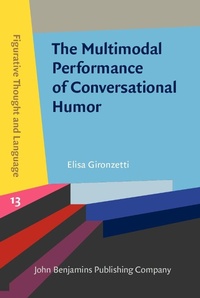
Multimodal Performance of Conversational Humor
1st Edition
Published on 21. April 2022
255 pages
978-90-272-5785-7 (ISBN)
Description

This volume is the first monograph exploring the functions of visual cues in humor, advocating for the development of a non-linguocentric theory of humor performance. It analyzes a corpus of dyadic, face-to-face interactions in Spanish and English to study the relationship between humor, smiling, and gaze, and shows how, by focusing on these elements, it is possible to shed light on the "unsaid" of conversations. In the book, the humorous framing of an utterance is shown to be negotiated and co-constructed dialogically and multimodally, through changes and patterns of smiling synchronicity, smiling intensity, and eye movements. The study also analyzes the multimodal features of failed humor and proposes a new categorization from a dialogic perspective. Because of its interdisciplinary approach, which includes facial expression analysis and eye tracking, this book is relevant to humor researchers as well as scholars in social and behavioral sciences interested in multimodality and embodied cognition.
More details
Other editions
Additional editions
Elisa Gironzetti
The Multimodal Performance of Conversational Humor
Book
04/2022
John Benjamins Publishing Co
€123.30
Shipment within 10-15 days
Content
- Intro
- The Multimodal Performance of Conversational Humor
- Editorial page
- Title page
- Copyright page
- Dedication page
- Table of contents
- List of figures
- List of tables
- Preface
- Chapter 1. Approaching the multimodal study of conversational humor
- 1.1 Why a multimodal study of conversational humor?
- 1.2 The field of humor studies
- 1.2.1 The linguistics of humor
- 1.2.2 Cognitive linguistics and humor
- 1.3 The study of conversational humor
- 1.3.2 Defining and identifying conversational humor
- 1.4 The study of humor markers
- 1.4.1 Terminological issues in the study of humor markers
- 1.4.2 Prosodic cues of humor
- 1.4.2.1 Empirical and experimental studies of prosodic humor cues
- 1.4.3 Laughter as a humor cue
- 1.4.4 Irony cues
- 1.5 Scope and organization of the volume
- Chapter 2. Performing conversational humor multimodally - an overview
- 2.1 Introduction
- 2.2 Researching the multimodal performance of conversational humor
- 2.2.1 Data collection setting and instruments
- 2.2.2 Participants
- 2.2.3 Data collection procedure
- 2.2.4 Treatment of data
- 2.3 Individual smiling behavior
- 2.4 Joint negotiation and co-construction of the humorous frame
- 2.5 Smiling dialogic synergy
- 2.6 Gaze
- 2.6.1 Gaze aversion and conversational humor
- 2.6.2 Gaze to the mouth and conversational irony
- 2.7 Failed humor
- 2.8 Conclusions
- Chapter 3. Individual smiling behavior
- 3.1 Introduction
- 3.2 Smiling as a social emotional expression
- 3.2.1 Smiling within the Basic Emotion Theory (BET)
- 3.2.2 Smiling within the Behavioral Ecology View (BEV)
- 3.2.3 Smiling within the Theory of Affective Pragmatics (TAP)
- 3.3 The study of smiling intensity
- 3.3.1 Facial Action Coding System (FACS)
- 3.3.2 Smiling intensity scales
- 3.3.2.1 Additive FACS-based scoring systems and applications
- 3.3.2.2 Holistic FACS-based scoring system
- 3.4 Smiling and humor
- 3.4.1 Duchenne display and phony smiles
- 3.4.2 Smiling voice
- 3.5 Individual smiling behavior and conversational humor
- 3.5.1 Smiling intensity during humorous and non-humorous discourse
- 3.5.2 Smiling intensity in English and Spanish
- 3.5.3 Smiling intensity by males and females
- 3.5.4 Smiling intensity across types of humor
- 3.5.5 Smiling intensity across conversational roles
- 3.6 Conclusions
- Chapter 4. Smiling patterns and dialogical smiling synergy
- 4.1 Introduction
- 4.2 Social cognitive theories of interactional behavior
- 4.2.1 Behavioral alignment, synchron(icit)y, and coupling
- 4.2.2 From alignment to synergy
- 4.2.3 Embodied cognition and facial displays
- 4.3 Analyzing smiling patterns and synchronicity during humorous discourse
- 4.4 Smiling patterns during humorous discourse
- 4.4.1 Framing smiling pattern
- 4.4.2 Accommodation gesture
- 4.4.3 Deadpan deliveries of humor
- 4.4.4 Peak smiling pattern
- 4.5 Smiling synchronicity
- 4.6 Conclusions
- Chapter 5. Eye movements
- 5.1 Introduction
- 5.2 The study of eye movements
- 5.2.1 Brief history of eye-tracking
- 5.2.2 How people look at faces
- 5.2.3 Social eye-tracking
- 5.3 Social, affective, and cognitive functions of gaze
- 5.3.1 The processing of written irony
- 5.3.2 Eye movements and humor
- 5.4 Social eye-tracking for conversational humor
- 5.4.1 Gaze to the interlocutor's smiling facial areas: Eyes and mouth
- 5.4.2 Gaze to the interlocutor's eyes or mouth
- 5.4.3 The effect of conversational role on gaze
- 5.5 Linear mixed model analyses
- 5.5.1 Gaze duration and smiling facial areas (eyes and mouth together)
- 5.5.2 Gaze duration to the interlocutor's mouth or eyes
- 5.5.3 Fixation duration and humor
- 5.6 Conclusions
- Chapter 6. Failed conversational humor
- 6.1 Introduction
- 6.2 What is failed humor?
- 6.2.1 Models and empirical studies on failed humor
- 6.2.2 Failed humor: Cues, signals, and responses
- 6.3 Multimodal cues of failed conversational humor
- 6.3.1 Failed humor as misalignment
- 6.3.2 Failed humor understanding
- 6.3.2 Failed humor appreciation or agreement
- 6.3.3 Joint failed humor appreciation
- 6.4 Conclusions
- Chapter 7. Conclusions: Looking backwards and looking forward
- 7.1 Introduction
- 7.2 How conversational humor is performed multimodally
- 7.2.1 The multimodal performance of successful punchlines
- 7.2.2 The multimodal performance of successful jablines
- 7.2.3 The multimodal performance of successful ironic comments
- 7.2.4 The multimodal performance of failed humor
- 7.3 Implications for applied humor research
- 7.3.1 How smiling supports the negotiation of the humorous framing
- 7.3.2 How gaze supports the negotiation of the humorous framing
- 7.4 Limitations and future research directions
- 7.4.1 Towards a multimodal theory of humor performance
- References
- Appendix A. Research protocol
- A1. Eye-tracking specifications, calibration, and data
- A.2 Areas of interest
- Appendix B. Individual smiling intensity by Dyad
- Appendix C. Demographic questionnaire
- Appendix D. Jokes in English and Spanish
- Index
