

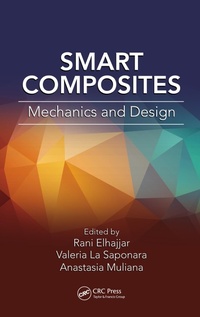
Smart Composites
Mechanics and Design
1st Edition
Published on 14. December 2013
430 pages
978-1-4398-9802-4 (ISBN)
Description

Smart Composites: Mechanics and Design addresses the current progress in the mechanics and design of smart composites and multifunctional structures. Divided into three parts, it covers characterization of properties, analyses, and design of various advanced composite material systems with an emphasis on the coupled mechanical and non-mechanical behaviors.
Part one includes analyses of smart materials related to electrically conductive, magnetostrictive nanocomposites and design of active fiber composites. These discussions include several techniques and challenges in manufacturing smart composites and characterizing coupled properties, as well as the analyses of composite structures at various length and time scales undergoing coupled mechanical and non-mechanical stimuli considering elastic, viscoelastic (and/or viscoplastic), fatigue, and damage behaviors.
Part two is dedicated to a higher-scale analysis of smart structures with topics such as piezoelectrically actuated bistable composites, wing morphing design using macrofiber composites, and multifunctional layered composite beams. The analytical expressions for characterization of the smart structures are presented with an attention to practical application.
Finally, part three presents recent advances regarding sensing and structural health monitoring with a focus on how the sensing abilities can be integrated within the material and provide continuous sensing, recognizing that multifunctional materials can be designed to both improve and enhance the health-monitoring capabilities and also enable effective nondestructive evaluation.
Smart Composites: Mechanics and Design is an essential text for those interested in materials that not only possess the classical properties of stiffness and strength, but also act as actuators under a variety of external stimuli, provide passive and active response to enable structural health monitoring, facilitate advanced nondestructive testing strategies, and enable shape-changing and morphing structures.
Part one includes analyses of smart materials related to electrically conductive, magnetostrictive nanocomposites and design of active fiber composites. These discussions include several techniques and challenges in manufacturing smart composites and characterizing coupled properties, as well as the analyses of composite structures at various length and time scales undergoing coupled mechanical and non-mechanical stimuli considering elastic, viscoelastic (and/or viscoplastic), fatigue, and damage behaviors.
Part two is dedicated to a higher-scale analysis of smart structures with topics such as piezoelectrically actuated bistable composites, wing morphing design using macrofiber composites, and multifunctional layered composite beams. The analytical expressions for characterization of the smart structures are presented with an attention to practical application.
Finally, part three presents recent advances regarding sensing and structural health monitoring with a focus on how the sensing abilities can be integrated within the material and provide continuous sensing, recognizing that multifunctional materials can be designed to both improve and enhance the health-monitoring capabilities and also enable effective nondestructive evaluation.
Smart Composites: Mechanics and Design is an essential text for those interested in materials that not only possess the classical properties of stiffness and strength, but also act as actuators under a variety of external stimuli, provide passive and active response to enable structural health monitoring, facilitate advanced nondestructive testing strategies, and enable shape-changing and morphing structures.
Reviews / Votes
"With the rapidly rising demand for materials with multiple integrated functionalities comes the need to understand, model, and predict behavior of such materials and structures made of them. This 415-page book presents a valuable and timely contribution to the literature on the subject and is the fifth one in the Composite Materials: Analysis and Design book series edited by Ever J. Barbero, one of the leading authorities in the area of composite materials. The book comprises 12 chapters written by 25 researchers with significant expertise in the field working at US and UK universities. The chapters present a selection of the latest research on smart composites. ... This book would be useful for senior undergraduate and postgraduate students as well as practicing engineers. It would be suitable for those who already have expertise in working with composites but want to extend their knowledge and understanding to multifunctional composites, with a view to be able to develop new engineering tools for their design and analysis."-Professor Maria Kashtalyan, University of Aberdeen, Scotland, from The Aeronautical Journal, September 2014
"This is an excellent book by editors and authors who have significant expertise in smart composite materials and sensing technologies. It is a book useful for advanced-level students, unifying the contents usually one could find in separate textbooks of composite materials, mechanics of composite structures, and sensors technologies. The book covers the whole spectrum from material modeling to structural analysis to health monitoring applications. It is a very good complementary advanced textbook. This book should be very useful for senior undergraduate students, graduate students, and engineers all over the world, in particular with the increasing demands to develop techniques for energy harvesting and long-term structural health monitoring of civil infrastructures."
-Gergis W. William, West Virginia University, Morgantown, USA
"...represents a timely and seminal treatment of this general topic. The comprehensive coverage and breadth of individual topics, and including examples and exercises (problems) makes the book suitable for students, researchers, and professors at universities, research institutes, and industry."
-Robert E. Rolands, University of Wisconsin-Madison, USA
More details
Series
Edition
1. Auflage
Language
English
Place of publication
Baton Rouge
United States
Publishing group
Taylor & Francis Inc
Target group
College/higher education
Illustrations
100 s/w Abbildungen
100 b/w images
ISBN-13
978-1-4398-9802-4 (9781439898024)
Copyright in bibliographic data and cover images is held by Nielsen Book Services Limited or by the publishers or by their respective licensors: all rights reserved.
Schweitzer Classification
Other editions
Additional editions
Book
10/2017
1st Edition
CRC Press
€170.84
Shipment within 10-20 days
Book
12/2013
1st Edition
CRC Press
€321.88
Shipment within 15-20 days
Persons
Rani Elhajjar is currently a faculty member at the Department of Civil Engineering and Mechanics, University of Wisconsin-Milwaukee, USA. He holds a Ph.D from the Georgia Institute of Technology, Atlanta, USA and has researched the development of analytical and experimental techniques for fracture in pultruded composite materials, test methods for through thickness fracture testing in composites, and nondestructive experimental techniques using thermoelastic stress analysis, digital image correlation, and acoustic emission. Prior to this appointment, he was structural analyst on the 787 Dreamliner program at Boeing, Everett, Washington, USA, where he was responsible for several test programs including the effects of defects on the fuselage structure.
Valeria La Saponara is associate professor at the Department of Mechanical and Aerospace Engineering, University of California-Davis, USA. She holds a Ph.D in aerospace engineering from the Georgia Institute of Technology, Atlanta, USA (Georgia Tech). A recipient of a CAREER Award from the National Science Foundation, she has worked in the space research industry for an Italian microgravity-focused research center, subcontractor of NASA, and the European Space Agency; as well as served as instructor in civil and environmental engineering at Georgia Tech, and as assistant professor of mechanical engineering at the University of Utah, Salt Lake City, USA.
Anastasia Muliana is associate professor and Gulf Oil/Thomas A. Dietz career development professor II at Texas A&M University, College Station, USA. She holds a Ph.D from the Georgia Institute of Technology, Atlanta, USA. An educator and researcher of micromechanics and viscoelastic response of composites, she has been published in over 60 journals and 25 conference proceedings. Her work has been recognized at the university level, through a TEES Select Young Faculty Award, as well as nationally thr
Valeria La Saponara is associate professor at the Department of Mechanical and Aerospace Engineering, University of California-Davis, USA. She holds a Ph.D in aerospace engineering from the Georgia Institute of Technology, Atlanta, USA (Georgia Tech). A recipient of a CAREER Award from the National Science Foundation, she has worked in the space research industry for an Italian microgravity-focused research center, subcontractor of NASA, and the European Space Agency; as well as served as instructor in civil and environmental engineering at Georgia Tech, and as assistant professor of mechanical engineering at the University of Utah, Salt Lake City, USA.
Anastasia Muliana is associate professor and Gulf Oil/Thomas A. Dietz career development professor II at Texas A&M University, College Station, USA. She holds a Ph.D from the Georgia Institute of Technology, Atlanta, USA. An educator and researcher of micromechanics and viscoelastic response of composites, she has been published in over 60 journals and 25 conference proceedings. Her work has been recognized at the university level, through a TEES Select Young Faculty Award, as well as nationally thr
Content
Field Coupling Analysis in Electrically Conductive Composites. Design and Characterization of Magnetostrictive Composites. Graphitic Carbon Nanomaterials for Multifunctional Nanocomposites. Active Fiber Composites: Modeling, Fabrication, and Characterization. Mechanics and Design of Smart Composites: Modeling and Characterization of Piezoelectrically Actuated Bistable Composites. Wing Morphing Design Using Macrofiber Composites. Analyses of Multifunctional Layered Composite Beams. Wireless Health Monitoring and Sensing of Smart Structures. Acoustic Emission of Composites: A Compilation of Different Techniques and Analyses. Neural Network Nondestructive Evaluation of Composite Structures from Acoustic Emission Data. Prediction of Ultimate Compression after Impact Loads in Graphite-Epoxy Coupons from Ultrasonic C-Scan Images Using Neural Networks. Distributed In Situ Health Monitoring of Nanocomposite-Enhanced Fiber-Reinforced Polymer Composites.
