

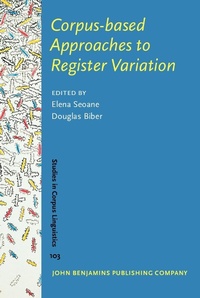
Corpus-based Approaches to Register Variation
Studies in Honor of Doug Biber
1st Edition
Published on 8. December 2021
353 pages
978-90-272-5845-8 (ISBN)
Description

As the first collective volume to focus exclusively on corpus-based approaches to register variation, this book provides an exhaustive account of the range and depth of possibilities that the domain of register variation in English has to offer. It illustrates register variation analysis in different theoretical frameworks, such as Probabilistic Grammar, Systemic Functional Linguistics, and Information Theory, and proposes a new framework within the Text Linguistic Approach: the continuous-situational analytical framework. Several of the contributions apply Multi-Dimensional Analysis to corpus data in order to unveil register (dis)similarities, while others rely on logistic regression models and periodization techniques based on Kullback-Leibler divergence. The volume includes both inter-register and intra-register variation analysis of a wide spectrum of varieties, speakers and periods: British and American English, learner varieties, L2 varieties, and also contains diachronic studies covering early and late Modern English. This broad scope should be a source of inspiration for anyone interested in historical and ongoing register variation in a vast range of varieties of English worldwide.
More details
Other editions
Additional editions
Elena Seoane | Douglas Biber
Corpus-based Approaches to Register Variation
Book
12/2021
John Benjamins Publishing Co
€123.30
Shipment within 10-15 days
Content
- Intro
- Corpus-based Approaches to Register Variation
- Editorial page
- Title page
- Copyright page
- Table of contents
- Acknowledgements
- Biographical notes
- Chapter 1. A corpus-based approach to register variation
- 1. Introduction
- 2. Contributions to this volume
- Corpora
- References
- Chapter 2. Extending text-linguistic studies of register variation to a continuous situational space: Case studies from the web and natural conversation
- 1. Introduction
- 1.1 Methodological and theoretical issues arising in previous empirical studies of situational variation
- 2. Case study 1: Situational variation among web documents
- 2.1 Background
- 2.2 Coding scheme and multi-dimensional analysis
- 2.3 Situational text types on the web
- 3. Case study 2: Conversational discourse types
- 3.1 Coding discourse units in extended conversations
- 3.2 Analysing continuous communicative parameters to identify and describe conversational discourse types
- 4. Conclusion
- References
- Chapter 3. How register-specific is probabilistic grammatical knowledge?: A programmatic sketch and a case study on the dative alternation with give
- 1. Introduction
- 2. Register in variationist linguistics
- 3. A programmatic sketch
- 3.1 Research questions
- 3.2 Methodology
- 4. Case study: The dative alternation in English
- 4.1 Variable context
- 4.2 Language-internal constraints
- 4.3 Analysis
- 4.4 Results
- 5. Discussion and conclusion
- References
- Chapter 4. Theme as a proxy for register categorization
- 1. Introduction
- 2. Theoretical bases
- 2.1 Theoretical framework: Systemic Functional Linguistics
- 2.2 Theme: Concept and categorization
- 2.3 Theme and register in systemic functional linguistics
- 3. An empirical analysis of register
- 4. Summary, conclusions and further research
- Funding
- References
- Chapter 5. Between context and community: Regional variation in register effects in the English dative alternation
- 1. Introduction
- 2. Combining the variationist perspective with register studies
- 3. Data and methodology
- 3.1 The data
- 3.2 Coding of variables: Language-internal and -external constraints
- 3.3 Statistical measures
- 4. Results
- 4.1 Overall distribution by register and variety
- 4.2 The importance of context vs community
- 4.3 Cross-regional variation in register effects
- 5. Discussion
- 6. Conclusion
- References
- Appendix
- Chapter 6. A register variation perspective on varieties of English
- 1. Introduction
- 2. State of the art
- 3. Data
- 3.1 The corpus
- 3.2 Feature extraction
- 4. Geometric multivariate analysis
- 4.1 The first four dimensions of the LDA
- 4.2 Observations about variation across the three varieties
- 4.3 General discussion
- 5. Conclusions
- Acknowledgements
- References
- Chapter 7. Register and modification in the noun phrase
- 1. Introduction
- 2. Registers
- 3. Data and method
- 4. Prenominal modification
- 5. Prepositional phrases as postnominal modifiers
- 6. Clauses as postnominal modifiers
- 7. Conclusion
- References
- Chapter 8. A register approach toward pop lyrics in EFL education
- 1. Introduction
- 2. Previous register-based research on pop lyrics
- 3. Data and methodology
- 4. Results
- 4.1 Situational characteristics
- 4.2 Linguistic analysis
- 5. Lyrics and conversationality: Discussion and implications for EFL education
- References
- Chapter 9. On the importance of register in learner writing: A multi-dimensional approach
- 1. Introduction
- 2. Register variation in learner corpus research
- 3. Data and method
- 3.1 Corpora
- 3.2 Method
- 4. Results and discussion
- 4.1 The dimensions
- 4.2 The effect of L1 background, NS status, and register
- 5. Conclusion
- References
- Chapter 10. Nominalizations in Early Modern English: A cross-register perspective
- 1. Introduction
- 2. Sources and methodology
- 3. Results
- 3.1 Overall distribution of nominalization across registers
- 3.2 Diachronic distribution of nominalizations across registers
- 3.3 Suffix productivity diachronically
- 4. Conclusion
- Acknowledgements
- Funding
- References
- Chapter 11. Measuring informativity: The rise of compounds as informationally dense structures in 20th-century Scientific English
- 1. Introduction
- 2. Methods
- 2.1 Data
- 2.2 Data-driven periodization with Kullback-Leibler divergence
- 2.3 Determining informativity: Surprisal
- 3. Tracing change in grammatical use in 20th-century Scientific English
- 3.1 The temporal dynamics of grammatical use in 20th-century Scientific English
- 3.2 Kinds of change in grammatical use: Inspecting distinctive patterns
- 3.3 Tracing changes towards the use of informationally dense structures
- 4. Tracing the development of informationally dense structures
- 5. Conclusion
- References
- Chapter 12. Exploring sub-register variation in Victorian newspapers: Evidence from the British Library Newspapers database
- 1. Introduction
- 2. Register analysis using BL Newspapers
- 3. Material and method
- 3.1 Extracting a sample
- 3.2 Method of analysis
- 4. Results
- 5. Discussion and conclusions
- References
- Appendix A
- Index
